J-Times Editorial
J-Times 編集部 / J-Times Editorial Team
第3回 エルトゥールル号と樫野の人々 — 嵐の夜の手当てが、日本とトルコをつないだ
つなぐ人 — 日本と世界の物語 · 13 min · Japanese audio
In 1890 the Ottoman frigate Ertuğrul sank off Kushimoto, Japan, and islanders saved 69 sailors. How that rescue and a 1985 Tehran airlift linked Japan and Turkey.
Read this article to earn +5 MTC
Short answer (as of 2026-10-27): On the night of 16 September 1890, the Ottoman frigate Ertuğrul struck a reef off Kashinozaki on Kii-Ōshima island, now part of Kushimoto, Wakayama. Two lighthouse keepers and the island's villagers cared for the 69 men who reached shore. Japan and Turkey still call this the starting point of their friendship.
That is the official summary, and it is true. This biography looks behind it at the people: the keepers who wrote down every bandage they used, the village head who sent runners across the island in a storm, the journalist who carried the news to Istanbul, the samurai family's son, adopted into a tea-ceremony family, whose life became a legend, and the Turkish crews who flew into Tehran in 1985. It also shows where the records disagree, and where a good story has grown larger than the evidence.
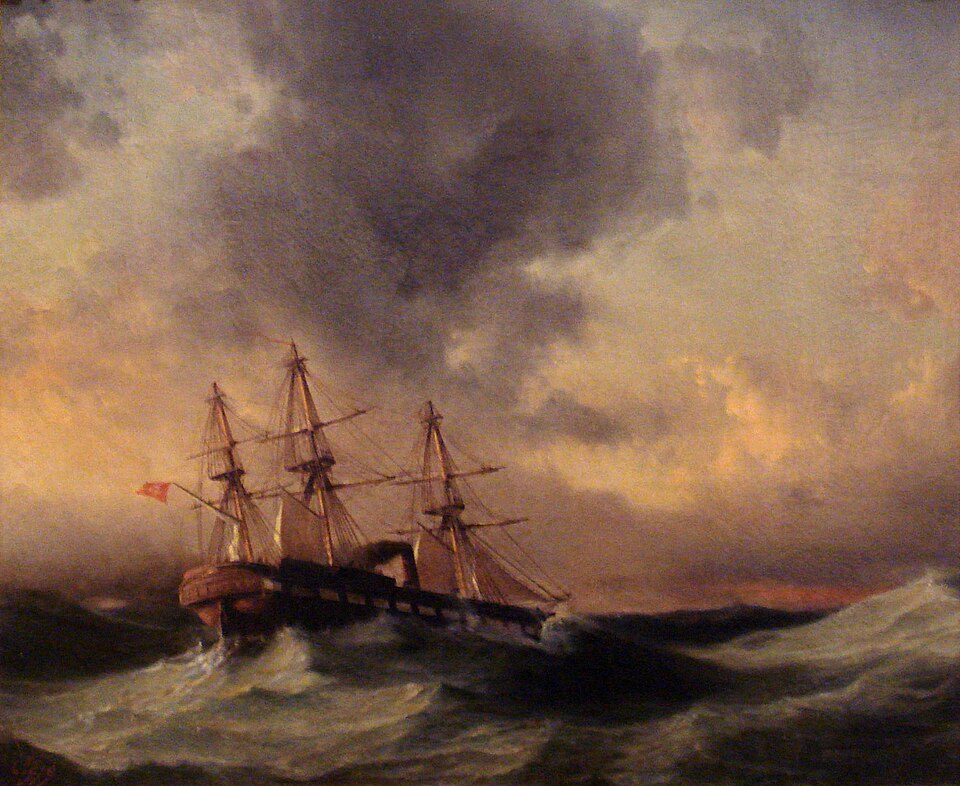
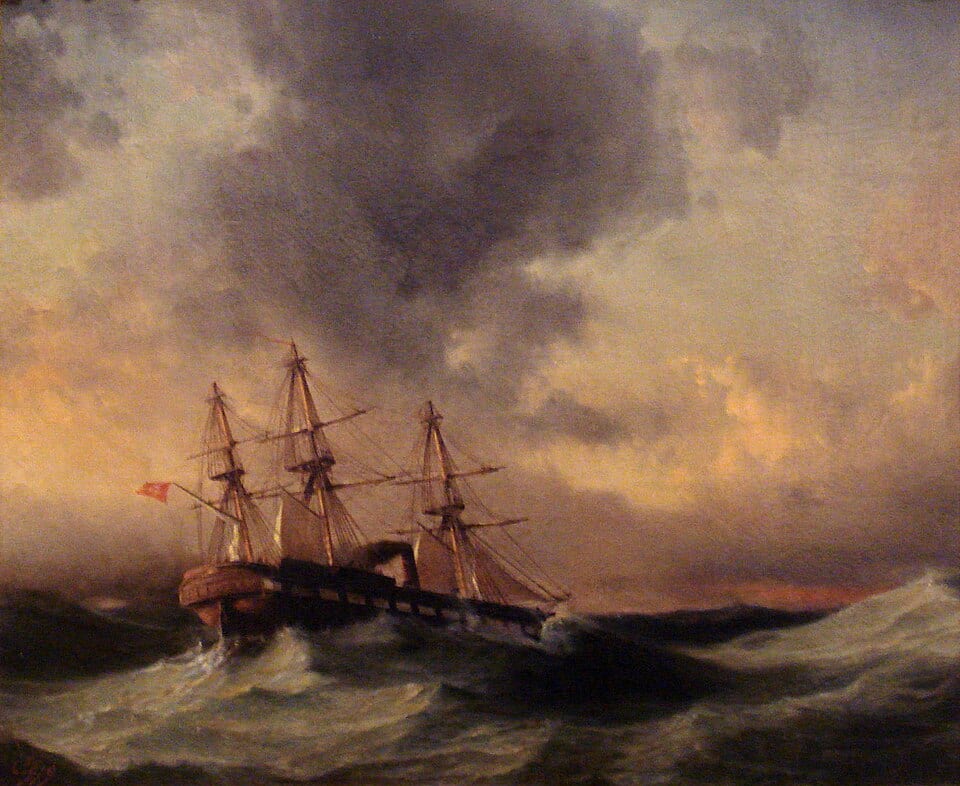
Painting: Commodore Osman Nuri Pasha (1839-1906), "Voyage of frigate Ertuğrul to Japan", Istanbul Naval Museum. Wikimedia Commons, public domain.
What was the Ertuğrul incident?
The Ertuğrul incident was the wreck of an Ottoman navy frigate on its way home from a goodwill mission to Emperor Meiji. It sank off Kashinozaki on Kii-Ōshima at about 21:30 on 16 September 1890, and only 69 of the men on board survived.
Japan's Cabinet Office, in a 2005 report by its expert panel on passing on disaster lessons, calls it the first large-scale wreck of a foreign ship in Japan's history. Kushimoto Town's own account says the wooden ship, 26 years old, met a typhoon the day after leaving Yokohama, was driven onto the Funagōra reef that sailors had long feared, and sank after seawater pouring in through the broken hull set off an explosion in the engine room.
| Ship | Ertuğrul, Ottoman navy frigate (wooden, sail and steam) |
| Envoy | Rear Admiral Osman Pasha, carrying the Sultan's order and gifts to Emperor Meiji |
| Left Istanbul | 14 July 1889 |
| Reached Yokohama | 7 June 1890 |
| Left Yokohama | 15 September 1890 |
| Wrecked | 16 September 1890, about 21:30, off Kashinozaki, Ōshima village (now Kushimoto, Wakayama) |
| Survivors | 69 (all sources agree) |
| Dead | About 500 to 587, depending on the source (see below) |
Sources: Kushimoto Town, "Exchange with Turkey"; Cabinet Office, "1890 Ertuğrul Incident" report (2005), summary sheet and chapter 2.
Why was an Ottoman warship in Japan?
The Ottoman Sultan Abdülhamid II sent the Ertuğrul to return a courtesy: Japan's Prince Komatsu Akihito had visited Istanbul in 1887. Kushimoto Town adds that the Sultan also hoped to move towards an equal treaty with Japan, another country then bound by unequal treaties with the European powers.
The envoy, Osman Pasha, was received by Emperor Meiji, presented the highest Ottoman order and other gifts, and spent three months in Tokyo, according to Kushimoto. The Cabinet Office report adds two details that the friendship story often leaves out. The voyage was also a show of the Sultan's role as leader of the Muslim world at ports along the way, and the ship's departure from Japan was delayed by an outbreak of cholera. Kushimoto writes that Japanese officials, knowing September was typhoon season, advised repairs before leaving; the admiral sailed on 15 September as planned.
How did the people of Kashino help the survivors?
The survivors swam or were thrown ashore below the cliffs and climbed towards the only light they could see, the Kashinozaki lighthouse. The two keepers treated them through the night, then the hamlet head, the village head, three doctors and the villagers took over.
The Cabinet Office report reprints the lighthouse log, as copied before the war by a Foreign Ministry official (the original is now lost). It is the closest we can get to that night:
- 22:15, 16 September. The keeper on duty, named in the log as 乃美権之丞, saw "one foreigner, his body covered in blood" come in. He called his colleague, 瀧澤正浄, with a whistle. The man could say only "Turkey" and made the gesture of a ship going down. Nine more arrived; the keepers dressed their wounds in their own quarters and sent a servant to the hamlet head.
- 05:50-07:30, 17 September. Fifty-three more men reached the lighthouse, six of them badly hurt. The log lists what was used: lard, ointment, gauze, boric acid, bandages and sheets from government stock, and, from the keepers' own belongings, cotton cloth, white rice, firewood and paper.
- The count. Sixty-three survivors came to the lighthouse and six to Kashino cove: 69 in all.
The Cabinet Office report notes that every survivor reached the island by his own strength; no one was found alive in the sea afterwards.
Hamlet head Saitō (齋藤半之右衛門) moved 25 men who could walk to a temple in Kashino (大龍寺), where a local doctor treated them. Village head Oki Amane received the news at 10:30 on 17 September. He sent two doctors ahead, asked a third to follow, and was at Kashino an hour later with a constable and a clerk. He sent runners to the county office and to Tanabe, the nearest telegraph office, about five hours away, to wire the prefecture; that evening he had the Navy Ministry and the Kure naval base wired as well. With help from the English-speaking captain of the steamer Bōchō Maru, which had sheltered from the storm in Ōshima harbour, he learned it was an Ottoman warship and sent two surviving officers to Kobe on his own authority. The diary he kept to 1 October, now in the Turkish Memorial Museum, is called by the Cabinet Office report "a first-class record of disaster lessons".
For days the villagers searched the shore and the sea. By 7 October, 251 bodies had been examined and buried on Ōshima and on the opposite coast; Osman Pasha's body was never found. Nippon.com (2015) adds that the islanders gave up their emergency food. Many more vivid details of the rescue circulate in books and films; we did not find them in these primary records, so we leave them out.
Help also crossed flags. The German gunboat Wolf, in Kobe at the time, sailed to Ōshima on 19 September and carried most of the survivors to Kobe on 20-21 September, before Japan's own warship Yaeyama arrived. The Cabinet Office report reads this as the custom of sea rescue among navies, not politics.
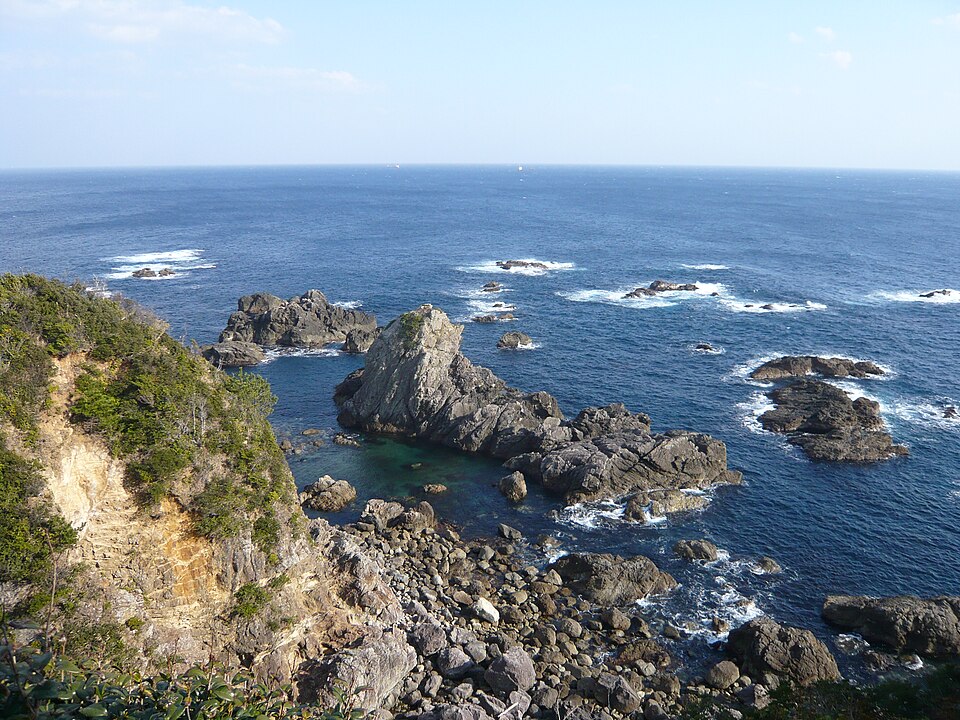
Photo: Opqr, 2014. Wikimedia Commons, CC BY-SA 3.0. The uploader notes that the ship struck the reef at the centre of the frame.
How many died, and how many survived?
All sources agree that 69 men survived. The number of dead is less certain: Kushimoto Town and Wakayama Prefecture give 587, Japan's Foreign Ministry has given both "nearly 600" and 581, and the Cabinet Office report says about 500, because the exact number on board is not known.
| Source | Dead | Survivors |
|---|---|---|
| Kushimoto Town, memorial page | 587 of 656 aboard | 69 |
| Wakayama Prefecture (international exchange page; "nagomi" 2025) | 587 | 69 |
| Ministry of Foreign Affairs, Diplomatic Archives Q&A | "nearly 600", including Osman Pasha | 69 |
| Ministry of Foreign Affairs, 2013 briefing note; nippon.com 2024 | 581 | 69 |
| Wakayama Prefectural Assembly resolution, 2010 | "600-odd aboard" | 69 |
| Cabinet Office report, 2005 | "about 500"; exact number unknown | 69 |
| Village head Oki's letter, 17 September 1890 (first estimate) | 580 of 650 | — |
The Cabinet Office report explains why: Ottoman sources give different crew numbers for the departure from Istanbul, at least 13 men had already died of cholera and tuberculosis in Japan, and no Japanese record of the number on board when the ship left has been found. This article uses "69 survivors" as fact and gives the death toll with its source.
How did the survivors get home?
The survivors were treated in Kobe by Imperial Household doctors and Japanese Red Cross staff, and two Japanese warships, the Hiei and the Kongō, carried them back. They left Kobe on 11 October 1890 and reached Istanbul in early January 1891.
Kushimoto Town writes that Emperor Meiji sent his physicians and the Empress sent 13 nurses. According to the Cabinet Office report, the government decided on 26 September to send the two ships, at a cost of ¥126,487.60 from the reserve fund, after newspapers led by Jiji Shimpō called for it. The report is frank about motives. The papers were thinking partly of Japan's standing in Europe; the Navy Minister's written order put training the 88 cadets on board first and returning the survivors second. One of those cadets was Akiyama Saneyuki, later a famous naval strategist.
The dates differ slightly between official accounts:
- Cabinet Office report: the ships left Shinagawa on 5 October, left Kobe with the survivors on 11 October, were refused entry to Istanbul near the Dardanelles and handed the survivors to an Ottoman warship there, then entered Istanbul with special permission on 2 January 1891.
- Kushimoto Town: the survivors "set off on 5 October" and arrived in Istanbul on 2 January 1891.
- MOFA Diplomatic Archives: the ships left Kobe on 11 October, handed the survivors over at Port Said, and reached Istanbul on 1 January 1891.
Who carried the story to Turkey?
Newspapers raised donations across Japan, and a Jiji Shimpō reporter, Noda Shōtarō, sailed on the Hiei to hand them over in Istanbul. He stayed about two years, taught Japanese at the Ottoman military academy at the Sultan's request, and became, the Cabinet Office report says, the earliest confirmed Japanese convert to Islam.
The report gives a rich picture of how ordinary Japanese responded. The Tokyo Nichinichi began its fund after one man walked into its office on 19 September and gave three yen. Temperance groups, a youth society that held a concert and Buddhist temples in Tokyo and Kobe held collections and memorial rites. Jiji Shimpō raised more than ¥4,000 and, while other papers struggled with the transfer, sent the money with Noda as a French bill of exchange. His reports from the voyage ran in the paper. Ottoman newspapers featured him in June 1891.
Then he was forgotten. The report's author, Nobuo Misawa of Toyo University, writes that Noda returned after two years and died young, and that his achievements were not properly presented in Japan until a 2003 exhibition. It is a quiet reminder that the people who connect countries are not always the ones history remembers.
Who was Yamada Torajirō, and what did he really do?
Yamada Torajirō (1866-1957) was a young man from a samurai family who raised money for the Ertuğrul victims in Tokyo, reached Istanbul in April 1892, opened a shop selling Japanese goods and spent about 20 years there in total. He later led a Japan-Turkey trade association and became head of a tea-ceremony school.
The Gunma Prefectural Library, introducing a 2023 biography written by his grandchild, says he was born in 1866 as the second son of the Nakamura family, senior retainers of the Numata domain, and was adopted at 15 into the Yamada family, heads of the Sōhen school of tea. He later became head of the school and was also active as Yamada Sōyū. The Cabinet Office report records that in 1890 he placed his own newspaper advertisements, gave lectures and staged two days of performances to raise funds, though the amount is unknown, and that he reached Istanbul in April 1892. With Noda's help he met Ottoman officials, assisted at the academy and opened the Nakamura shop.
Yamada is the hero of many retellings, and the same report, in a column titled "Yamada Torajirō, the man of legend; Noda Shōtarō, the man forgotten", checks the popular claims against the record:
- That Atatürk was his pupil. Researchers who examined Atatürk's school years found no record that he studied Japanese; the report says one author simply wrote it down.
- That he was the first Japanese Muslim. His own memoir does not say so; the report traces the story to a confusion with Noda.
- That he personally delivered about ¥5,000. The report thinks this figure is probably the total of all Japanese donations, and that Yamada's share was much smaller.
- What stands. Many Japanese visitors to Istanbul did rely on his help, and he did send information to Japan's minister in Vienna during the Russo-Japanese War; how much it mattered is unknown.
After returning to Japan around the First World War, Yamada became the real driving force, as director, of the Japan-Turkey Trade Association founded in Osaka in November 1926, the report says, and he met Atatürk in 1930. His story deserves telling; it is better told as what it was.
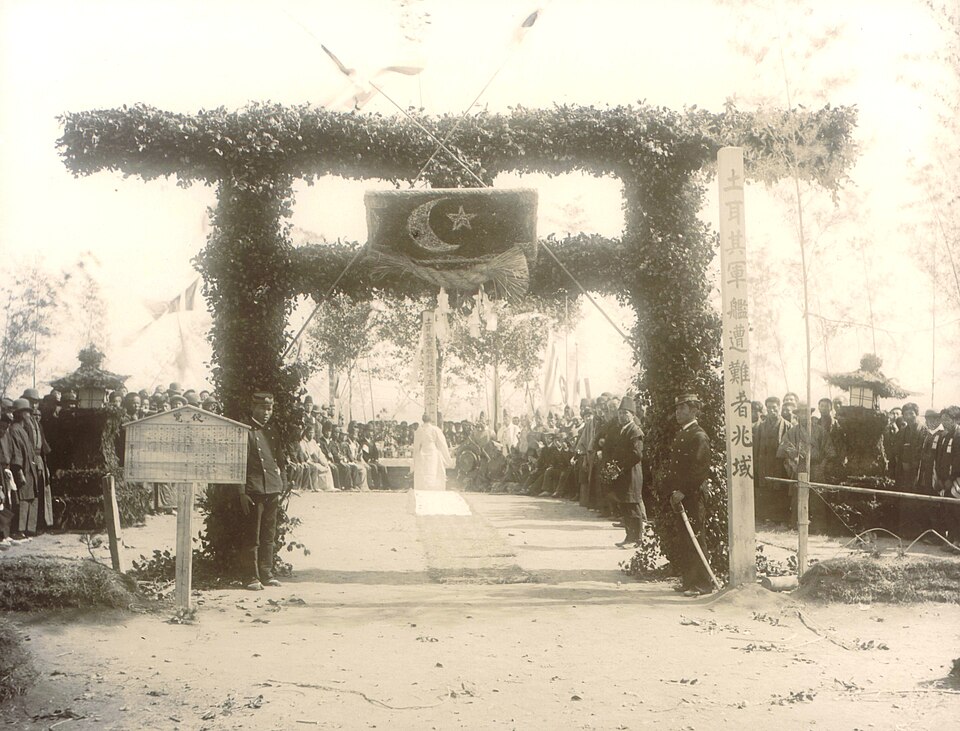
Photo: unknown photographer. Wikimedia Commons, public domain (PD-Japan-oldphoto). Commons dates it to 1890; which ceremony it shows is not identified.
How has the memory been kept in Kushimoto?
Local volunteers raised a monument over the graves in February 1891, a Japan-Turkey trade association held the first large memorial in August 1928, and Turkey's founder Atatürk had the present monument built, unveiled on 3 June 1937. Since then Kushimoto has held a joint memorial with Turkey every five years, except during the Second World War.
- 1891. A first stone, "Monument to the wreck of the Turkish warship", was raised by local people above the reef where the dead were buried (Kushimoto).
- 1893. The Ottoman government sent Ōshima village a gift of about ¥3,000. The governor told the village not to divide it among households but to invest it as the village's common fund (Cabinet Office report).
- 1928-1929. The first memorial organised by the trade association that Yamada led was held in August 1928 (Kushimoto gives 6 August; the Cabinet Office report gives 5 August and calls the basis of the date unclear). Emperor Shōwa visited the monument on 3 June 1929.
- 1937. Hearing of the Emperor's visit, Atatürk decided to rebuild the graves and raise a new monument, designed and built by Wakayama Prefecture and unveiled on 3 June 1937 (Kushimoto). The Cabinet Office report notes that the army and trade groups were closely involved, and that from this point the wreck began to be told less as a disaster lesson and more as a foundation for diplomacy and trade.
- War. Kushimoto says the memorials paused during the Second World War. The Cabinet Office report records that Turkey broke off relations with Japan in January 1945 and declared war on 23 February 1945. The friendship was not unbroken; it was resumed.
- After the war. The Turkish Memorial Museum opened on 3 June 1974 (Cabinet Office report). In 1972 a copy of the Kashino monument was raised in Mersin; Kushimoto's council resolved on sister-city ties with Yakakent in 1964 and Mersin in 1975, and formal signings followed in 1997 and 1994 (Kushimoto).
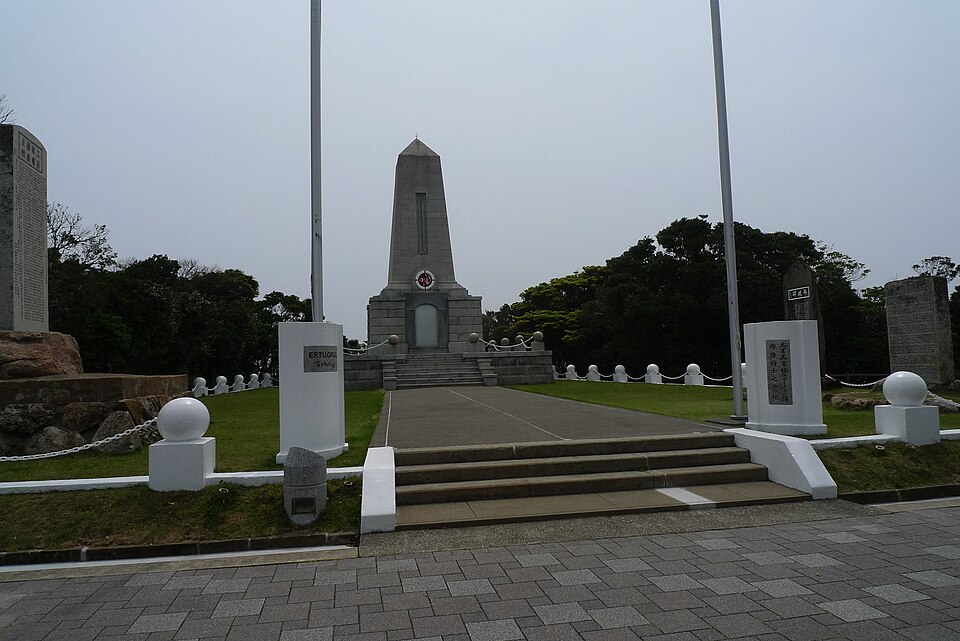
Photo: Motokoka, 2010. Wikimedia Commons, CC BY-SA 4.0.
What happened in Tehran in 1985?
In March 1985, during the Iran-Iraq War, Iraq announced it would treat all aircraft over Iran as targets. Japanese residents in Tehran could not get seats out, and Japan sent no plane. After appeals from the Japanese side, Turkish Prime Minister Turgut Özal decided to send Turkish Airlines aircraft, and almost all the Japanese who wanted to leave got out before the deadline.
That is how Japan's Ministry of Foreign Affairs summarised it in 2013, when Prime Minister Abe expressed condolences for the death of one of the pilots. The ministry put the number wishing to leave at about 250. Other accounts:
| Source | What it says |
|---|---|
| MOFA, 2013 | About 250 wished to leave; foreign airlines put their own nationals first; Özal's decision; almost all escaped before the deadline |
| Prime Minister's Office, January 2006 | Prime Minister Koizumi met former Turkish Airlines pilot Ali Özdemir in Istanbul to thank him; the flight rescued about 250 Japanese "in response to the request of the Government of Japan" |
| Kushimoto Town | Iraq's announcement came on 17 March with a 48-hour deadline; Japan's plane was not sent because safety could not be assured; two Turkish aircraft took all 215 Japanese out, one hour before the deadline |
| Turkish Embassy in Tokyo, ambassador's article, 2025 | Türkiye evacuated 215 Japanese citizens on Turkish Airlines aircraft, "another milestone" in the friendship |
| Aviation Wire, 2015 | A DC-10 was used; Turkish Airlines worked with Japan's ambassador in Iran and the Iranian government; 215 rescued |
| Wakayama Prefectural Assembly, 2010 | Two Turkish aircraft rescued "over a hundred" Japanese |
The numbers differ partly because some count those who wished to leave and some count those on the Turkish flights. We could not confirm the exact date and time of the flights with two sources, so we do not give them.
Was the 1985 rescue a "repayment" for 1890?
Many people say so, and some Turkish diplomats are quoted as saying so, but the official records we checked describe it more carefully. Japan's Foreign Ministry credits appeals from the Japanese side and Prime Minister Özal's decision; the Turkish Embassy calls it "another milestone".
Here is who said what:
- Kushimoto Town heads its page "Turkey's repayment in 1985" and quotes Neçati Utkan, then Turkish ambassador to Japan: "The Turkish people have not forgotten the devoted rescue that the Japanese carried out at the time of the Ertuğrul. I learned it in a history textbook in primary school. Even children in Turkey know about the Ertuğrul. It is only today's Japanese who do not. That is why a Turkish Airlines plane flew to help the Japanese in trouble in Tehran." The page also carries the line often searched for in Japan, "We only repaid the debt of the Ertuğrul", as a heading. It gives no date or original publication for the ambassador's words, and we could not find one.
- A 2013 newsletter piece by a Japanese resident of Istanbul, published by the Iwate International Association after the funeral of pilot Orhan Suyolcu, says Japan's ambassador in Tehran asked the Turkish ambassador for help and was told, "We have not forgotten the debt of the Ertuğrul". This is a second-hand account.
- The Wakayama Prefectural Assembly (2010) wrote only that "it is said" the rescue rested on the close friendship built since the Ertuğrul.
- Japan's Foreign Ministry (2013) and the Prime Minister's Office (2006) describe a request from Japan and a Turkish decision, without giving the Ertuğrul as the reason.
Two historical sources help explain why the "repayment" story became so strong. The Wakayama Prefectural Archives, in a teaching sheet, writes that it was after the 1985 rescue that the Ertuğrul rescue became widely known as the beginning of the two countries' friendship. The Cabinet Office report, written in 2005, notes that the wreck came to be told as a beautiful story and was linked to the 1985 charter flight in NHK's documentary series Project X; its author voices concern, for the sake of the relationship itself, about the media retelling it as legend without checking the facts, and argues that real friendship needs the truth dug up, not the beautiful story repeated.
Both things can be true. People who were there felt they were being thanked across 95 years. The record also shows two governments, embassies and airline crews making decisions under pressure. Holding both is more respectful to everyone involved, including the Turkish crews who took the risk.
How have Japan and Turkey helped each other since?
The two countries established diplomatic relations in 1924 and marked their centenary in 2024. In recent decades they have sent help after each other's major earthquakes, and Kushimoto has raised donations for Turkey more than once.
The Turkish ambassador's 2025 article dates diplomatic relations to 1924 and speaks of "solidarity demonstrated mutually in the recent decades following the major earthquakes". After the February 2023 earthquakes in south-eastern Türkiye, Kushimoto collected ¥31,216,503 between 7 February and 16 September 2023 and gave it all to the Turkish Embassy, according to the town; it had also run an appeal after the 2020 İzmir earthquake. In August 2025, the 135th anniversary, Wakayama's governor and Kushimoto's mayor visited Türkiye and signed a memorandum for youth exchanges on disaster prevention and culture, Japan's Foreign Ministry reports. On Japan's own tradition of disaster preparedness, see why Japan's disaster preparedness could help save the world.
How do you visit the memorial, the Turkish Memorial Museum and the Kashinozaki Lighthouse?
All three stand together at Kashino, on the eastern tip of Kii-Ōshima. From JR Kushimoto Station it is about 37 minutes by bus or 20 minutes by taxi, across the Kushimoto Ōhashi bridge.
| Turkish Memorial Museum | Ertuğrul memorial | Kashinozaki Lighthouse | Old lighthouse keepers' house | |
|---|---|---|---|---|
| Address | 1025-26 Kashino, Kushimoto | Kashino, Kushimoto | 1006-1 Kashino, Kushimoto | 1006-1 Kashino, Kushimoto |
| Hours (as published) | 9:00-17:00 | 9:00-17:00 | Grounds open; tower interior closed | 9:00-17:00 |
| Closed (as published) | Open every day (see note) | — | — | Wednesdays and Thursdays; also some holidays |
| Admission (as published) | Adults ¥500; school pupils ¥250; groups of 15+ ¥400 / ¥200; half price with a disability certificate | Free | Free | ¥100 (free for school pupils) |
| Phone | 0735-65-0628 | — | — | 0735-65-8515 |
Hours, fees and addresses from Kushimoto Town's tourism pages, checked on 27 October 2026. Note: Wakayama Prefecture's 2025 magazine page lists the museum as "open every day" in one line and "closed Thursdays (open in the summer holidays)" in another. Phone the museum before a weekday visit.
- By train. Kushimoto Station is on the JR Kinokuni Line; the town says the limited express Kuroshio takes from about 3 hours 30 minutes from Shin-Osaka. From Tokyo, fly to Nanki-Shirahama (about 80 minutes from Haneda) and continue by bus or train.
- By local bus. Kushimoto's community bus Ōshima Line runs to Kashino lighthouse every day, at ¥200 a ride (as of 2026-10-27). Check the town's timetable before you go, as services are infrequent.
- By car. Free parking (84 spaces) near the museum. The Kushimoto Ōhashi bridge has linked the island to the mainland since 8 September 1999.
- At the site. The memorial looks straight down on the Funagōra reef. The lighthouse, designed by the British engineer Richard Henry Brunton and lit in 1870, is described by Kushimoto as Japan's oldest stone lighthouse; you cannot enter the tower, but a spiral stair lets you climb to its gallery. The keepers' house next door, where the 1890 survivors were first treated, is a registered tangible cultural property and can be visited inside.
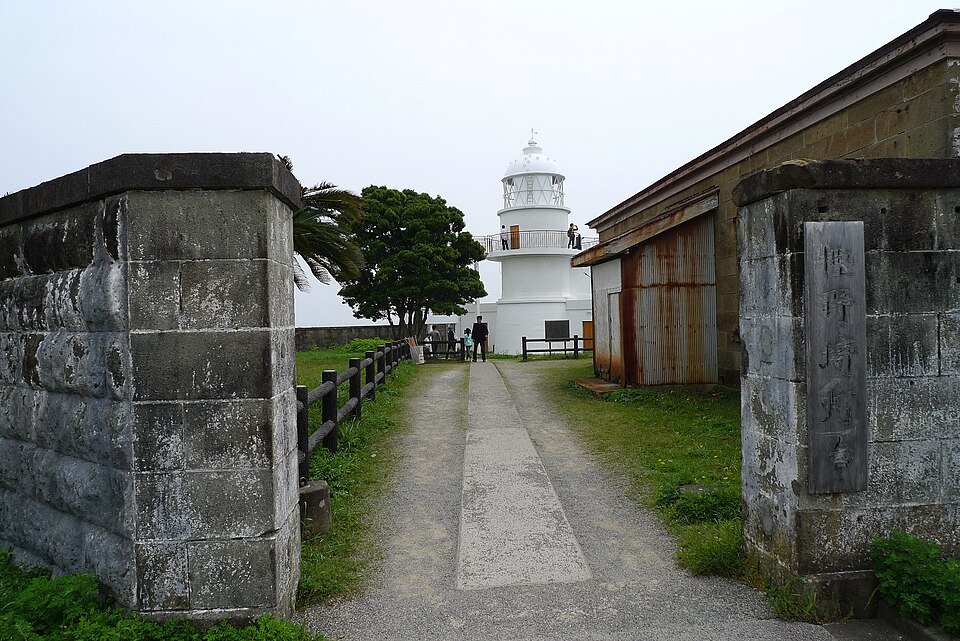
Photo: Motokoka, 2010. Wikimedia Commons, CC BY-SA 4.0.
When is the Ertuğrul memorial ceremony?
Kushimoto holds a memorial ceremony at the monument on 16 September, the anniversary of the wreck. The 2026 ceremony was held on Wednesday 16 September 2026, from 11:00 to about noon, and the town invited anyone to attend. The 2027 ceremony had not been announced as of 2026-10-27.
- 2026 (136th year). Kushimoto Town's notice set the ceremony for 16 September 2026, 11:00-12:00, in front of the Kashinozaki memorial, with a moment of silence, the Turkish and Japanese anthems, an address by Mayor Tashima Katsumasa, remarks by the Turkish Embassy's military attaché, flowers and the memorial song.
- 2025 (135th year). Wakayama Prefecture reports that the ceremony took place on 16 September 2025 before the monument, attended by Turkey's ambassador, the mayor and many local residents.
- Every five years. Kushimoto says it holds a larger memorial jointly with Turkey every five years. In 2020, the 130th year, the ceremony on 16 September was streamed online.
- 2027. Not announced (as of 2026-10-27). 16 September 2027 falls on a Thursday; check Kushimoto Town's international exchange page in late summer.
What can we take from this story?
On a stormy night, people on a poor island helped strangers whose language they could not speak, and wrote down exactly what they gave. Nations later built friendship, policy and legend on that night. Remembering it honestly means keeping both the kindness and the history around it.
The record is generous to the villagers and keepers, and it does not need to be improved. It also shows national motives at every stage: a navy that put cadet training first, newspapers thinking of Japan's image in Europe, a 1937 monument shaped by the army and by trade, a war in which Turkey declared war on Japan. Friendship survived all of that because people at each end kept choosing it.
A few questions to take away:
- The keepers on Kashinozaki did not know who the bleeding man was, only that he needed help. What would it take for us to respond that way to strangers today, whatever their nationality?
- Noda Shōtarō is almost forgotten and Yamada Torajirō became a legend. Whose part in our own national stories have we forgotten, and whose have we enlarged?
- If 1985 was not simply a "repayment", but people in two countries choosing to help, does that make the story smaller or larger?
For other people who linked Japan and the wider world, see our biographies of Yoichi Hatta, the engineer of Taiwan's Wushantou Dam and William Adams (Miura Anjin) and the ships he built in Ito.
Frequently asked questions
How many people survived the Ertuğrul shipwreck?
Sixty-nine. The Kashinozaki lighthouse log records 63 survivors arriving at the lighthouse and six at Kashino cove, and every later Japanese and Turkish source we checked gives 69.
How many died?
It depends on the source: 587 (Kushimoto Town, Wakayama Prefecture), 581 (MOFA 2013, nippon.com 2024), "nearly 600" (MOFA Diplomatic Archives), or "about 500, exact number unknown" (Cabinet Office report, 2005).
Who said "We only repaid the debt of the Ertuğrul"?
The phrase appears as a heading on Kushimoto Town's official page, which attributes a longer statement to Neçati Utkan, then Turkish ambassador to Japan. We could not find the original publication or date of his words.
Did Atatürk study Japanese under Yamada Torajirō?
There is no evidence for it. The Cabinet Office report (2005) says researchers who examined Atatürk's school years found no record that he learned Japanese.
Where is the Turkish Memorial Museum, and how much does it cost?
At 1025-26 Kashino, Kushimoto, next to the memorial and the lighthouse. As of 2026-10-27 the town lists 9:00-17:00 and ¥500 for adults (¥250 for school pupils).
Can you go inside the Kashinozaki Lighthouse?
No. The tower interior is closed, but Kushimoto Town says a spiral staircase lets visitors climb to its gallery. The old keepers' house next to it is open (closed Wednesdays and Thursdays, ¥100).
When is the memorial ceremony?
On 16 September each year in front of the Kashinozaki memorial. The 2026 ceremony was on 16 September 2026; the 2027 date had not been announced as of 2026-10-27.
Is there a film about the Ertuğrul?
Yes. Kainan 1890, a Japan-Turkey co-production about the 1890 wreck and the 1985 Tehran rescue, opened in Japan in December 2015, according to Kushimoto Town. It is a dramatisation, not a documentary.
Sources and dates checked (all checked on 2026-10-27)
- Kushimoto Town, "Exchange with Turkey: the wreck of the Ertuğrul" (voyage, wreck, 587 dead and 69 survivors, Kobe, 5 October and 2 January dates, 1891 monument, 1928 memorial, 1929 visit, 1937 monument, five-yearly memorials) — town.kushimoto.wakayama.jp/gyosei/kokusai-koryu/turkey… (primary)
- Kushimoto Town, "The story of the bond between Japan and Turkey" (1985 rescue as told by the town, 17 March announcement, 215 Japanese, two aircraft, Utkan quotation) — town.kushimoto.wakayama.jp/kanko/kizuna/turkey.html (primary, town's own account)
- Kushimoto Town, notice of the 2026 Ertuğrul memorial ceremony (16 September 2026, 11:00-12:00, programme) — town.kushimoto.wakayama.jp/gyosei/kokusai-koryu/2022-0… (primary)
- Kushimoto Town, 130th anniversary ceremony 2020 — town.kushimoto.wakayama.jp/gyosei/kokusai-koryu/yuko13… (primary)
- Kushimoto Town, sister cities Mersin and Yakakent — town.kushimoto.wakayama.jp/gyosei/kokusai-koryu/mersin… , town.kushimoto.wakayama.jp/gyosei/kokusai-koryu/yakake… (primary)
- Kushimoto Town, 2023 Türkiye earthquake donations report — town.kushimoto.wakayama.jp/gyosei/kokusai-koryu/2023-0… (primary)
- Kushimoto Town tourism pages: Turkish Memorial Museum, memorial, Kashinozaki Lighthouse, old keepers' house, lighthouse story, Kushimoto Ōhashi, access, community bus — town.kushimoto.wakayama.jp/kanko/oshima/torukokinenkan… , town.kushimoto.wakayama.jp/kanko/oshima/torucogunkan.h… , town.kushimoto.wakayama.jp/kanko/oshima/kasinozaki.htm… , town.kushimoto.wakayama.jp/kanko/oshima/kasinozakitoud… , town.kushimoto.wakayama.jp/kanko/kizuna/kashinozaki.ht… , town.kushimoto.wakayama.jp/kanko/oshima/kushimoto-ooha… , town.kushimoto.wakayama.jp/kanko/access/index.html , town.kushimoto.wakayama.jp/kurashi/community-bus/index… (primary)
- Cabinet Office (Japan), Expert Panel on Passing on Disaster Lessons, 1890 Ertuğrul Incident report (March 2005): summary sheet; chapter 2 (lighthouse log, village head Oki's response, the Wolf, burials, Hiei and Kongō, newspapers, Noda Shōtarō, Yamada Torajirō column by Nobuo Misawa, 1893 gift); chapter 4 (memorials 1891-1974, trade association, wartime break) — bousai.go.jp/kyoiku/kyokun/kyoukunnokeis… (public body; reproduces primary records)
- Cabinet Office, Kōhō Bōsai no. 34 (July 2006), "Learning from past disasters 8: the Ertuğrul incident" — bousai.go.jp/kyoiku/kyokun/kyoukunnokeis… (public body)
- Ministry of Foreign Affairs, Diplomatic Archives Q&A, "Did the Meiji government send the Turkish survivors home?" (read via the Internet Archive copy of 20 May 2026, because the live page returned HTTP 403) — mofa.go.jp/mofaj/annai/honsho/shiryo/q… (primary)
- Ministry of Foreign Affairs, "Turkish Defence Minister Yılmaz calls on Prime Minister Abe" (6 March 2013; notes on the Ertuğrul, 581 dead, and the 1985 Tehran rescue) (Internet Archive copy) — mofa.go.jp/mofaj/kaidan/s_abe2/130306_… (primary)
- Ministry of Foreign Affairs, Glocal Diplomacy Net, "Friendship between Wakayama Prefecture and Türkiye" (2025 visit and memorandum; 587 dead; 215 Japanese) (Internet Archive copy) — mofa.go.jp/mofaj/gaiko/local/pagew_000… (primary)
- Prime Minister's Office of Japan, "Prime Minister visits Turkey (third day)", 12 January 2006 (meeting with pilot Ali Özdemir) (Internet Archive copy) — japan.kantei.go.jp/koizumiphoto/2006/01/12turk… (primary)
- Embassy of the Republic of Türkiye in Tokyo, Ambassador Oğuzhan Ertuğrul's article for the Japan Times on the 102nd anniversary of the Republic (2025; relations since 1924, 215 Japanese evacuated in 1985) — tokyo-emb.mfa.gov.tr/Content/assets/consulate/im… (primary)
- Wakayama Prefecture, "Turkey and Japan: the origin of friendship is Wakayama" — pref.wakayama.lg.jp/prefg/022300/kokusaikouryu/… (primary)
- Wakayama Prefecture, nagomi vol. 58 (2025), "135 years since the Ertuğrul" (16 September 2025 ceremony, museum hours and fees) — pref.wakayama.lg.jp/prefg/000200/nagomi/w58/23_… (primary)
- Wakayama Prefectural Assembly, resolution on the 120th anniversary (23 June 2010) — pref.wakayama.lg.jp/prefg/200100/cms/d00200264_… (primary)
- Wakayama Prefectural Archives, teaching sheet on the Ertuğrul (how the memory changed over time) — lib.wakayama-c.ed.jp/monjyo/archive/kyouiku/ertu… (public body)
- Gunma Prefectural Library, new-acquisitions sheet on Watari Tsukiko, Yamada Torajirō (enlarged edition, 2023) (birth, Numata, adoption into the Sōhen school) — library.pref.gunma.jp/wysiwyg/file/download/1/534… (public body)
- Aichi International Association, "Türkiye and Japan" (Ertuğrul about 600 dead; 1924 relations; 1985 evacuation at the Japanese government's request) — www2.aia.pref.aichi.jp/koryu/j/turkey/turkey.pdf/w…
- Iwate International Association, overseas network report "Turkey pilot's funeral" (Emiko Kitayama, 27 February 2013) — iwate-ia.or.jp/cms/media/others/overseas_n…
- nippon.com, "125 years since the Ertuğrul" (Naohisa Murakami, 16 September 2015) — nippon.com/ja/behind/l00127
- nippon.com, "Japan and Turkey: A Century of Imperial Patronage and Mutual Aid" (18 December 2024) — nippon.com/en/in-depth/d01079
- Aviation Wire, "Turkish Airlines special livery for the Tehran rescue flight of 30 years ago" (30 November 2015) — aviationwire.jp/archives/76001
- Anadolu Agency, "Plane hailing Turkish-Japanese bond completes 1st flight" (30 November 2015) — aa.com.tr/en/turkey/plane-hailing-tur…
- Calendar check: 16 September 1890 was a Tuesday; 16 September 2026 a Wednesday; 16 September 2027 a Thursday (Python datetime, 2026-10-27)
- Images: Wikimedia Commons file pages (licences checked) — commons.wikimedia.org/wiki/File:Voyage_of_frigate… , commons.wikimedia.org/wiki/File:Kii_oshima_turkey… , commons.wikimedia.org/wiki/File:Cérémonie_funérai… , commons.wikimedia.org/wiki/File:Cenotaph_of_Turke… , commons.wikimedia.org/wiki/File:Kashinozaki_Light…
By J-Times Editorial (information as of 2026-10-27)
About this article
- By
- J-Times Editorial
- Published
Sources are cited in the text and at the end. If you spot an error, please tell us. Editorial policy & corrections
J-Times is published by Jon&Coo Inc.
Written by
J-Times Editorial
J-Times 編集部 / J-Times Editorial Team