J-Times Editorial
J-Times 編集部 / J-Times Editorial Team
William Adams, the English pilot who served Tokugawa Ieyasu, built two Western-style ships in Ito, Izu. Why there, and where did the 120-ton ship end up?
Read this article to earn +5 MTC
William Adams (Miura Anjin) and Ito: why Japan's first Western-style ships were built in Ito
Short answer (as of 2026-09-23): William Adams, an English pilot who reached Japan in 1600, built two Western-style ships for Tokugawa Ieyasu in Ito, Izu — one of about 80 tons and one of 120 tons.
Most people outside Japan meet William Adams through fiction: he is the historical figure behind the pilot in James Clavell's Shōgun and its television adaptations. The real man left a paper trail that is surprisingly easy to follow. His own letter of October 1611, written in Japan and later printed by the Hakluyt Society, describes the ships he built. Ito City, Yokosuka City, Hirado City and the British Library each hold part of the rest of the story. This article follows those sources, and flags where they disagree.
Who was William Adams, and how did he become "Miura Anjin"?
William Adams was an English navigator, born in Gillingham, Kent, in 1564, who arrived in Japan in 1600 as pilot of the Dutch ship Liefde and stayed in Japan until his death in 1620.
The Liefde reached Bungo, on the island of Kyushu, in April 1600. Adams himself wrote that when the ship anchored there were 24 men left aboard, "sicke and whole", and that three died the next day. Ito City lists the landing place as Usuki in present-day Oita Prefecture; the Ito Tourist Association names the Sashiu district of Usuki.
Within weeks Adams was taken by galley to Osaka. In a letter to his wife he dated his arrival at "the great king's citie" to 12 May 1600 and described being questioned at length through a Portuguese interpreter. The "great king" was Tokugawa Ieyasu, who would win the Battle of Sekigahara later that year. Adams wrote that Ieyasu asked him about everything, "both conserning warre and peace betweene countrey and countrey", and called him back for further questioning two days later. For a ruler about to control Japan's foreign trade, a pilot who had just crossed two oceans and knew the Dutch, the English and their rivals was worth keeping.
The name "Miura Anjin" records that relationship. Anjin (按針) means a ship's pilot, as the Ito Tourist Association explains. Miura refers to the Miura district of Sagami Province (today's Kanagawa), where Ieyasu gave him land at Hemi, now part of Yokosuka. Yokosuka City's historic-site page puts the estate at 220 koku; an inscription on a stone memorial that the same city documents, and the Ito Tourist Association, both give 250 koku. Adams, writing in 1611, described it more plainly: "a living, like unto a lordship in England, with eightie or ninetie husbandmen". The Ito Tourist Association adds that Ieyasu also gave him two swords, the mark of a samurai.
Why were Western-style ships built in Ito?
Ieyasu wanted ocean-going ships built the European way, and the Ito shore offered timber from the Amagi mountains, a steep-sided shoreline and well-formed sand spits suited to building by hand — according to the Ito Tourist Association.
Adams's own account of how the first ship started is modest. Some four or five years after his arrival, he wrote, Ieyasu asked him to build "a small ship". Adams answered that he was "no carpenter". Ieyasu told him to try anyway: if it was not good, it did not matter. The result, in Adams's words, was "a ship of the burthen of eightie tunnes, or there about", built "in all respects as our manner is". Ieyasu came aboard, liked it, and Adams's standing at court rose with it.
Adams's letter does not name the place. The link to Ito comes from Japanese local sources. The Ito Tourist Association says Ieyasu sent Adams to Ito with the shogunate's ship commissioner, Mukai Shōgen, and gives three reasons the site worked in an age without machinery:
- Timber. Ito sits with the Amagi mountain range at its back, so hull timber could be brought down easily.
- Deep water close in. The shoreline drops away steeply, so a finished hull did not have far to go to float.
- Sand spits. A well-developed sand bar at the river mouth could be dug out as a building bed.
The same page summarises a passage from the early-Edo chronicle Keichō Kenmonroku (慶長見聞録) describing the method: a pit was dug in the sand spit, timbers were laid as a cradle, the hull was built on top and lowered as work progressed, and on completion the river was dammed and then released so the water floated the ship out. In other words, a "sand dock". The Ito Tourist Association also notes that researchers disagree on which bank of the river the dock stood — earlier work placed it on the right bank; later study combined with geological surveys suggests the left.
One detail differs between official sources. The Ito Tourist Association places the shipyard at the mouth of the Matsukawa River. Ito City's sister-city page says the ship was built on the Tōjin River (唐人川), a smaller stream that the tourist association describes as running near today's Anjin Memorial Park. The sources agree on Ito; they differ on the exact watercourse.
How big were the ships, and when were they built?
Adams himself gives the sizes — about 80 tons and 120 tons — but not the years. Later sources date them differently, between 1604 and 1607.
Here the sources genuinely disagree, so it is worth laying them side by side:
| Year | Event | Source |
|---|---|---|
| 1564 | Adams born in Gillingham, Kent (24 September) | Ito Tourist Association; Yokosuka City (year only) |
| 1600 | Liefde reaches Bungo (April); Adams meets Ieyasu in Osaka (May) | Adams's letters (Hakluyt Society, 1850); Ito City |
| c.1604–1605 | First ship, about 80 tons | Adams's 1611 letter (size); Ito Tourist Association (1604); Ito City (1605, "first Western-style ship") |
| c.1605–1607 | Second ship, 120 tons, later called San Buena Ventura | Adams's 1611 letter (size); Ito Tourist Association (1607) |
| 1609 | Spanish galleon San Francisco wrecked off Onjuku (30 September) | Onjuku Town; Chiba Prefecture |
| 1610 | Adams's 120-ton ship carries Rodrigo de Vivero's party to Acapulco | Adams's 1611 letter; Chiba Prefecture |
| 1611 | Spain sends thanks, including a clock now at Kunōzan Tōshōgū | Kunōzan Tōshōgū; Shizuoka Prefecture (donor, maker); Adams's 1611 letter (the 1611 gift) |
| 1613 | Adams comes to Hirado and helps set up the English trading house | British Library; Nagasaki Prefecture; Ito City |
| 1620 | Adams dies at Hirado | British Library; Yokosuka City; Toho University |
| 1947 | First Anjin Festival in Ito | Ito Tourist Association |
| 1982 | Ito twinned with Gillingham (renewed with Medway, 1999) | Ito City; Medway Council |
Two disagreements matter. On size, Adams's own letter says "an hundred and twentie tunnes" for the second ship; the 1885 Dictionary of National Biography gives 110 tons. We follow Adams, who built it. On dates, the Ito Tourist Association says 1604 for the first ship and 1607 for the second, while Ito City's sister-city page gives 1605 for the building of the San Buena Ventura. Neither date comes from Adams, so we give a range rather than pick one.
Where did the ship built in Ito go?
The 120-ton ship crossed the Pacific. In 1610 Ieyasu lent it to Rodrigo de Vivero, the shipwrecked former governor of the Philippines, who sailed it to Acapulco in New Spain (Mexico).
On 30 September 1609, the galleon San Francisco, carrying Vivero home from Manila, was driven ashore at Iwawada, in today's Onjuku, Chiba. Onjuku Town records 317 survivors; Adams, writing two years later, put the number saved at "three hundred fortie, or three hundred fiftie". Villagers cared for them, and Vivero was received by the shogunate.
Adams's letter explains what happened next: his larger ship had been "lent to the Gouernour of Manilla, to goe with eightie of his men, to saile to Acapulca", and "this Gouernour was sent in the bigger ship which I made, in ann. 1610". Chiba Prefecture's account adds that the ship was named San Buena Ventura and that 23 Japanese, including the merchant Tanaka Shōsuke, sailed with it. The Ito Tourist Association gives an arrival date in Acapulco of 27 October.
The voyage had a diplomatic afterlife. Adams wrote that in 1611 the Spanish sent another ship "with a great present, and with an Embassadour to the Emperour" and paid for Ieyasu's ship in goods and money — adding that the Spaniards now had the ship in the Philippines. Kunōzan Tōshōgū shrine in Shizuoka still holds a clock that King Philip III of Spain sent Ieyasu in 1611 as thanks for the rescue. The shrine says it was made in Madrid in 1581 and is designated an Important Cultural Property. A ship built on the beach at Ito had become part of the earliest official exchanges between Japan, Spain and Mexico.
What is left of William Adams in Ito today?
Ito remembers Adams through the Anjin Festival, held every August, a memorial park near the river mouth, and a sister-city link with his birthplace — while his graves are in Hirado and Yokosuka.
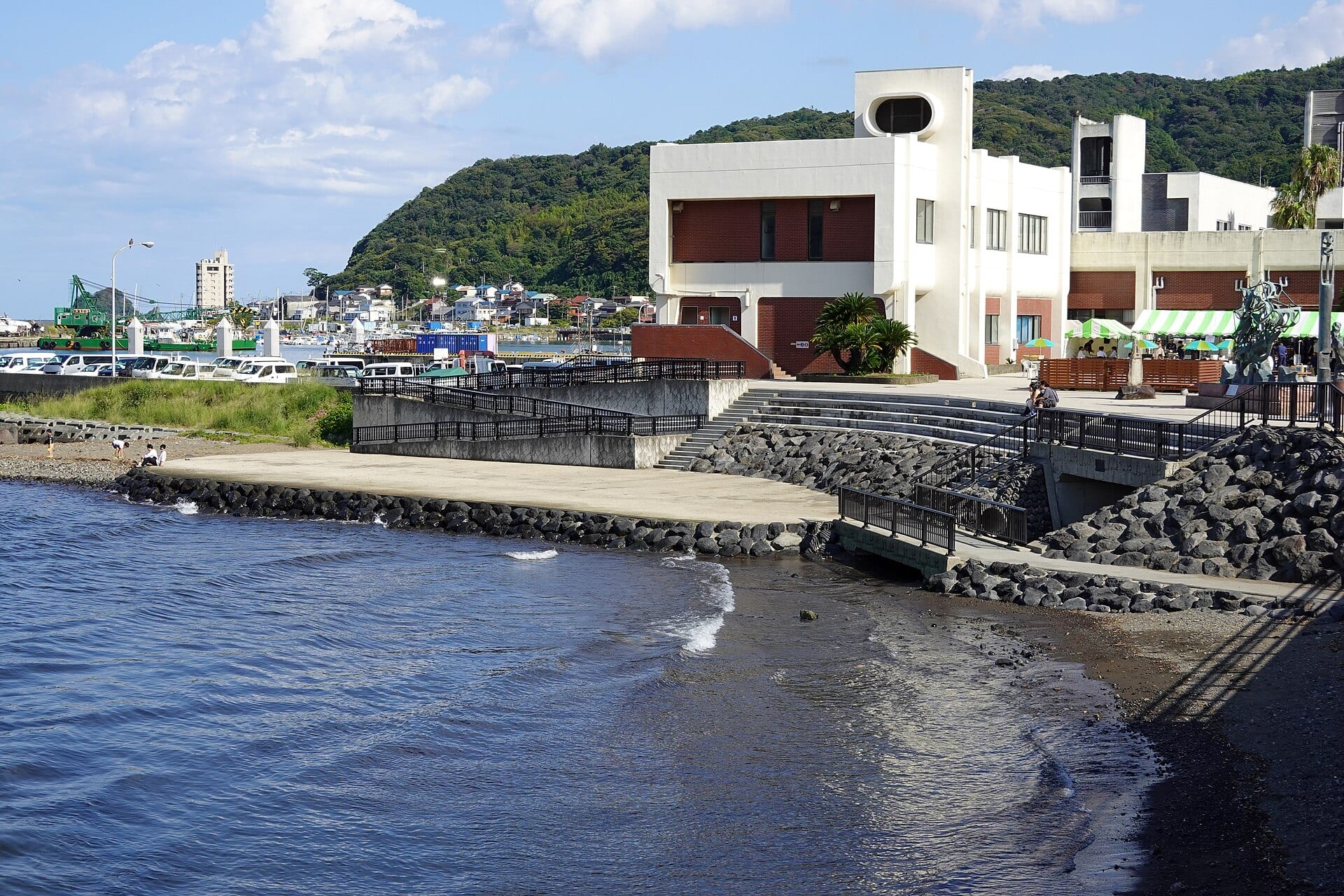
The Anjin Festival (Anjin-sai) is held in Ito every August in his honour; the Ito Tourist Association dates the first festival to 1947. For this year's and next year's festival dates alongside Ito's other events, see Ito's festival and events calendar, including the Anjin Festival. Near the shore, Anjin Memorial Park holds sculpture by Kenji Shigeoka, according to the tourist association. Ito City runs a subsidy for community projects that commemorate Adams and spread knowledge of his link to the city.
The link with England is formal. Ito City says it signed a sister-city agreement with Gillingham on 10 August 1982 because the town was Adams's birthplace, and renewed it with Medway on 9 April 1999 after Gillingham merged into the new authority. Medway Council records the Ito and Yokosuka links among its international relationships. Ito also forms one of four "Anjin cities" with Usuki (where he landed), Yokosuka (his estate) and Hirado (where he died).
Adams died at Hirado on 16 May 1620, according to the British Library and a Toho University study. His memorial at Hemi in Yokosuka was designated a national historic site in 1923; Yokosuka City describes the two stone towers there as memorials built facing Edo at his wish rather than as his burial place. In Hirado, remains excavated near the traditional grave were analysed by a team led by Toho University; the 2020 study concluded they were very probably Adams's, while not ruling out another individual.
William Adams and Ito: frequently asked questions
Did William Adams ever go back to England? No. In his 1611 letter he wrote that he had asked Ieyasu for leave to go home to his wife and children and that Ieyasu "would not let me goe". He died at Hirado in 1620, according to the British Library and Nagasaki Prefecture's tourism site.
Did Adams build Japan's first Western-style ship? Ito City describes the ship built in Ito as Japan's first Western-style sailing ship. Adams's own letter confirms he built two European-style ships of about 80 and 120 tons for Ieyasu; it does not make a "first" claim itself.
Is Adams buried in Ito? No. His death and burial were in Hirado, Nagasaki. Yokosuka has a memorial at his former estate at Hemi. Ito is where his ships were built.
Why is he called "Anjin"? Anjin means pilot, the role he held on the Liefde. "Miura" comes from the Miura district where his estate lay.
When is the Anjin Festival? It is held every August in Ito. Exact dates change each year; check the events calendar linked above.
Sources (checked 2026-09-23)
- William Adams, letter dated Japan, 22 October 1611 ("To my unknowne friends and countri-men"), and letter to his wife, in Thomas Rundall (ed.), Memorials of the Empire of Japon in the XVI and XVII Centuries, Hakluyt Society, 1850, pp. 18–40 — https://archive.org/details/memorialsofempir00rundrich (primary: Adams's own words)
- British Library, "William Adams – from Gillingham to Japan" (death at Hirado 16 May 1620; letter of 23 October 1611, IOR/E/3/1) — https://www.bl.uk/stories/blogs/posts/william-adams-from-gillingham-to-japan
- Ito City, sister and friendship cities (Gillingham 1982, Medway 1999; ship built 1605) — https://www.city.ito.shizuoka.jp/gyosei/shiseijoho/itoshinogaiyo/shinoprofile/4812.html
- Ito City, Miura Anjin partner cities (Usuki, Ito, Yokosuka, Hirado) — https://www.city.ito.shizuoka.jp/gyosei/soshikikarasagasu/kankoka/kanko/7391.html
- Ito City, Miura Anjin commemoration subsidy — https://www.city.ito.shizuoka.jp/gyosei/soshikikarasagasu/kankoka/shiseijoho/13497.html
- Ito Tourist Association, Miura Anjin feature (JA) — https://itospa.com/anjin ; (EN) — https://itospa.com/anjin/eng
- Ito Tourist Association, Anjin Festival history (first festival 1947) — https://itospa.com/feature/detail_129.html
- Yokosuka City, Miura Anjin grave (national historic site, 1923) — https://www.city.yokosuka.kanagawa.jp/8120/bunkazai/kuni09.html
- Yokosuka City, stone memorial inscription — https://www.city.yokosuka.kanagawa.jp/8120/bunkazai/miuraanjin_sekihi.html
- Hirado City, 2019 announcement on remains near the Anjin grave — https://www.city.hirado.nagasaki.jp/kurashi/gyosei/pickup/2019/2019-0402-1621-212.html
- Toho University press release on identification of the Hirado remains (2021) — https://www.toho-u.ac.jp/press/2020_index/20210113-1113.html
- Onjuku Town, Mexico Memorial Park (San Francisco wreck, 1609) — https://www.town.onjuku.chiba.jp/sub4/3/mexico_kinentou1.html
- Chiba Prefecture, exchange with Mexico (1610 voyage, San Buena Ventura) — https://www.pref.chiba.lg.jp/kokusai/kokusaikouryuu/exchange/mexico/index.html
- Kunōzan Tōshōgū, Ieyasu's clock — https://www.toshogu.or.jp/about/clock/
- Shizuoka Prefecture, the Western clock at Kunōzan — https://www.pref.shizuoka.jp/kensei/information/myshizuoka/1002263/1040950/1011370.html
- Nagasaki Prefecture tourism site (Nagasaki Tourism Association / prefectural tourism division), Miura Anjin and Hirado — https://www.nagasaki-tabinet.com/blog/83
- Medway Council, report on sister-city relationships (18 September 2008) — https://democracy.medway.gov.uk/Data/Council/20080918/Agenda/f20080918r-7.pdf
- Auxiliary: Dictionary of National Biography (1885), "Adams, William (d.1620)" — https://en.wikisource.org/wiki/Dictionary_of_National_Biography,_1885-1900/Adams,_William_(d.1620)
Written by the J-Times Editorial Team. Facts current as of 2026-09-23.
Featured image: 663highland / Wikimedia Commons / CC BY-SA 4.0 (https://commons.wikimedia.org/wiki/File:231007_Anjin_Memorial_Park_Ito_Shizuoka_pref_Japan01s3.jpg)
Written by
J-Times Editorial
J-Times 編集部 / J-Times Editorial Team