J-Times Editorial
J-Times 編集部 / J-Times Editorial Team
A practical guide to the bullet train: how to book, which side Mount Fuji is on, the oversized-luggage rule, peak-season Nozomi restrictions, ekiben, the 7-minute clean, the new Supreme Class cabins, and an honest look at the 'zero fatalities' record.
Read this article to earn +5 MTC
Short answer (as of 2026-10-26): The easiest way to ride is to book a reserved seat on your phone or at a station ticket machine. Tokyo to Kyoto takes about 2 hours 10 minutes on a Nozomi. For Mount Fuji on the Tokaido Shinkansen, sit on the E-seat side: on the right going towards Osaka, on the left going towards Tokyo. On the Tokaido, Sanyo and Kyushu lines, luggage whose three sides add up to more than 160 cm needs a reservation. Every Nozomi is all-reserved over New Year (25 December 2026 to 5 January 2027). And the famous "no fatalities since 1964" really means no passenger on board has been killed or injured in a train accident such as a derailment or collision.
On 1 October 1964, just before the Tokyo Olympics opened, the Tokaido Shinkansen began running. Sixty-two years later, the bullet train has turned travel time in Japan from something to endure into something to enjoy, with views and a boxed lunch.
For a visitor, though, the enjoyment starts after the confusion: which ticket, bought where, for which seat? This guide puts the practical steps first (booking, seats, luggage, manners on board), then turns to the pleasures (ekiben, the view) and to what the safety record actually says. Information comes mainly from JR Central, JR East and other official sources, checked on 26 October 2026.
How fast is the Shinkansen?
The Tokaido Shinkansen tops out at 285 km/h. Japan's fastest is the Tohoku Shinkansen's Hayabusa at 320 km/h. It is not the fastest train in the world.
JR Central gives the Tokaido line's maximum speed as 285 km/h and its fastest Tokyo to Shin-Osaka run as 2 hours 21 minutes (March 2023 timetable). The timetable change of 14 March 2026 cut three minutes from some 2-hour-30 Nozomi runs and raised the maximum to 13 Nozomi trains an hour. Tokyo to Kyoto takes roughly 2 hours 10 minutes by Nozomi (JR Tokai Tours says about 2:10; the Ekitan route-search service gives 2:10 to 2:20).
Japan's fastest service is the E5 Hayabusa, which has run at 320 km/h between Utsunomiya and Morioka on the Tohoku Shinkansen since 16 March 2013 (JR East). In China, some trains on the Beijing-Shanghai high-speed line have run at 350 km/h since September 2017. So calling the Shinkansen "the world's fastest" is wrong. Its real strengths are frequency and punctuality.
How many people use it?
About 460,000 people a day on the Tokaido Shinkansen alone, on 383 trains a day (FY2024, including extra trains).
Those figures come from JR Central's 2025 annual report. Multiplied out, that is roughly 170 million passengers a year on one line. JR Central's English site puts the total since 1964 at about 7 billion (as of FY2023).
Is it true there have been no deaths since 1964?
No passenger on board has died in a derailment or collision. That is not the same as nobody ever having died on the Shinkansen.
JR Central says the Tokaido Shinkansen has had no accidents resulting in death or injury to passengers on board since it opened. nippon.com reports that no passenger has died in a derailment or collision on any full-gauge Shinkansen line. Trains have derailed in earthquakes: on 16 March 2022, 16 of the 17 cars of the Tohoku Shinkansen's Yamabiko 223 left the rails in an earthquake off Fukushima, and nobody died (Japan Transport Safety Board report).
Some events fall outside that "zero", though:
- 27 December 1995: at Mishima Station on the Tokaido line, a high-school student whose finger was caught in a closing door was dragged by the departing train and killed. Reports at the time called it the first passenger death on the Shinkansen.
- 30 June 2015: a man set himself on fire aboard the Nozomi 225, and a woman passenger caught in the fire died. MLIT classed it as the Shinkansen's first train-fire accident.
- 9 June 2018: a man attacked passengers with a knife on the Nozomi 265, and a passenger who tried to stop him was killed.
The Shinkansen is an exceptionally safe way to travel. But "zero deaths in 60 years" is not accurate, and the safety it has today has been built, layer by layer, in response to accidents and crimes. One example is early earthquake detection: seismometers along the line and the coast pick up the first, faster P-waves and trigger the emergency brakes before the main shaking arrives (JR West, JR East).
How do I buy a ticket? Do I need to reserve?
Booking on your phone is the surest way. Don't count on unreserved seats in busy seasons.
- Tokaido, Sanyo and Kyushu Shinkansen: JR Central's online services, Smart EX (no annual fee) or Express Reservation. Some seats can be booked up to a year ahead. Available in English.
- Tohoku, Hokkaido, Joetsu, Hokuriku, Yamagata and Akita Shinkansen: JR East's Ekinet, in English as JR-EAST Train Reservation.
- At the station: reserved-seat ticket machines or the staffed Midori-no-madoguchi ticket office.
Reserved and unreserved. Normally cars 1 and 2 of a Nozomi are unreserved. But JR Central and JR West have announced that in FY2026 every Nozomi on the Tokaido and Sanyo lines will be all-reserved during Golden Week (24 April to 6 May), Obon (7 to 16 August), Silver Week (18 to 23 September) and New Year (25 December 2026 to 5 January 2027). During those periods an unreserved ticket does not get you a seat on a Nozomi; you would stand in the vestibule. Hikari and Kodama trains still have unreserved cars.
With a Japan Rail Pass. The official site lists the 7-day ordinary pass at ¥50,000 when bought online. The pass alone does not cover Nozomi or Mizuho trains: you need a separate Nozomi/Mizuho ticket for each ride, ¥4,960 between Tokyo and Kyoto or Shin-Osaka.
For a fuller comparison of tickets and passes, see Japan transportation guide 2026: JR Pass, Suica, Shinkansen and rural buses.
Where should I sit, and which side is Mount Fuji on?

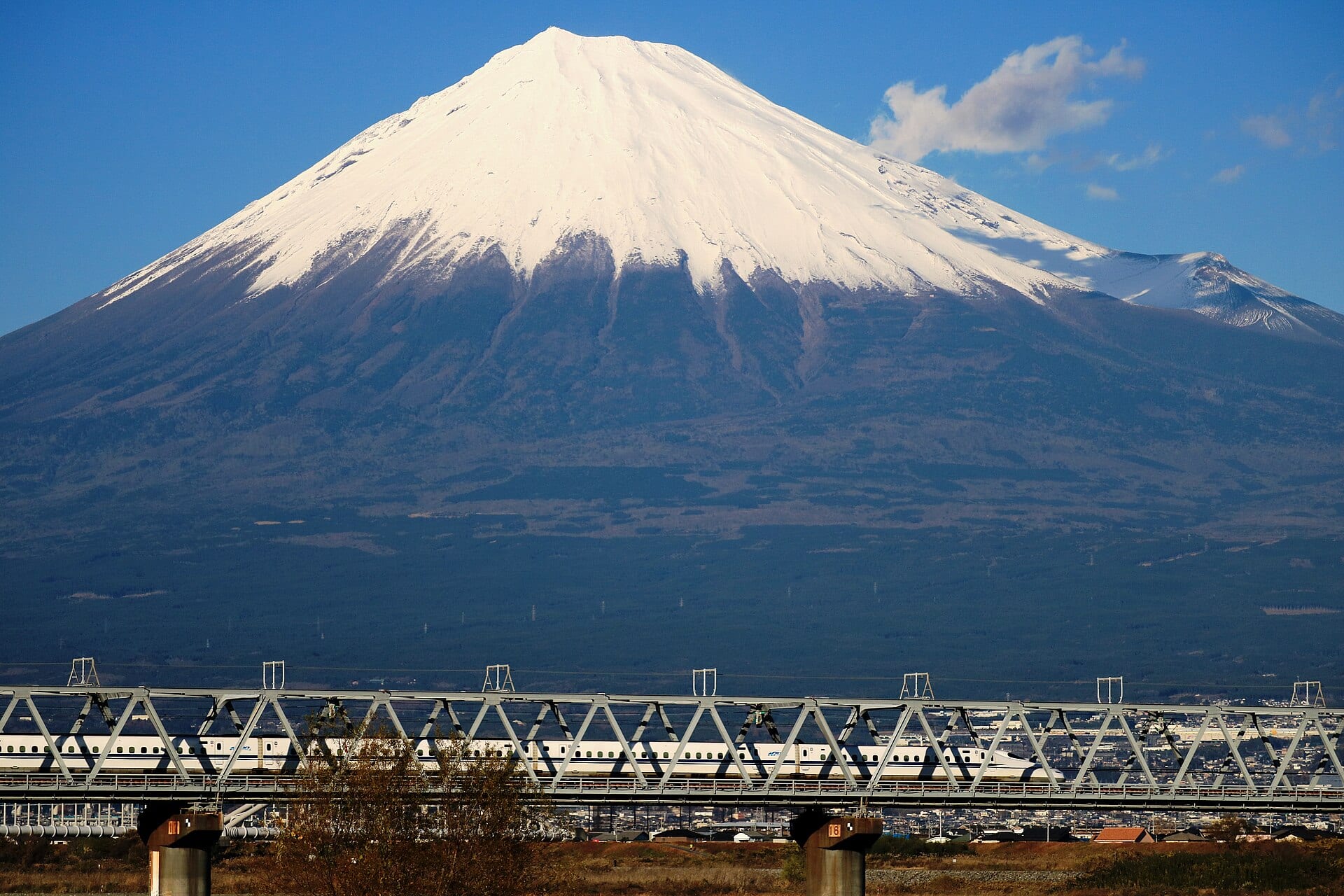
Mount Fuji is on the E-seat side: on your right heading for Osaka, on your left heading for Tokyo.
Standard cars on the Tokaido Shinkansen have rows of three seats (A, B, C) and two (D, E) either side of the aisle. Fuji appears on the E side. After Mishima the train runs through hills of tea fields, the mountain rises behind Mount Ashitaka, and around the Fuji River bridge just before Shin-Fuji the whole cone comes into view. Norimono News recommends the morning, when cold air is clearest. From the A side, Fuji appears for just a moment on the left in one stretch, a view known as hidari-Fuji, "Fuji on the left".

- Two travelling together: the D-E pair.
- Easy in and out: aisle seats C or D.
- Family of three: A-B-C together.
- Big luggage: the last row of a car, which has the oversized-baggage space behind it (see below).
For why Fuji means so much in Japan, see the strange story of Mount Fuji.
What about big suitcases?
On the Tokaido, Sanyo, Kyushu and Nishi-Kyushu Shinkansen, luggage with a combined length, width and height of 161 to 250 cm is "oversized" and needs a reservation.
JR Central says you reserve a "seat with an oversized baggage area" when you buy your ticket; it costs the same as an ordinary reserved seat. Bring oversized luggage without a reservation and you pay a ¥1,000 fee (tax included) on board and store it where the conductor tells you. Anything over 250 cm cannot be brought on. Pushchairs, musical instruments and sports equipment are exempt from the oversized rule, but you still need a reservation to use the baggage space.
Bags up to 160 cm go on the overhead rack.
How should I behave on board?
Take calls in the vestibule, ask before you recline, and take your rubbish with you.
- Phone calls: step out to the vestibule at the end of the car before answering.
- Reclining: a quick word to the person behind first (taoshite mo ii desu ka?, "may I recline?"). If they are eating, wait a moment.
- Food and drink: ekiben and a beer are part of the experience. Go easy on very strong smells.
- Rubbish: bag it up and use the bins in the vestibule or at your station.
- Turning seats: groups can swivel a row to face each other; check with whoever is behind first, and turn it back when you leave.
For manners on platforms and local trains, see train, bus and taxi etiquette in Japan.
Where do I buy an ekiben, and where did they come from?

At shops inside the station you leave from. At Tokyo Station, Ekiben-ya Matsuri is the best known.
Accounts differ on the first ekiben. JR East's own media site says it is generally held to be the one sold at Utsunomiya Station on the Nippon Railway, which opened on 16 July 1885: two rice balls with pickled plum, sprinkled with black sesame, and two slices of pickled radish, wrapped in bamboo sheath. The Kobe Shimbun notes rival claims for Kobe and Ueno stations, but reports that the Utsunomiya story is the most widely accepted.
The pleasure of ekiben is that a whole region's ingredients and ingenuity fit in one box. Leave from Kanazawa on the Hokuriku Shinkansen and you might eat grilled blackthroat seaperch; leave from Sendai and it might be beef tongue. For more regional food, see beyond sushi: Japan's regional cuisine.
What is the "7-minute clean" at Tokyo Station?
The work of the crews who turn round Tohoku, Joetsu, Hokuriku and other Shinkansen trains at Tokyo Station in very little time.
At Tokyo Station a train sometimes has only about 12 minutes between arriving and leaving again. Getting passengers off and on takes at least five, which leaves about seven for cleaning and servicing (Gendai Business, 2019): rubbish collected, seats turned, toilets cleaned, lost property checked. Overseas media have called it the "7-minute miracle". The same article points out that the speed is less a choice than something forced by the timetable and the station's limits.
Bagging your rubbish and turning your seat back before you leave is a small way of respecting that work.
What is new on the Shinkansen in 2026?
On 1 October 2026, private cabins above Green Car class, called Supreme Class, began running on the Tokaido and Sanyo Shinkansen.
According to JR Central, the cabins are in car 7 (up to two people) and car 10 (one person) and are booked through Smart EX. One way between Tokyo and Shin-Osaka on a Nozomi in regular season, per adult, the single cabin in car 10 is ¥42,390 and car 7 is ¥60,790. The March 2026 timetable also added the first Nozomi ever to start from Kyoto, a seasonal train leaving at 6:03.
For the line that comes next, the Chuo maglev, see Linear Chuo Shinkansen and the water dispute that held it up.
What does the Shinkansen teach about travel?
Air travel tries to make the time between departure and arrival disappear. Two hours on the Shinkansen don't. Tea fields slide past, Fuji appears, and the lid comes off a box that tastes of a town you haven't reached yet. The journey itself becomes a way of getting to know the country.
Those two hours rest on a lot of people you never see: drivers and controllers keeping the timetable, the crews turning trains round in minutes, the kitchens packing ekiben before dawn. Enjoying the Shinkansen is partly a matter of noticing them. For how Japanese trains keep such precise time, see why Japanese trains run on time.
A checklist before you ride
- Reserved seat booked on Smart EX or JR-EAST Train Reservation.
- Know that Nozomi is all-reserved in peak seasons.
- Using a JR Pass on a Nozomi or Mizuho? Buy the Nozomi/Mizuho ticket.
- Luggage over 160 cm? Reserve a seat with an oversized-baggage area.
- Want Fuji? Pick seat E, ideally on a clear morning.
- Buy your ekiben before boarding.
- Calls in the vestibule; ask before reclining.
Common slips, and how to recover
- Unreserved cars full? Wait for the next Hikari or Kodama, or check the ticket machine for spare reserved seats.
- Brought a big case without a reservation? Follow the conductor's directions and pay the ¥1,000 fee. Reserve next time.
- Boarded a Nozomi on a JR Pass without the extra ticket? Tell the conductor and pay the difference.
- Missed your stop? Tell the conductor, who will sort out the extra fare and how to get back.
Frequently asked questions
Can I ride without a reservation?
Yes, on trains with unreserved cars. But in peak seasons every Nozomi is all-reserved and an unreserved ticket won't get you a seat.
Which side is Mount Fuji on?
The E-seat side of the Tokaido Shinkansen: right towards Osaka, left towards Tokyo. Look out between Mishima and Shin-Fuji, around the Fuji River bridge.
Can I eat on the Shinkansen?
Yes. Ekiben are one of the joys of the trip. Take your rubbish with you or use the vestibule bins.
What do I do with a big suitcase?
If it measures 161 to 250 cm in total, reserve a seat with an oversized-baggage area on the Tokaido, Sanyo, Kyushu and Nishi-Kyushu lines. Without one, there is a ¥1,000 fee.
Has the Shinkansen really never had a fatal accident?
No passenger on board has died in a derailment or collision. But people have died in the 1995 Mishima Station accident and in the 2015 and 2018 attacks on board.
What happens in an earthquake?
When seismometers detect the start of a quake, the emergency brakes are applied automatically. Follow the crew's instructions. For emergency contacts while travelling, see what to do in an emergency in Japan.
Sources and dates checked (all checked on 2026-10-26)
- JR Central, "About the Tokaido Shinkansen" (no accidents causing death or injury to passengers on board; FY2023 trains, passengers and delay; 285 km/h; Tokyo-Shin-Osaka 2:21; about 7 billion passengers since 1964) — global.jr-central.co.jp/en/company/about_shinkansen (primary)
- JR Central, Annual Report 2025 (FY2024: 383 trains a day including extras, 460,000 passengers a day) — company.jr-central.co.jp/ir/annualreport/_pdf/annual… (primary); Taiwan Public Television (383 trains a day in 2024) — news.pts.org.tw/article/771314
- nippon.com, "The Tokaido Shinkansen's world-class safety, reliability and frequency" (25 May 2018) — nippon.com/en/features/h00201
- March 2026 timetable change: Impress Travel Watch — travel.watch.impress.co.jp/docs/news/2070933.html ; Tabiris — tabiris.com/?p=59693 ; Tabi-mag, first Kyoto-origin Nozomi — tabi-mag.jp/nozomi548
- Tokyo-Kyoto journey time: Ekitan, "Shinkansen from Kyoto to Tokyo" (1 April 2026) — ekitan.com/en/article/kyoto-to-tokyo-s… ; JR Tokai Tours leaflet (April 2026 information) — gotokyo.org/book/wp-content/uploads/202…
- JR East, E5 Hayabusa (320 km/h from 16 March 2013) — jreast.co.jp/morioka/e510 (primary); Tetsudo.com — tetsudo.com/report/230
- Beijing-Shanghai 350 km/h (from 21 September 2017): Railway PRO — railwaypro.com/wp/350-kmh-resumed-beijing-… ; Yicai Global — yicaiglobal.com/news/fuxing-trains-carry-46…
- Mishima Station, 1995: Seattle Times (AP, 28 December 1995) — archive.seattletimes.com/archive/19951228/2159969/te… ; Wikipedia, "Mishima Station incident" — en.wikipedia.org/wiki/Mishima_Station_incide…
- 2015 on-board fire: Norimono News — trafficnews.jp/post/41259 ; Toyo Keizai Online — toyokeizai.net/articles/-/77588
- 2018 stabbing: J-CAST News (June 2018) — j-cast.com/2018/06/11331041.html ; Norimono News (government measures) — trafficnews.jp/post/80991/4 ; Toyo Keizai Online — toyokeizai.net/articles/-/224678
- 2022 Fukushima earthquake derailment: Japan Transport Safety Board report RA2024-1-1 — jtsb.mlit.go.jp/railway/rep-acci/RA2024-1-1… (primary); Toyo Keizai Online — toyokeizai.net/articles/-/539930
- Early earthquake detection: JR West, "Strengthening early earthquake detection using seafloor seismometer data" (30 October 2017, MLIT-hosted; P-wave detection and emergency braking) — mlit.go.jp/common/001214991.pdf (primary); JR East (7 April 2023) — jreast.co.jp/press/2023/20230407_ho01.pd… (primary)
- JR Central and JR West, all-reserved Nozomi periods in FY2026 (7 January 2026; Smart EX and Express Reservation up to one year ahead) — jr-central.co.jp/news/release/_pdf/000044849… (primary); Tetsudo Channel — tetsudo-ch.com/13020406.html
- Japan Rail Pass official site (prices; Nozomi/Mizuho ticket) — japanrailpass.net/en/purchase/price , japanrailpass.net/en/use/special-ticket (primary)
- Mount Fuji views: Norimono News (14 February 2020) — trafficnews.jp/post/93280/5 ; Tabi-mag, "hidari-Fuji" — tabi-mag.jp/shinkansen-leftfuji
- JR Central, "Oversized baggage" (161-250 cm, reservation, ¥1,000) — global.jr-central.co.jp/en/info/oversized-baggage (primary); Tabiris — shinkansen.tabiris.com/baggage160.html
- Origins of ekiben: JR East media (updated 8 January 2025) — media.jreast.co.jp/articles/2604 (primary); Kobe Shimbun — kobe-np.co.jp/news/tajima/202103/sp/00141…
- Tokyo Station cleaning: Gendai Business (4 September 2019) — gendai.media/articles/-/66967 ; Japan Today — japantoday.com/category/lifestyle/view/shi…
- JR Central, "Supreme Class" (from 1 October 2026; cars 7 and 10; fares) — global.jr-central.co.jp/en/supremeclass (primary); The Nation, Thailand (Jiji Press) — nationthailand.com/news/40068597 ; nippon.com (Jiji Press, Spanish edition) — nippon.com/es/news/yjj2026061701056
- Images: Wikimedia Commons file pages (licences checked) — commons.wikimedia.org/wiki/File:Mount_Fuji_and_Sh… , commons.wikimedia.org/wiki/File:Series-N700S_743-… , commons.wikimedia.org/wiki/File:たかのののどぐろめし(金沢駅)20…
By J-Times Editorial (information as of 2026-10-26)
About this article
- By
- J-Times Editorial
- Published
- Updated
Sources are cited in the text and at the end. If you spot an error, please tell us. Editorial policy & corrections
J-Times is published by Jon&Coo Inc.
Written by
J-Times Editorial
J-Times 編集部 / J-Times Editorial Team