
J-Times Editorial
J-Times 編集部 / J-Times Editorial Team
Japan's regional food goes far beyond sushi: the farm ministry lists 1,365 local dishes. A practical guide to eating three classics where they began, Sanuki udon in Kagawa, ramen at Fukuoka's yatai stalls and soba in Nagano, plus a seasonal list and seven steps for finding local food.
Read this article to earn +5 MTC
Short answer (as of 2026-10-26): Japan's regional cooking is so varied that the Ministry of Agriculture, Forestry and Fisheries' online database lists 1,365 local dishes across all 47 prefectures (as of March 2022). Three famous ones, Kagawa's Sanuki udon, Fukuoka's street-stall ramen and Nagano's soba, are best eaten where they were born, and a little know-how helps. At a self-service udon shop you pick up your own tempura and pay at the end. Fukuoka's street stalls (yatai) must display prices and may not serve raw fish under city rules. Nagano's new-season soba appears from mid-October to early November.
This is a full rewrite of a short article we published in March 2026. Claims we could not verify, such as "over 600 udon shops in Kagawa", "from 200 yen" and "Nagano's buckwheat is the world's best", have been replaced with official statistics or removed, and every figure is dated.
Abroad, "Japanese food" usually means sushi and ramen. Much of what Japanese people actually eat is plainer and more local. In mountain valleys where rice would not grow, people kneaded flour into noodles and dumplings; on cold coasts they salted fish to make sauce. Regional dishes are a record of how people made the most of where they lived.

What counts as regional food, and how much is there?
Regional dishes (kyodo ryori) are foods made from local produce and handed down through local life and festivals. The farm ministry's database "Our Regional Cuisines" covers all 47 prefectures with 1,365 dishes (March 2022), each with its history and a recipe, and it has an English version.
The ministry launched the database in 2020 and aimed for about 30 dishes per prefecture. Separately, Japan's Agency for Cultural Affairs certifies food traditions passed down locally as "100-year foods"; 329 had been certified when we checked on 26 October 2026.
Visitors are interested. A 2022 survey by the Development Bank of Japan and the Japan Travel Bureau Foundation, cited by the farm ministry, found "eating local dishes" (51%) was the second most popular thing foreign visitors wanted to do on trips to rural Japan, just behind hot springs and nature (52%).
The database's histories show a few recurring reasons these dishes exist:
- Making do without rice. Yamanashi's hoto, wide noodles stewed with pumpkin in miso, was eaten as a staple in mountain areas where rice did poorly. Nagano's oyaki dumplings came from the same need.
- Preserving the catch. Akita's shottsuru is a fish sauce made by salting sandfish for a year or more, a substitute when soy sauce was expensive.
- Feast days. In Kagawa, people traditionally made udon by hand for New Year, festivals and guests.
- Making foreign food local. Fukuoka's chicken hotpot, mizutaki, is said to have grown out of Chinese-style chicken stews and Western soups that arrived through Nagasaki.
Sanuki udon (Kagawa): why here, and how do you order?
Kagawa has more soba and udon restaurants per head than any other prefecture: 5.08 per 10,000 people against a national 1.99 (2021 economic census). Its capital, Takamatsu, also spends the most per household on udon and soba, both at home and eating out (2024 household survey).
According to Kagawa Prefecture, a Takamatsu household spent ¥6,582 a year on fresh udon and soba (1.8 times the national average) and ¥16,156 eating them out (2.1 times). The prefecture notes that the census counts restaurants only, so noodle makers that also serve customers may be classed as manufacturers and left out. That is why we have dropped the old "over 600 shops" figure.
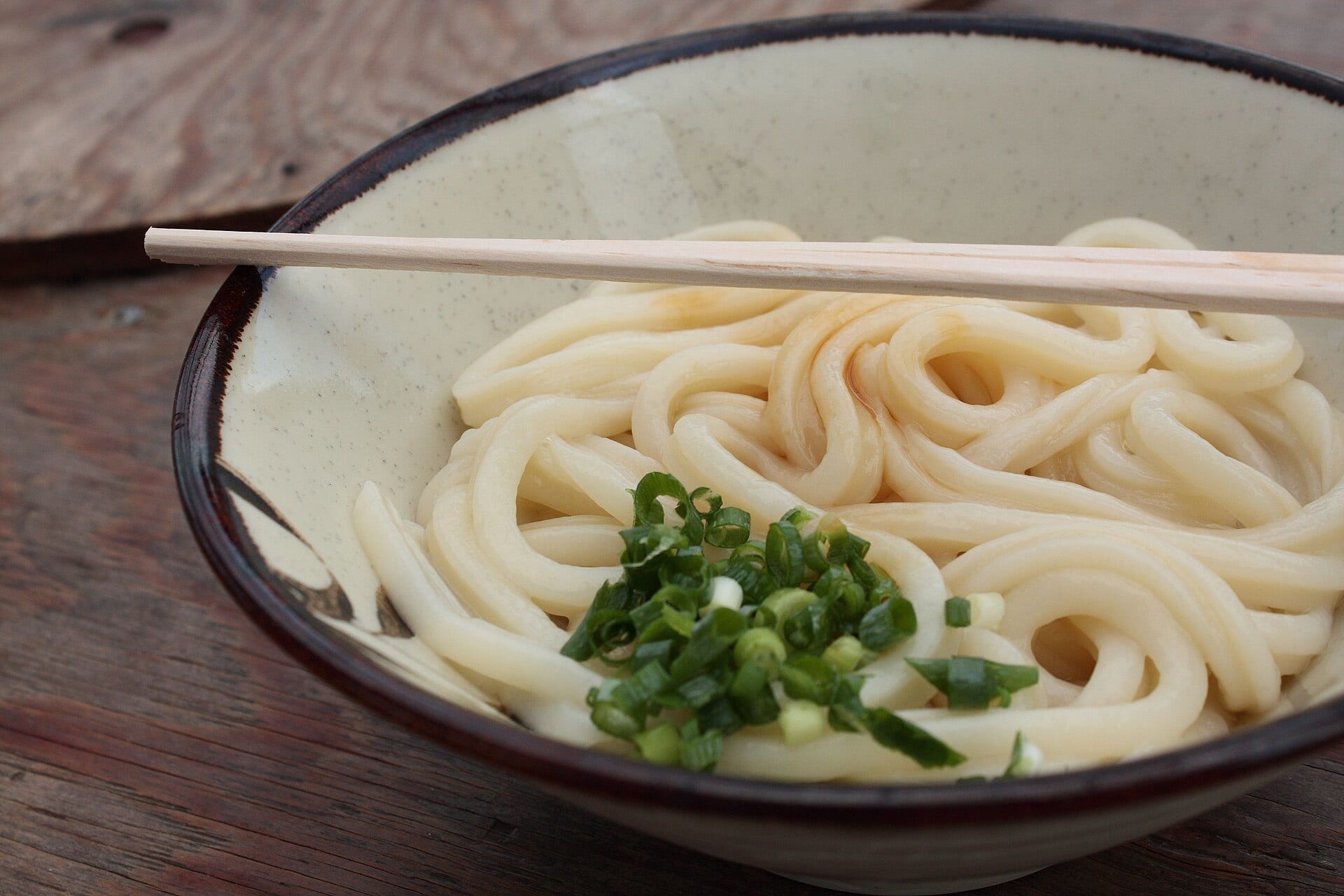
The farm ministry's database explains why udon took root here: little rain and a mild climate suited wheat; the Inland Sea around Ibuki Island yielded the anchovies used for iriko stock; and shallow beaches supported salt-making, which in turn supplied soy sauce brewers on Shodoshima. An Edo-period screen painting of the Konpira festival already shows udon shops. Kagawa now grows its own wheat variety for udon, Sanuki no Yume. In winter, look for shippoku udon, topped with root vegetables and fried tofu simmered in anchovy stock.
How a self-service shop works (it varies)
- Take a tray, and a glass of water if offered.
- Order your noodles: the size (one portion varies by shop), hot or cold, and style, such as kake (in broth), kama-age (straight from the pot, with dipping sauce) or bukkake (with a splash of strong sauce).
- Help yourself to tempura or rice balls.
- Add toppings such as spring onion, tempura crumbs and ginger, usually free.
- Pay at the till.
- Return your tray to the counter when you finish.
Common mistakes: arriving in mid-afternoon to find the shop sold out and closed; finding a noodle maker's shop open only from early morning to lunchtime; or carrying no cash. Check hours and payment before you go, and start early.
Fukuoka's yatai: what are the rules?
Fukuoka city has 100 street stalls (1 April 2026), down from more than 400 at their peak in the decade from the mid-1960s. To stop the decline, the city passed a yatai ordinance in 2013, set operating rules and now recruits new stall-keepers by open application.
The city says stalls used to cause late-night noise, smells, blocked pavements and illegal sub-letting of permits, so it wrote rules and decided to keep them as "an important attraction". New operators are chosen by an independent panel; the sixth round, which closed in June 2026, drew 102 applicants for 23 pitches, which open in April 2027.

The city's guidance for customers:
- Stalls start setting up in the early evening; wait until they are ready.
- If a stall is full, wait somewhere that does not block the pavement. Stalls may not put tables or chairs outside their footprint.
- No raw food: sashimi, potato salad and okyuto (a seaweed jelly) cannot be served.
- Stalls must display a menu with prices. Check before ordering, and query the bill on the spot if something looks wrong.
- Ask the stall where the toilet is.
- Keep your voice down: people live nearby.
Ordering Fukuoka ramen
Fukuoka Prefecture's tourism site says tonkotsu (pork-bone) ramen began in Kurume, and that the very thin noodles and kaedama, ordering a second serving of noodles into your remaining soup, spread from stalls in Nagahama by the fish market, where workers needed food fast. Thin noodles cook quickly.
- Choose your noodle firmness, from firmest: kona-otoshi, harigane, barikata, kata, futsu (normal), yawa. Say nothing and you get normal.
- Order kaedama just before you finish the first bowl, while the soup is hot. At ticket-machine shops, buy the kaedama ticket in advance.
- Season as you go with the pickled mustard greens, red ginger and sesame on the counter.
Away from the stalls, try mizutaki and gameni (chicken and vegetables simmered together); both are on the farm ministry's list of 100 representative regional dishes.
Shinshu soba (Nagano): is it local buckwheat?
Nagano is regarded as the birthplace of soba noodles. But only about 30% of the buckwheat eaten in Japan is grown in Japan (fiscal 2025), and Hokkaido, not Nagano, is the largest producer. "Shinshu soba" on a label does not by itself tell you where the buckwheat grew.
The farm ministry says the earliest written record of buckwheat noodles is in documents at Josho-ji temple in Okuwa, Kiso district, Nagano. In 2025 Japan harvested 38,200 tonnes of buckwheat: 16,800 tonnes in Hokkaido and 2,490 tonnes in Nagano, fourth among prefectures. Most imports come from China and the US. If local flour matters to you, check the menu or ask.
According to the ministry, buckwheat suited Nagano's cold highlands, where rice and wheat struggled; the best is said to come from foggy land around 700 metres up.

Tips for soba in Nagano:
- Go for new-season soba (shin-soba), which appears from about mid-October to early November.
- Try local styles. Togakushi serves soba in small bundles; Ina's Takato soba comes with a dip of grated-radish juice and grilled miso; Nagawa's toji soba is dipped in a hot pot of broth in a small bamboo basket.
- The wasabi is local too: over 90% of Nagano's wasabi comes from Azumino, the ministry says.
- Slurping is fine. For more on table manners, see Dining manners in Japan and Chopstick etiquette.
What other regional dishes are worth travelling for?
Match the season to the place. All of these are described, with their origins and seasons, in the farm ministry's database.
| Prefecture | Dish | What it is | When |
|---|---|---|---|
| Akita | Kiritanpo nabe | Pounded rice grilled on sticks, simmered in chicken stock; from Odate and Kazuno | New-rice season, as a harvest meal |
| Akita | Shottsuru nabe | Sandfish hotpot seasoned with fish sauce | November-December, when sandfish are caught |
| Yamanashi | Hoto | Wide noodles stewed with pumpkin in miso | All year, more in winter |
| Nagano | Oyaki | Wheat or buckwheat dumplings filled with seasonal vegetables, grilled or steamed | All year; essential at Obon in northern Nagano |
| Fukuoka | Mizutaki, gameni | Bone-in chicken hotpot; chicken and vegetables simmered | All year, and at festivals |
| Hiroshima | Okonomiyaki | Thin batter layered with cabbage, pork and noodles | All year; eaten from the hotplate with a spatula |

Hiroshima Prefecture has the most okonomiyaki restaurants per 100,000 people in Japan (2014 economic census), the farm ministry notes. The dish grew out of a prewar snack, issen yoshoku, after the war, helped by the many ironworks that made hotplates easy to come by. Even within Hiroshima it varies: Kure's version uses thin local udon, and Shobara's is eaten with ponzu.

Seven steps to finding regional food on your trip
- Look up your destination in the farm ministry's regional food database (English version available) or the Agency for Cultural Affairs' 100-year foods.
- Match the season. New soba, sandfish and new-rice kiritanpo all have clear seasons. See Japan's four seasons.
- Check opening hours and closing days. Udon makers may open at dawn and close at lunch; yatai open in the evening.
- Check how to pay. Small shops and stalls may take cash only. No tipping: see Tipping in Japan.
- Plan transport. The best places are often away from stations; see Getting around Japan.
- Ask your inn. Ryokan and guesthouse staff know where locals eat and what is in season.
- Point and ask. "Osusume wa dore desu ka?" ("What do you recommend?") usually gets a helpful answer.
Common mistakes: arriving at a famous shop at noon and losing an hour to the queue; occupying a small stall with a big group for a long time; being loud or photographing people in markets and residential streets; and judging the local version against what you ate in Tokyo. For travel beyond the big cities, see Beyond overtourism: Japan's quieter towns and Beyond Tokyo and Kyoto.
A Japanese view: why eat it where it was born?
Few of these dishes came from plenty. Most grew from a shortage: no rice, long winters, expensive soy sauce. Families and shopkeepers then served them at festivals, at New Year and to guests, and kept making them for generations. You can eat udon in Tokyo. Going to the source means joining, briefly, the rhythm of a place: the noodle maker at work before dawn, the stalls going up at dusk, the fog over a buckwheat field. For the flavour behind it all, see What is umami?, and for Japanese food abroad, After sushi, which Japanese foods are growing abroad?
Frequently asked questions
How much does a bowl of udon cost in Kagawa? Prices vary by shop and size and change over time, so we do not list them. Most shops display prices clearly.
What hours do Fukuoka's yatai keep? Each stall sets its own. According to the city, stalls start setting up in the early evening. Days off vary too, so check before you go.
Can I order sashimi at a yatai? No. City rules ban raw food at stalls.
Is "Shinshu soba" made with Nagano buckwheat? Not necessarily. About 70% of the buckwheat eaten in Japan is imported, and sources vary by shop and product.
Where can I look up regional dishes in English? The farm ministry's "Our Regional Cuisines" site has an English version searchable by prefecture.
Sources and dates checked (all checked on 2026-10-26)
- MAFF, "Our Regional Cuisines" database (Japanese and English), dish pages for shippoku udon (Kagawa), hand-made soba and oyaki (Nagano), hoto (Yamanashi), gameni and mizutaki (Fukuoka), kiritanpo nabe and shottsuru nabe (Akita), okonomiyaki (Hiroshima) — maff.go.jp/j/keikaku/syokubunka/k_ryou… , maff.go.jp/e/policies/market/k_ryouri/… , e.g. maff.go.jp/j/keikaku/syokubunka/k_ryou… (primary)
- Washoku Culture Network Kyushu newsletter (MAFF announcement: 1,365 dishes, all prefectures, March 2022) — maff.go.jp/kyusyu/syokuryou/syokubunka… ; Newswitch (Nikkan Kogyo) — newswitch.jp/p/35268
- Agency for Cultural Affairs, "What are 100-year foods?" (329 certified) — bunka.go.jp/seisaku/shokubunka/foodcult… (primary)
- MAFF, food culture and inbound tourism (DBJ/JTBF 2022 survey: local dishes 51%) — maff.go.jp/j/nousin/kouryu/nouhakusuis… (primary)
- Kagawa Prefecture statistics: soba/udon restaurants per 10,000 people (2021 economic census) and household spending on udon and soba (2024 household survey) — pref.kagawa.lg.jp/tokei/sogo/udonken/0001.htm… , pref.kagawa.lg.jp/tokei/sogo/udonken/0004.htm… (primary); Japan Health Insurance Association Kagawa column — kyoukaikenpo.or.jp/shibu/kagawa/assets/202604c…
- Self-service udon ordering guide (Kagawa shop guide) — kagawan.com/?p=716
- Fukuoka City, yatai Q&A; selection committee paper, 23 April 2026 (100 stalls on 1 April 2026); sixth recruitment results, 12 June 2026; customer rules leaflet — city.fukuoka.lg.jp/keizai/yatai/charm/yataiQA.… , city.fukuoka.lg.jp/keizai/yatai/shisei/documen… , city.fukuoka.lg.jp/shisei/kouhou-hodo/hodo-hap… , city.fukuoka.lg.jp/keizai/kankou/shisei/docume… (primary)
- Fukuoka Prefecture Tourism Association, Crossroad Fukuoka, tonkotsu ramen feature (origins, firmness, kaedama) — crossroadfukuoka.jp/feature/noodles (primary); tabi-mag, Ganso Nagahamaya — tabi-mag.jp/fu0363
- MAFF, "The situation of buckwheat", July 2026 (Josho-ji record, 2025 harvest by prefecture, 30% domestic share, import sources) — maff.go.jp/j/seisan/tokusan/attach/pdf… (primary)
- Images: Wikimedia Commons file pages (licences checked) — commons.wikimedia.org/wiki/File:Kama-age_sanuki_u… , commons.wikimedia.org/wiki/File:Yatai_beside_Naka… , commons.wikimedia.org/wiki/File:160430_Togakushi_… , commons.wikimedia.org/wiki/File:Traditionnal_nabe… , commons.wikimedia.org/wiki/File:Prepared_okonomiy…
By J-Times Editorial (information as of 2026-10-26)
About this article
- By
- J-Times Editorial
- Published
- Updated
Sources are cited in the text and at the end. If you spot an error, please tell us. Editorial policy & corrections
J-Times is published by Jon&Coo Inc.
Written by
J-Times Editorial
J-Times 編集部 / J-Times Editorial Team