J-Times Editorial
J-Times 編集部 / J-Times Editorial Team
In Japan, call 110 for police and 119 for fire or an ambulance; both can bring in an interpreter. Here is what else to dial, what to do when an Earthquake Early Warning sounds, and how to find an evacuation site, checked against official sources.
Read this article to earn +5 MTC
What to do in an emergency in Japan: the numbers, the hotline, and where to go
Short answer (as of 2026-10-02): Call 110 for the police and 119 for fire or an ambulance. Both can bring an interpreter onto the call. For help that is not life-or-death, call the JNTO Japan Visitor Hotline on 050-3816-2787. It runs 24 hours a day, in English, Chinese and Korean.
Disclosure: J-Times and Matsuri are both operated by Jon&Coo Inc. The last part of this guide describes Matsuri's free emergency page, which belongs to our own service. Every other fact here comes from government and public-agency sources, listed at the end with the date we checked them (2 October 2026).
Most trips to Japan pass without trouble. But this is a country of earthquakes, typhoons and heavy rain, and travellers also fall ill, get hurt and lose their way like anyone else. What often catches visitors out is not knowing which number to dial or what an alarm on their phone means. This guide takes the questions in the order you are likely to face them.
Which number do I call in Japan?
Dial 110 for the police and 119 for fire or an ambulance. Japan has no single 911-style number, so the call goes to whichever service you dial.
| Number | What it is for | Who answers |
|---|---|---|
| 110 | Crime, traffic accidents, anything that needs the police now | Police |
| 119 | Fire, injury, sudden illness (ambulance) | Fire department |
| 118 | Accidents and incidents at sea | Japan Coast Guard |
| #7119 | "Should I call an ambulance or go to hospital?" (in areas that run it) | Doctors, nurses and paramedic staff |
| 050-3816-2787 | Japan Visitor Hotline: emergencies, disasters, finding a hospital, general travel help | JNTO, 24 hours, English, Chinese and Korean |
| 171 | Disaster voice message board, opened after a major disaster | NTT and other phone carriers |
The Tokyo Metropolitan Police tell anyone who is a victim of, or witness to, a crime or traffic accident to dial 110. The Japan Coast Guard runs 118 for emergencies at sea. In 2019, 1,919 maritime accidents were first reported to the Coast Guard through 118. JNTO describes its Japan Visitor Hotline as "support in the event of emergencies such as illness, disaster, etc., and general tourism information". From outside Japan, the number is +81-50-3816-2787.
Can I call 110 or 119 if I don't speak Japanese?
Yes. Most fire departments in Japan can bring an interpreter onto a 119 call, and Tokyo's police and fire services both say they can help callers who don't speak Japanese.
Japan's Fire and Disaster Management Agency (FDMA) surveyed fire departments in early 2025. As of 1 January 2025, 673 of the country's 720 fire departments (93.5%) connected 119 callers to a telephone interpreting centre in a three-way call. The Tokyo Fire Department says its centre handles English, Chinese, Korean, Portuguese and Spanish this way. The Yokohama Fire Bureau offers the same languages and adds Vietnamese. On the police side, the Tokyo Metropolitan Police Department says: "If you do not speak Japanese, a police interpreter will be on the line to assist you."
Connecting an interpreter can take a moment. Yokohama asks callers to stay on the line and not hang up. These steps make the call faster:
- Say which service you need first. A 119 call in Tokyo starts with the question "Kaji desu ka, kyūkyū desu ka?" ("Fire or ambulance?"). Answer "Kaji desu" (fire) or "Kyūkyū desu" (ambulance).
- Say where you are. The Tokyo Fire Department warns that finding a mobile caller can take time. If you don't know the address, give a station, building, shop name or crossing you can see.
- Say who needs help and what happened: for example, someone has collapsed and is not responding.
If you have a Japanese speaker with you, Yokohama suggests asking them to make the call.
What if I'm not sure I need an ambulance?
In many parts of Japan you can dial #7119 and ask a medical team whether to call an ambulance, go to hospital now, or wait. If you'd rather speak English, the JNTO hotline can also point you to a hospital.
FDMA describes #7119 as a phone line where doctors, nurses and paramedic staff advise you when you can't decide whether to call an ambulance. They can also suggest first aid and a suitable hospital, and pass you to 119 if it's urgent. As of FDMA's page checked on 2 October 2026, #7119 ran in 42 areas, not the whole country. In Tokyo, the Tokyo Fire Department runs it 24 hours a day. From phones that can't dial #7119, call 03-3212-2323 in the 23 wards or 042-521-2323 in the Tama area. Neither FDMA nor the Tokyo Fire Department says which languages #7119 takes. If you need English, Chinese or Korean, call the JNTO hotline. JNTO says it can introduce "medical institutions where consultations can be done in foreign languages".
What happens when an earthquake hits?
Your phone, the TV or the radio may sound an Earthquake Early Warning seconds before strong shaking arrives. When you hear it, protect your head and get under something sturdy. Don't run outside.
The Japan Meteorological Agency (JMA) says the warning gives you only a few seconds to a few tens of seconds before strong shaking. JNTO's Safety tips page adds that you should act "even if you do not feel the vibrations". JMA's advice by situation:
- Indoors: protect your head and get under a sturdy table. Don't rush outside.
- In a shop, hall or station: follow the staff. Don't rush for the exits.
- On a train or bus: hold the strap or handrail firmly.
- In a lift: stop at the nearest floor and get out.
- Outside: watch for falling signs and glass, and for block walls that can collapse.
- Driving: turn on the hazard lights and slow down gradually. Don't brake hard.
If you are near the coast and the shaking is strong, or weak but long, JNTO's advice is to start evacuating to high ground.
Get the Safety tips app before you fly. Safety tips is a free iOS and Android app made under the supervision of the Japan Tourism Agency. According to its developer, it sends Earthquake Early Warnings (for intensity 4 or above), tsunami warnings, volcanic and weather warnings, heat-illness alerts and evacuation information in 15 languages.
Where do I go if I have to evacuate?
Go to a designated emergency evacuation site (shitei kinkyū hinan basho) that is marked for the danger you face. A "shelter" (hinanjo) is a different place, where people stay after the danger has passed.
Japan uses two words that are easy to mix up. The Cabinet Office and Japan's national mapping agency, the Geospatial Information Authority (GSI), both explain the difference:
- Emergency evacuation sites (hinan basho) are where you run to save your life. The local mayor designates each one for particular hazards. GSI's data covers eight: flood, landslide, storm surge, earthquake, tsunami, large fire, inland flooding and volcano.
- Evacuation shelters (hinanjo) are where people stay for a while after the danger, for example when their home is damaged. They are designated whatever the hazard.
The Cabinet Office notes that one building can be both.
When danger is close, GSI says to head for the evacuation site, not the shelter. Check the hazard as well. A school that is a flood site may not be an earthquake site, and an open space that is safe in an earthquake may be too low for a tsunami.
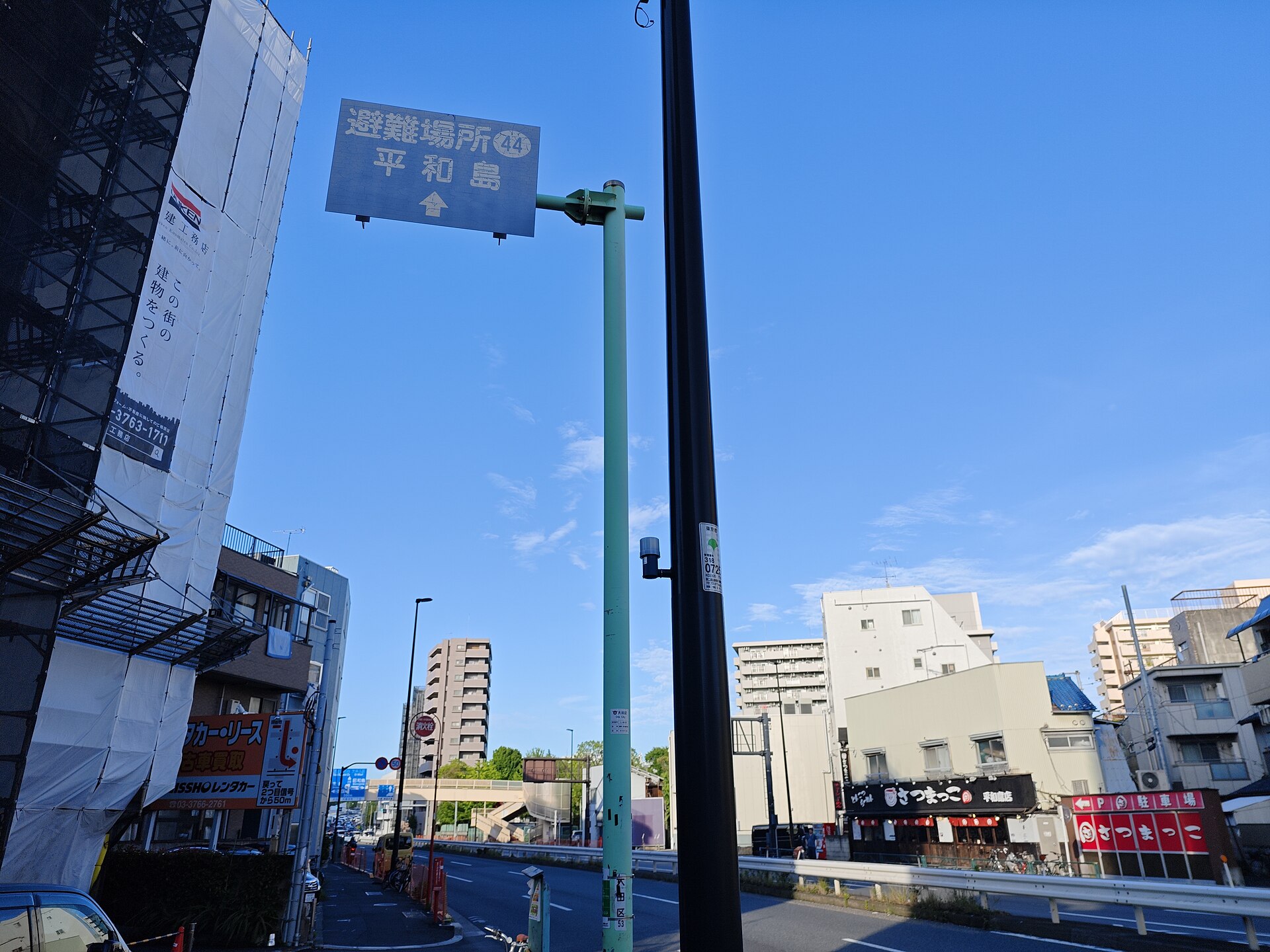
Tokyo adds another layer. To escape the large, spreading fires that can follow a major earthquake, the Tokyo Metropolitan Government designates big parks and open areas as wide-area evacuation sites (kōiki hinan basho), according to Chuo City. According to the photographer's description, the "44" on the sign below is the site's number on Tokyo's list.
If you are told to evacuate and don't know where to go, follow the signs and the instructions of local staff. Ask "Hinan basho wa doko desu ka?" ("Where is the evacuation site?").
What does Matsuri's emergency page do?
Matsuri's emergency mode (matsuri.group/en/emergency/) puts the numbers, nearby evacuation sites, first steps and point-to phrases on one free page. Once you have opened it, it opens again without signal.
We looked at the page on 2 October 2026 and checked it against the code. Here is what it does, and what it doesn't do.
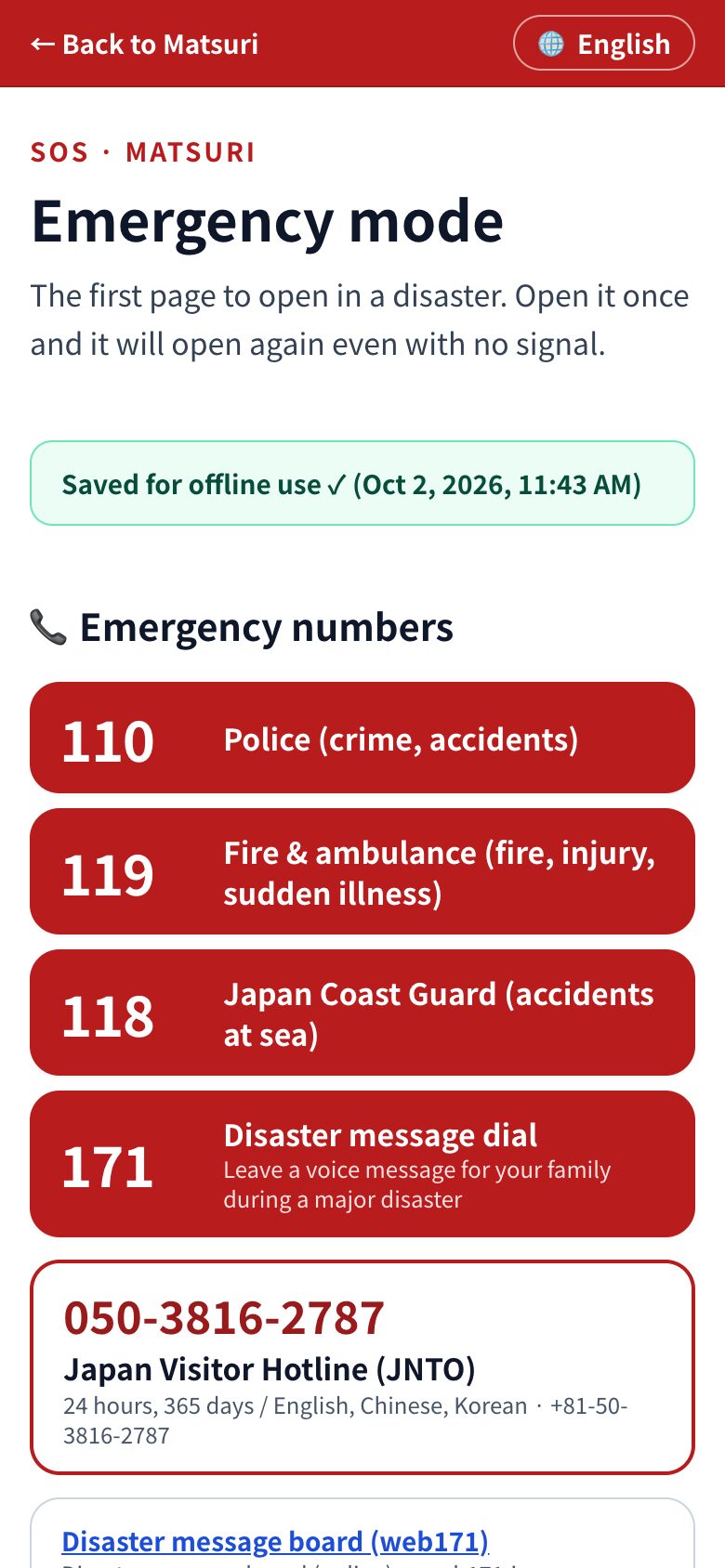
- Numbers as call buttons. 110, 119, 118, 171 and the JNTO hotline (050-3816-2787) each start a phone call when you tap them. There is also a link to web171, the online version of the disaster message board.
- Nearby evacuation sites. If you allow location access, it lists the closest designated emergency evacuation sites. Each one shows a straight-line distance, a compass direction, the hazards it is designated for, and links to open it in a maps app. The data is GSI's national list: 115,417 sites, in the version GSI updated on 12 June 2026. You can filter by hazard and search by name or address. It uses no map images, and the site data for your area is saved on your phone. That means the list keeps working offline for areas it has already loaded.
- Saved regions. You can save the prefectures you are visiting, so the list still works when you have neither signal nor a location fix.
- What to do first. Short do and don't lists for earthquake, tsunami, typhoon and heavy rain, and fire, with flood, landslide and volcano in a fold-out section.
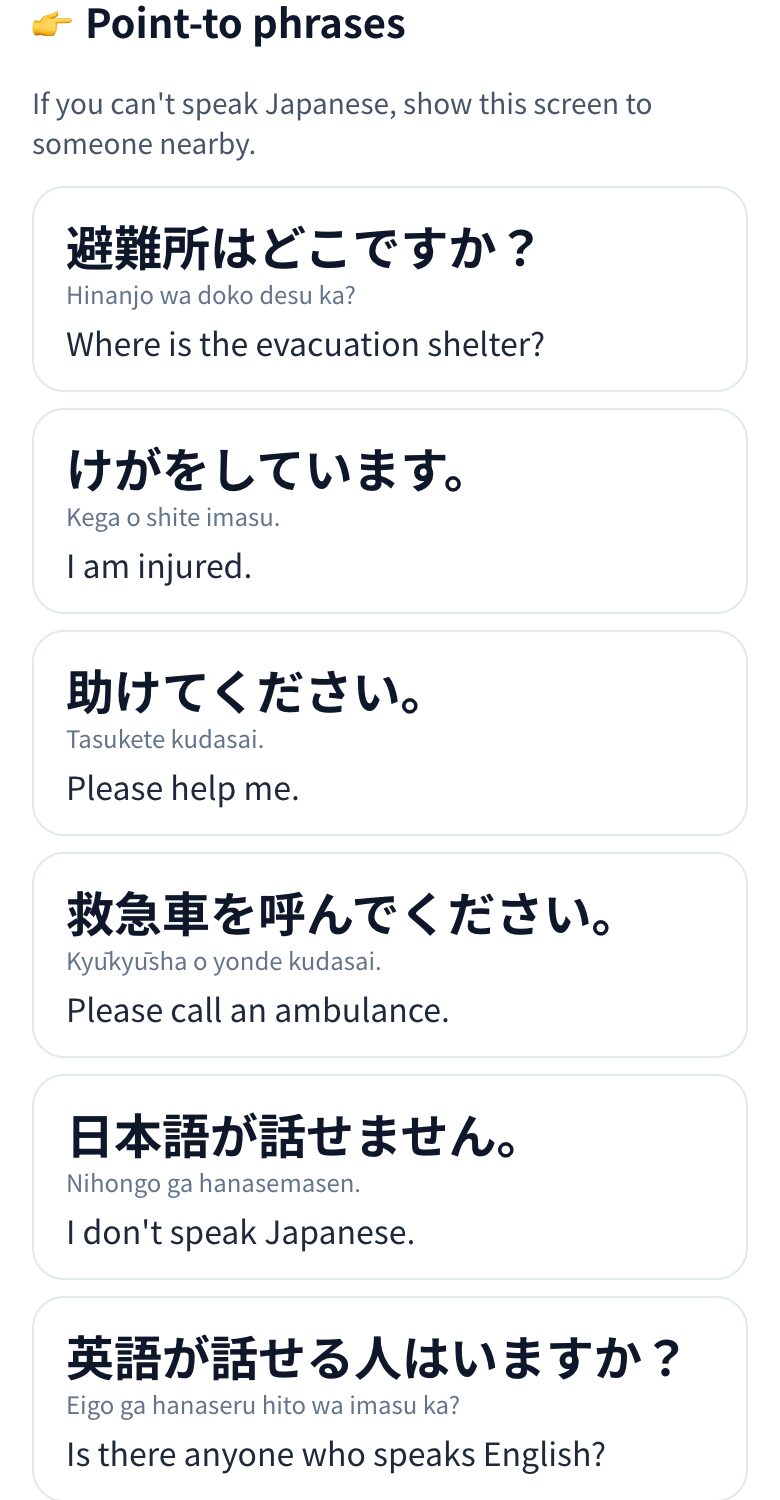
- Point-to phrases. Twelve Japanese sentences, each with romaji and a translation, to show to someone nearby: "I am injured", "Please call an ambulance", "I want to contact my embassy" and others.
- Links for live information. JMA's multilingual disaster page, NHK WORLD-JAPAN news and JNTO's Safety tips page.
- Six languages: English, Japanese, Chinese, Thai, Norwegian and Spanish.
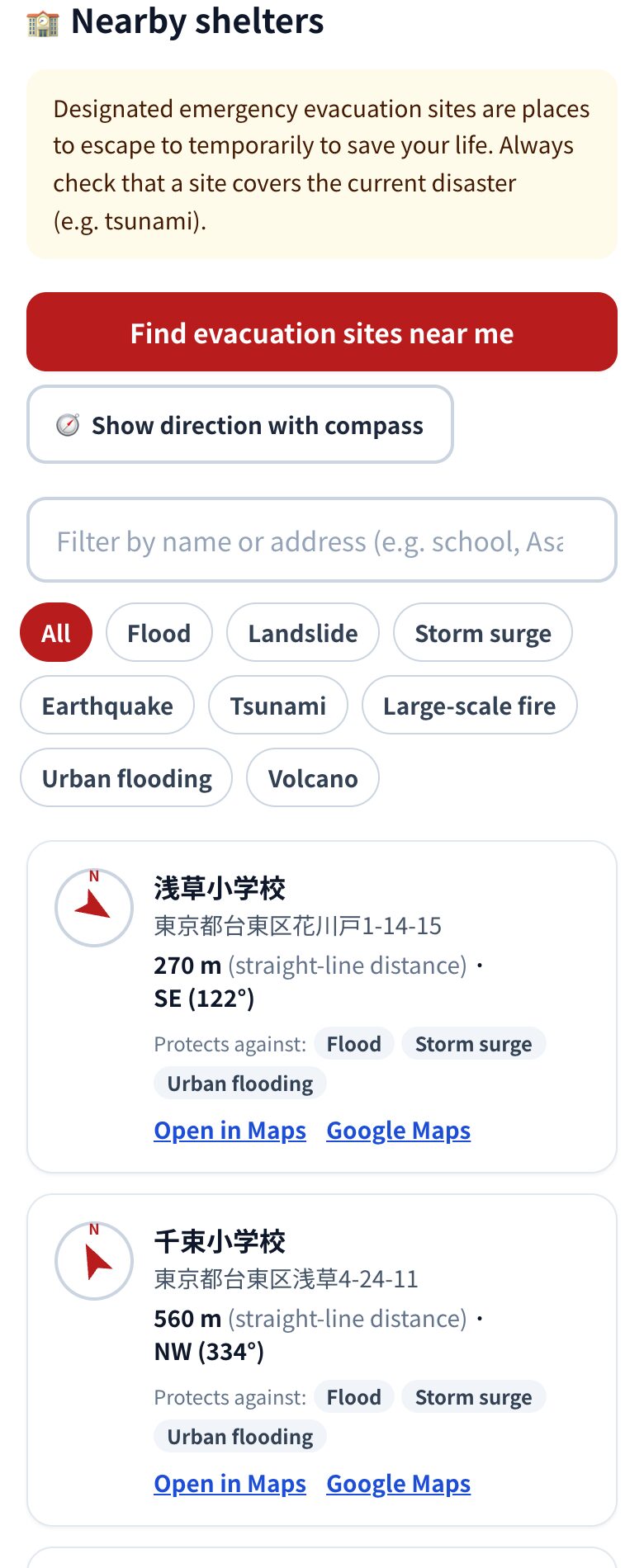
One limitation from our test. With the location set to Senso-ji in Asakusa, the nearest sites listed were neighbourhood schools designated for flood, storm surge and urban flooding. None was marked for earthquakes. With the Earthquake filter on, the nearest site listed was 2.4 km away in Chiyoda City. The list can only be as complete as the data local governments register with GSI, and the page itself says to follow on-site signs and local authorities. Use it as a starting point. In an earthquake in central Tokyo, also look for the blue wide-area evacuation site signs described above.
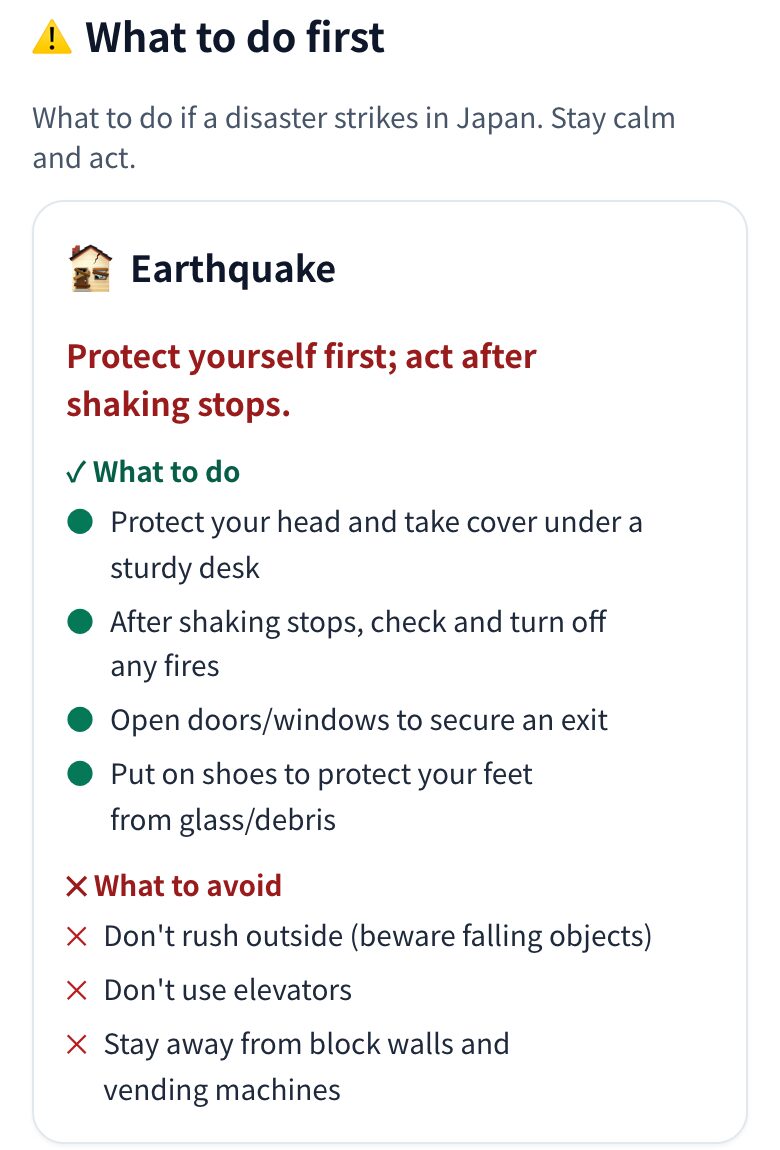
What it doesn't do. It doesn't send alerts, so it is not a substitute for the Safety tips app or your phone's warnings. It doesn't call anyone on your behalf. As of 2 October 2026 it doesn't list #7119. It is free and needs no login or booking.
How to find it. Bookmark matsuri.group/en/emergency/, or open Matsuri and go to My Page → Help → Just in case. My Page shows this row even if you are not logged in. Until 30 September 2026 a red SOS button in the site header also led to this page. It has since been moved to My Page. On an iPhone, add the page to your Home Screen and open it once from the icon while you still have signal. The page notes that the Home Screen copy is saved separately from Safari.
What should I set up before the trip?
Save the key numbers, install the Safety tips app, and open one offline-capable emergency page while you still have a connection.
- Save 110, 119 and 050-3816-2787 in your phone's contacts.
- Install Safety tips, and set the places you'll be staying.
- Open an emergency page once on hotel Wi-Fi (Matsuri's, or your own screenshots of the numbers above), so it is there when the network is not.
- Write your hotel's address in Japanese on paper or in a note, so you can tell 119 where you are.
- Know the difference between an evacuation site (run there) and a shelter (stay there later).
For why Japan's approach to disasters has drawn so much attention abroad, see How Japan's disaster preparedness is saving the world.
The Matsuri feature
This guide is part of J-Times' feature on Matsuri, the cultural-experience platform run by the same company. Start with the overview: What is Matsuri? A guide to finding cultural experiences in Japan.
Sources and dates checked
All checked on 2 October 2026.
- JNTO, Japan Visitor Hotline: https://www.jnto.go.jp/emergency/eng/mi_guide.html
- Japan Travel by JNTO, hotline page: https://www.japan.travel/en/plan/hotline/
- Tokyo Metropolitan Government Bureau of Public Health, Japan Visitor Hotline: https://www.hokeniryo.metro.tokyo.lg.jp/iryo/iryo_hoken/medical_info_eng/japan_visitor_hotline
- Tokyo Metropolitan Police Department, living guide (110 and interpreters): https://www.keishicho.metro.tokyo.lg.jp/multilingual/english/finding_services/living_guide/living_guide_e_1.html
- Tokyo Metropolitan Police Department, help hotline information: https://www.keishicho.metro.tokyo.lg.jp/multilingual/english/finding_services/help_desk/hotline_info.html
- Fire and Disaster Management Agency, three-way interpretation survey (as of 1 January 2025): https://www.fdma.go.jp/mission/enrichment/gaikokujin_syougaisya_torikumi/items/torikumi_shiryou1.pdf
- Tokyo Fire Department, how to call 119: https://www.tfd.metro.tokyo.lg.jp/lfe/119/119.html
- Tokyo Fire Department, Disaster Emergency Information Center (interpretation, Live119): https://www.tfd.metro.tokyo.lg.jp/ts/sa/info_center.html
- Yokohama City, calling 119 in a foreign language: https://www.city.yokohama.lg.jp/lang/residents/en/about-us/other/disaster/dialing_119/foreign119.html
- Fire and Disaster Management Agency, #7119: https://www.fdma.go.jp/mission/enrichment/appropriate/appropriate007.html
- Tokyo Fire Department, Emergency Consultation Center (#7119): http://www.tfd.metro.tokyo.lg.jp/lfe/kyuu_adv/soudan-center.html
- Japan Coast Guard (118): https://www.kaiho.mlit.go.jp/ and https://www.kaiho.mlit.go.jp/e/mission/saving_lives.html
- NTT East, Disaster Message Dial 171: https://www.ntt-east.co.jp/saigai/voice171/
- NTT West, Disaster Message Dial and web171: https://www.ntt-west.co.jp/dengon/
- Japan Meteorological Agency, what to do on an Earthquake Early Warning: https://www.jma.go.jp/jma/kishou/know/jishin/eew/koudou/koudou.html
- Japan Meteorological Agency, Earthquake Early Warning (English): https://www.jma.go.jp/jma/en/Activities/eew.html
- Japan Meteorological Agency, multilingual disaster information: https://www.jma.go.jp/jma/kokusai/multi.html
- JNTO, Safety tips: https://www.jnto.go.jp/safety-tips/eng/
- RC Solution (developer), Safety tips app: https://www.rcsc.co.jp/safety-tips-en
- App Store, Safety tips: https://apps.apple.com/us/app/safety-tips/id858357174
- Geospatial Information Authority of Japan, designated emergency evacuation sites: https://www.gsi.go.jp/bousaichiri/hinanbasho.html
- G-Spatial Information Center, evacuation site dataset: https://www.geospatial.jp/ckan/dataset/hinanbasho
- Cabinet Office (Disaster Management), designated emergency evacuation sites and shelters: https://www.bousai.go.jp/taisaku/hinanbasyo.html
- Chuo City, wide-area evacuation sites: https://www.city.chuo.lg.jp/a0011/bousaianzen/bousai/bousaitaisaku/hinanjo/kouikihinanbasho.html
- Tokyo Metropolitan Government, evacuation sites and routes: https://www.toshiseibi.metro.tokyo.lg.jp/bosai/hinan
- matsuri.group/en/emergency/ and My Page: viewed and captured 2 October 2026 (location for the shelter test set to Senso-ji, Asakusa)
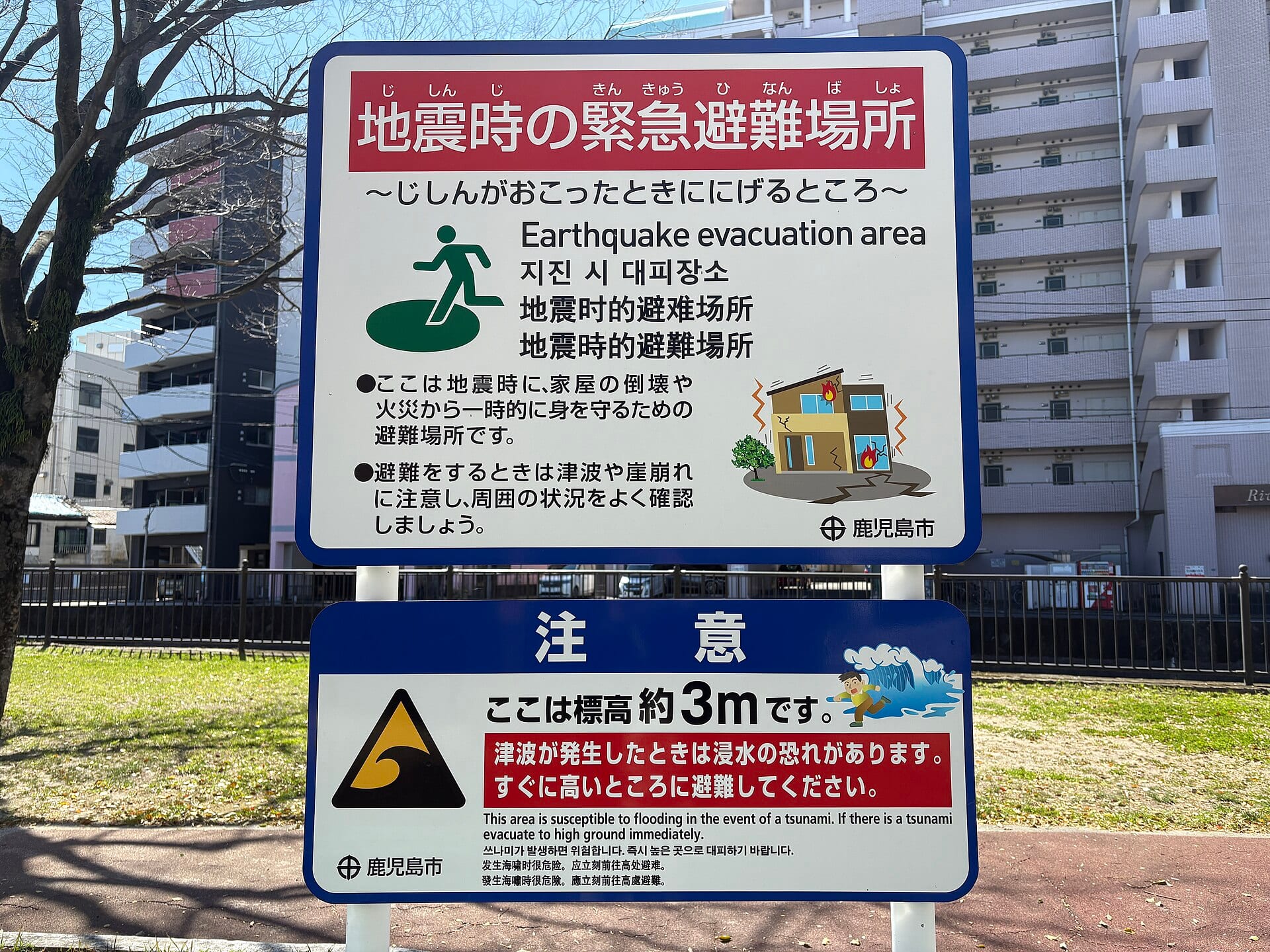
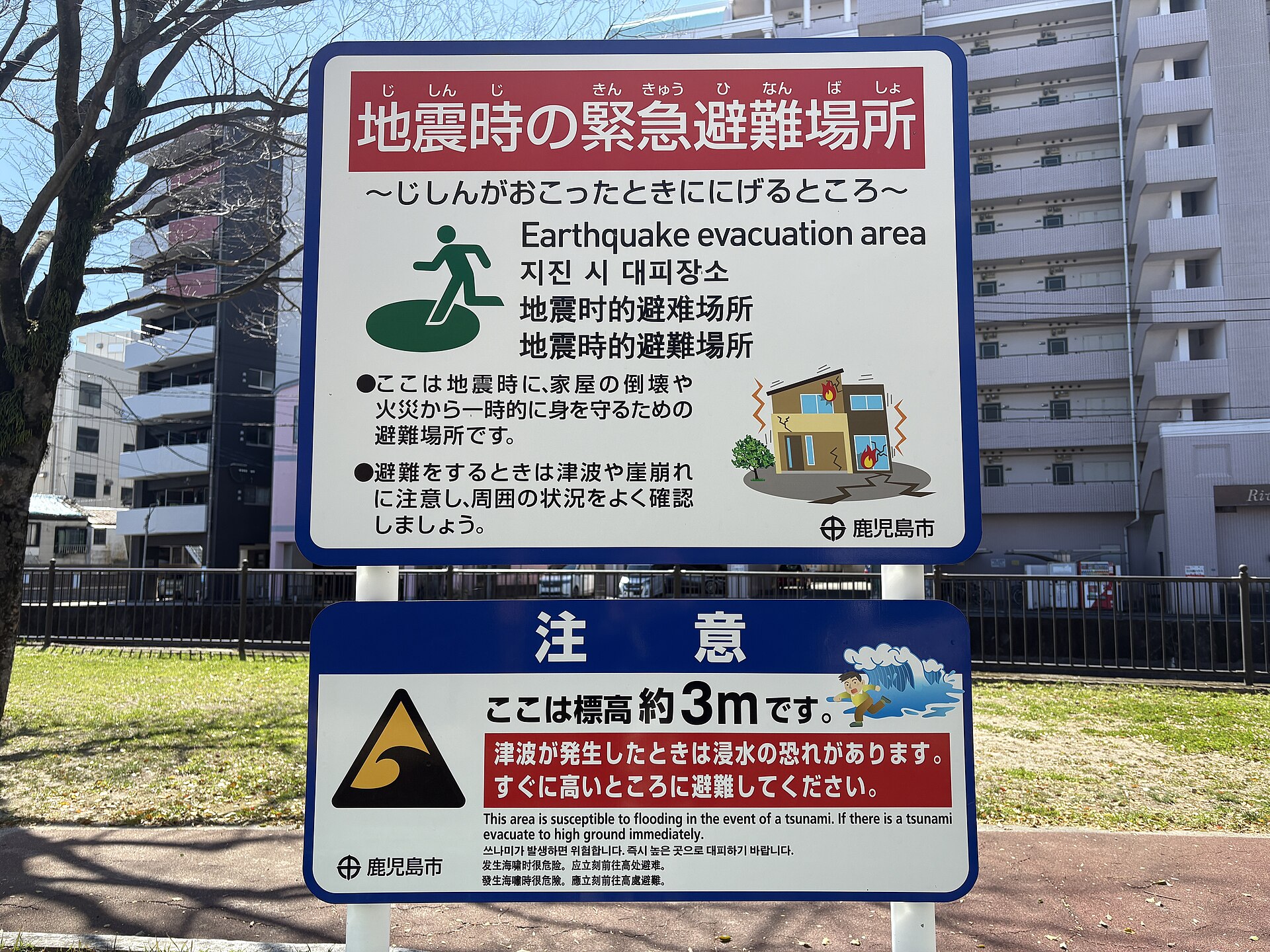
Featured image: あじさか / Wikimedia Commons / CC BY-SA 4.0 — https://commons.wikimedia.org/wiki/File:%E5%9C%B0%E9%9C%87%E6%99%82%E3%81%AE%E7%B7%8A%E6%80%A5%E9%81%BF%E9%9B%A3%E5%A0%B4%E6%89%80%E6%A1%88%E5%86%85%E6%A8%99%E8%AD%98%E7%9C%8B%E6%9D%BF_%E9%B9%BF%E5%85%90%E5%B3%B6%E5%B8%82_01.jpg (licence checked on the file page 2026-10-02)
Written by
J-Times Editorial
J-Times 編集部 / J-Times Editorial Team