J-Times Editorial
J-Times 編集部 / J-Times Editorial Team
第5回 なぜ日本の水道水は飲めるの? — 「世界で15カ国だけ」は本当か
なぜ?ニッポン · 7 min · Japanese audio
Japan's tap water meets 52 legal quality standards and is safe to drink. The 'only 15 countries' figure has no clear source: Japan's own ministry lists 9 based on travel advice, and WHO/UNICEF count 31. How it is kept safe, and when to take care.
Read this article to earn +5 MTC
Short answer (as of 26 October 2026): Yes. Japan's public tap water is managed to meet 52 legal water-quality standards and is generally safe to drink straight from the tap. But the popular line that "only 15 of the world's 196 countries have drinkable tap water" does not hold up. A chart from Japan's land ministry lists nine countries where tap water is "drinkable as is", but it is built from travel advice, not water tests. WHO and UNICEF count 31 countries where more than 99% of people had safely managed drinking water in 2024. The exact number varies with the measure, but countries where you can trust the tap are clearly a minority.
This article was first published in March 2026 and has been rewritten after checking it against government and international sources. Claims in the old version such as "15 of 196 countries", "51 parameters, stricter than WHO", "advanced treatment at all Tokyo plants by 2013" and "London 23%, Paris 8% leakage" were either wrong or could not be sourced, and have been corrected (see "What we corrected").
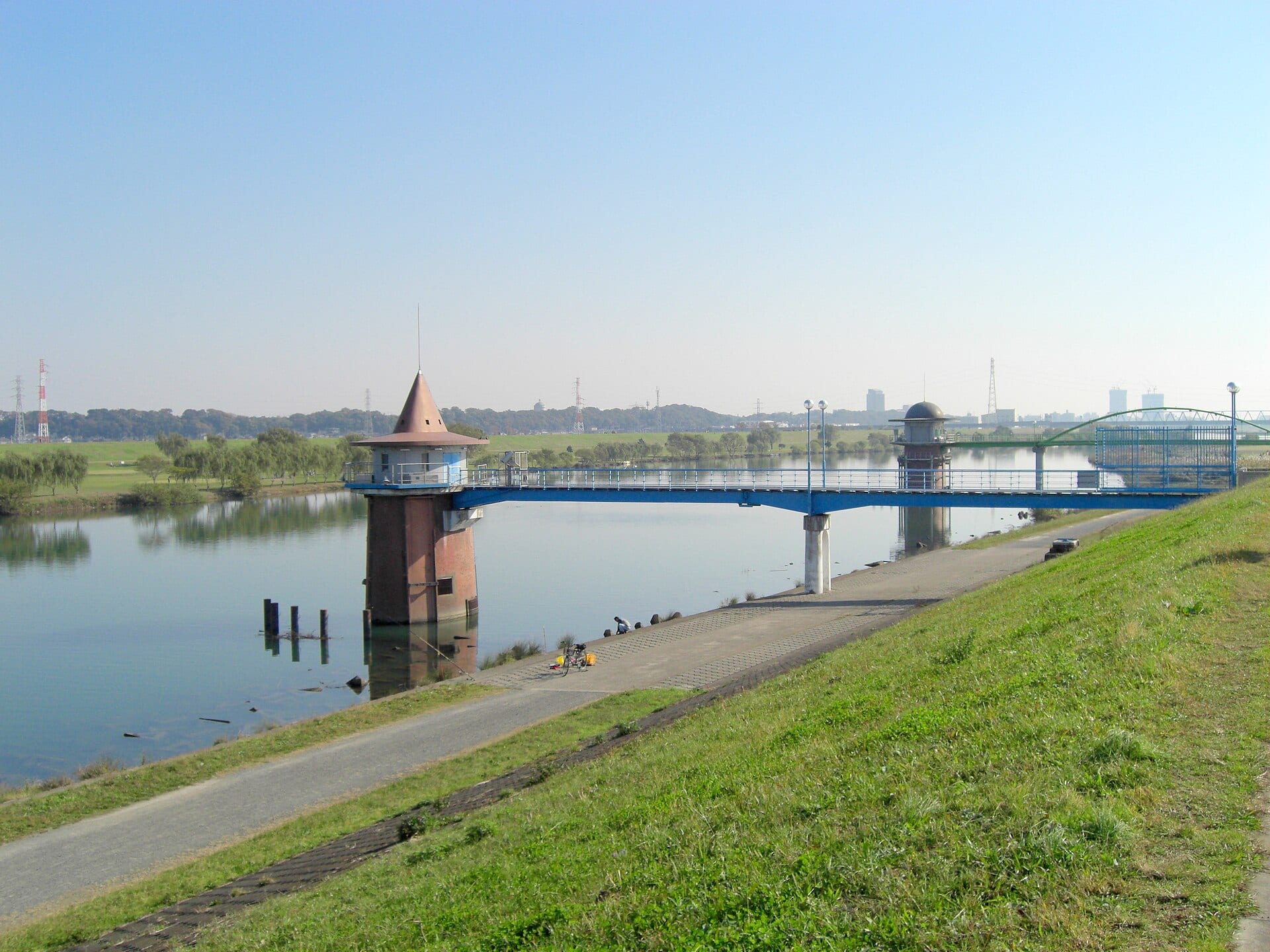
Behind every glass of tap water are intake towers drawing from the river, crews who walk the streets at night listening for the sound of leaking pipes, and technicians who test water from taps every day. What looks "normal" in Japan depends on that work continuing.

Photo: Mayuno / Wikimedia Commons / CC BY-SA 3.0
Is Japanese tap water really safe to drink straight from the tap?
Yes. Water utilities must supply water that meets the standards set under the Waterworks Act (52 parameters from April 2026) and must test it regularly. By law, tap water must also keep at least 0.1 mg/L of residual chlorine for disinfection.
On 1 April 2026, two PFAS chemicals, PFOS and PFOA, moved from the list of "management target" items into the binding standards, with a combined limit of 50 nanograms per litre. Utilities are now required to test for them, in principle at least every three months, and to meet the limit. Beyond the 52 standards there are 26 "management target" items that the government asks utilities to test, and 46 "items for further study".
Piped water reaches 98.3% of Japan's population (end of fiscal 2022). Coverage passed 90% in 1978.
We removed the old version's claim that the standards are "stricter than WHO guidelines": the number of items has changed, and we could not find an item-by-item comparison with WHO.
Where does "only 15 countries" come from?
We could not find a reliable source. The closest official figure is a chart in the land ministry's 2025 report on Japan's water resources. It lists nine countries where tap water is "drinkable as is" (Japan, New Zealand, Austria, Denmark, Finland, Iceland, the Netherlands, Norway and Sweden) and 33 where it is "drinkable but with care".
That chart was compiled by the ministry from the Foreign Ministry's overseas safety and medical information (as of June 2025) and the website of the travel guidebook Chikyu no Arukikata (as of November 2024). It summarises travel advice; it does not measure or compare water quality.
For international comparisons, the standard source is the WHO/UNICEF Joint Monitoring Programme (JMP):
- "Safely managed" drinking water means water available on the premises, when needed, and free from contamination.
- Worldwide in 2024: 74% of people had it; about 2.1 billion, one in four, did not.
- Countries in 2024: 89 had reached universal (over 99%) access to at least basic drinking water; 31 had reached universal access to safely managed drinking water.
Japan has over 99% coverage of at least basic drinking water. In the 2025 report's annex, however, there is no estimate of Japan's safely managed coverage. That does not mean the water is unsafe; it means Japan's data has not been reported in a form the JMP can use for that indicator.
What happens at a treatment plant?
The basic steps are to settle out particles with coagulants, filter the water through sand and disinfect it with chlorine. In Tokyo's 23 wards, every plant on the Tone and Ara river systems adds "advanced treatment": ozone followed by biological activated carbon.
According to Tokyo Waterworks' testing plan for fiscal 2026, advanced treatment removes musty-smelling compounds, organic matter and ammonia nitrogen that ordinary treatment cannot fully deal with. The Tone and Ara plants account for about 80% of treatment capacity for the 23 wards; some plants on the Tama river system do not use advanced treatment. The old version's claim that Tokyo "completed advanced purification at all plants by 2013" has been corrected.
The national effect shows in the numbers. In fiscal 1990 about 22 million people were affected by musty or other off-tastes in their water, largely because lakes and reservoirs were over-enriched with nutrients. With wider use of ozone and other advanced treatment, the figure has recently stayed at around 3.5 million or less, according to the land ministry.
Tokyo Waterworks tests water at 47 taps across the 23 wards. It keeps residual chlorine above the legal minimum of 0.1 mg/L but sets itself a target of 0.4 mg/L or less, stricter than the national target of 1 mg/L or less, to reduce the chlorine smell.
Is Tokyo's leakage rate really 3%?
Roughly, but it has crept up. Tokyo Waterworks reports a leakage rate of 3.9% in fiscal 2023. It fell from 10.2% in fiscal 1992 to a low of 2.0% in fiscal 2012 and has since stayed in the 3% range.
About 96% of leak repairs are on service pipes, the pipes that branch from the main under the road to each building. Tokyo runs acoustic surveys, listening for leaks underground, including at night when traffic is light. Ageing service pipes, and pipes left in empty houses, are named as growing problems.
We removed the old comparison with "London about 23%, Paris about 8%", because cities count leakage differently and we could not confirm figures on the same basis.
Nationally, pipes are ageing. The share of water mains older than their 40-year statutory life reached 23.6% in fiscal 2022 and is still rising, and only about 43% of treatment facilities are earthquake-resistant, according to the land ministry. Keeping today's "normal" for the next generation will take money and people to renew the system.
Why do so many people still buy bottled water?
In a 2024 Cabinet Office survey, 39.1% of people said they drink tap water as it is. 36.1% buy mineral water, 34.3% use a filter and 16.2% boil tap water first (multiple answers allowed).
Safety and taste are different questions. Some people dislike the smell or taste, or worry about the pipes in their building, and choose bottled water or a filter. The vending machine on every corner probably plays a part too (see why Japan's vending machines survive).
What should I watch out for?
If you are visiting
- Tap water in hotels, stations and public buildings is generally fine to drink.
- Don't drink from taps marked 飲用不可 or 飲めません ("not drinkable"); they may carry rainwater or well water.
- Spring water and mountain streams are not tested to tap-water standards.
- If you dislike the taste, chill it or buy bottled water. That is a matter of preference, not safety.
If you live in Japan
- In apartment blocks and buildings that store water in a tank first, the utility is responsible for quality up to the tank, and the building owner from the tank to your tap. Tanks must be cleaned at least once a year. If in doubt, ask the management company for its cleaning and inspection records.
- If the water looks, smells or tastes unusual, don't drink it; contact the building manager or your water utility.
In a disaster
- Earthquakes cut water supplies. After the July 2026 Kumamoto earthquake, about 82,540 households in Kumamoto Prefecture were without water by midday the next day.
- Store 3 litres per person per day for drinking and cooking, for at least three days (Ministry of Agriculture guidance). For the full checklist see What can the world learn from Japan's disaster preparedness?, and for emergencies while travelling see Emergency in Japan?
Common mistakes
- Assuming all water in Japan is safe and drinking from unmarked springs or "not drinkable" taps.
- Living with discoloured water from an old building's tank instead of reporting it.
- Not storing water, then searching shops for it after an earthquake.
Frequently asked questions
Is hotel tap water in Japan safe to drink? Generally yes. If an older building uses a storage tank, the building is responsible for that part of the system; ask at the front desk or buy bottled water if you are unsure.
The water smells of chlorine. Is that safe? By law, tap water must keep at least 0.1 mg/L of residual chlorine for disinfection. The smell is a sign the disinfectant is still working.
Do I need a water filter? Not for safety, if the water meets the standards. Many people use one for taste; about one in three does, according to the Cabinet Office survey.
What about PFAS? Since April 2026, a combined limit of 50 ng/L for PFOS and PFOA has been a legal tap-water standard, and utilities must test for it. Your local utility publishes its results.
Why don't you call it a "miracle"? Because it isn't one. Japan's safe tap water is the result of law, testing, infrastructure and the people who run it every day.
What we corrected
- "Only about 15 of 196 countries" → removed (no source); replaced with MLIT's chart (9 countries plus 33 with care, from travel advice) and WHO/UNICEF's count (31 countries over 99% safely managed).
- "51 parameters, stricter than WHO" → 52 parameters from April 2026; "stricter than WHO" removed.
- "Tokyo tests over 200 additional parameters" → replaced with test categories and 47 sampling taps (item count not re-verified).
- "Advanced treatment at all Tokyo plants by 2013" → all Tone/Ara plants (about 80% of ward capacity).
- "Blind taste tests" → removed (no source).
- "Leakage about 3%" → 3.9% in FY2023 (low of 2.0% in FY2012).
- "London 23%, Paris 8%" → removed (not comparable).
- "Most of Europe has hard water with strong chlorine taste" → removed (no source).
- Added: PFAS standard, residual chlorine, how people actually drink tap water, building tanks, ageing pipes and disaster preparation.
Sources and dates checked (all checked on 2026-10-26)
- MLIT, Current State of Water Resources in Japan 2025 (Figure 7-1-7 "Tap water around the world": 9 countries drinkable as is, 33 with care, compiled by MLIT from MOFA information and Chikyu no Arukikata; piped-water coverage 98.3%; off-taste population; 23.6% of mains past statutory life; seismic resilience of facilities; Cabinet Office 2024 water survey) — mlit.go.jp/mizukokudo/mizsei/mizukokud… , mlit.go.jp/mizukokudo/mizsei/content/0… (primary)
- WHO/UNICEF JMP, Progress on household drinking water, sanitation and hygiene 2000-2024: special focus on inequalities, August 2025 (74%; 2.1 billion; 89 and 31 countries; Japan annex entries) — washdata.org/reports/jmp-2025-wash-house… (primary)
- WHO news release, "1 in 4 people globally still lack access to safe drinking water", 26 August 2025 (definition of safely managed) — who.int/news/item/26-08-2025-1-in-4… (primary)
- Ministry of the Environment press release on the PFOS/PFOA tap-water standard, 30 June 2025 (in force 1 April 2026; 50 ng/L; testing about every three months) — env.go.jp/press/press_00075.html (primary)
- Saitama Prefecture, tap-water quality standards (52 items from 1 April 2026; 26 management target items; 46 items for study) — pref.saitama.lg.jp/a0706/suidou/standards.html
- Niigata Prefecture, PFOS and PFOA in tap water (52 items after the addition) — pref.niigata.lg.jp/sec/seikatueisei/-suidopfas…
- Tokyo Waterworks, Water Quality Testing Plan FY2026, chapter 2 (52 standards; 47 taps in the 23 wards; advanced treatment on Tone/Ara systems and plant capacities; residual chlorine 0.1 mg/L minimum, Tokyo target 0.4 mg/L) — waterworks.metro.tokyo.lg.jp/documents/d/waterworks/1020… (primary)
- Bureau of Waterworks, Tokyo Metropolitan Government, Prevention of Leakage in Tokyo 2024 (3.9% in FY2023; 10.2% in FY1992; annual series; 96% of repairs on service pipes; night-time acoustic surveys) — english.metro.tokyo.lg.jp/documents/d/english/r06rous… (primary)
- Tokyo Metropolitan Government, "Leakage Rate Decreased to 3.0%" (ANMC21 best practice) — sp.metro.tokyo.lg.jp/seisakukikaku/gaimubu/anmc2…
- Aichi Prefecture, management of building water tanks (owner responsible from tank to tap; cleaning at least yearly) — pref.aichi.jp/soshiki/jogesuido/cyosuisou… (primary)
- Hirakata City, leaflet on small building water tanks — city.hirakata.osaka.jp/cmsfiles/contents/0000001/1…
- Japanese Red Cross Society situation report, 29 July 2026 (MLIT information: about 82,540 households without water in Kumamoto, 12:00 on 29 July) — jrc.or.jp/domestic_rescue/pdf/2026072…
- Ministry of Agriculture, Forestry and Fisheries, household stockpiling (3 litres per person per day, at least three days) — maff.go.jp/j/pr/aff/2603/spe1_01.html (primary)
- Image: Wikimedia Commons file page (licence checked) — commons.wikimedia.org/wiki/File:Kanamachi-water_p…
By J-Times Editorial (information as of 2026-10-26)
About this article
- By
- J-Times Editorial
- Published
- Updated
Sources are cited in the text and at the end. If you spot an error, please tell us. Editorial policy & corrections
J-Times is published by Jon&Coo Inc.
Written by
J-Times Editorial
J-Times 編集部 / J-Times Editorial Team