J-Times Editorial
J-Times 編集部 / J-Times Editorial Team
Wabi-sabi is the Japanese sense of beauty in plain, imperfect, quietly aged things: wabi from the tea ceremony, sabi from Bashō's poetry. What each word means.
Read this article to earn +5 MTC
What is wabi-sabi? The meaning of wabi and sabi, and where the words come from
Short answer (as of 2026-09-23): Wabi-sabi is a Japanese sense of beauty that values plain, imperfect, quietly aged things. It joins two older words: wabi, refined in the tea ceremony, and sabi, refined in haikai poetry.
Search "wabi-sabi" in English and you will usually meet one line: the beauty of imperfection. That line is not wrong, but it compresses about five centuries of history into a slogan. In Japan the two halves have separate dictionary entries, separate histories and separate heroes. Wabi belongs mainly to the world of tea, from Murata Jukō in the fifteenth century to Sen no Rikyū in the sixteenth. Sabi belongs mainly to poetry, above all to Matsuo Bashō and his school in the seventeenth. The single word "wabi-sabi", as most English speakers use it, took shape much later, and one book in 1994 did a great deal to spread it.
This page sets out what each word means, where each comes from, and where the well-sourced history ends and the popular story begins. For a broader tour of Japanese ideas about living, see our overview of seven Japanese philosophies; this page stays with one idea and its sources.
What does wabi-sabi mean, in one sentence?
Wabi-sabi is an appreciation of beauty in things that are simple, lacking, weathered or quiet — a beauty that shows because something is not lavish, new or complete.
The Omotesenke school of tea, one of the three Sen family schools that descend from Rikyū, describes what people loosely call "the world of wabi and sabi" as a world of quiet solitude and clarity, or of a spare, withered elegance. It adds that the Japanese contribution was to take a mood that seems lonely and colourless and develop it into an aesthetic.
The Stanford Encyclopedia of Philosophy, in its entry on Japanese aesthetics, glosses the two words separately: wabi as "subdued, austere beauty" and sabi as "rustic patina". Those two short glosses are a good way to keep the halves apart. Wabi is about having little, and finding that enough. Sabi is about age and wear, and the depth that time gives to a surface or a mood.
What is the difference between wabi and sabi?
Wabi comes from a verb for being miserable or in want; sabi comes from a verb for growing old or faded. Both began as negative words and were later turned into terms of praise.
Omotesenke explains the roots plainly. Wabi comes from the verb wabu, meaning to be disheartened, to find something hard, or to fall on hard times; at its root is "the pain of things not going as one wishes". Sabi comes from sabu, meaning to grow old or lose colour, and carries the sense of vitality ebbing away. The Nipponica encyclopedia (Shogakukan) adds that in the eighth-century poetry anthology Man'yōshū, wabu and wabishi describe the pain of unrequited love and were "never" words for an aesthetic value.
The two then took different paths:
| Wabi (侘び) | Sabi (寂び) | |
|---|---|---|
| Root verb | wabu: to be in want, to despair | sabu: to grow old, to fade |
| Original feeling | frustration, poverty, loneliness | decline, desolation, age |
| Where it was refined | tea ceremony (15th–16th century) | classical poetry, then haikai (to 17th century) |
| Key figures | Murata Jukō, Takeno Jōō, Sen no Rikyū | Fujiwara no Shunzei (early use), Matsuo Bashō |
| Short gloss (SEP) | subdued, austere beauty | rustic patina |
In everyday Japanese the two are often said together, as wabi-sabi or "wabi and sabi". But on the Kotobank dictionary site, which aggregates Japan's major reference works, they appear as separate entries, and no entry exists for the compound (checked 2026-09-23). That is a small but telling detail: in Japan, the pairing is a conversational shorthand rather than a defined term.
Where does wabi come from — how did the tea masters make it an ideal?
The tea ideal of wabi grew in three steps: Murata Jukō (1423–1502) brought a spare, inward-looking style to tea, Takeno Jōō (1502–1555) named it wabi, and Sen no Rikyū (1522–1591) brought wabi tea to completion.
Before these three men, tea in Japan was often a lavish affair. Urasenke's history for beginners describes early Muromachi-period tea gatherings where people bet on guessing where a tea was grown, and Omotesenke describes tea displayed with costly Chinese wares at noisy banquets.
Murata Jukō. Omotesenke says Jukō is called the founder of wabi tea because of a short text known as the Kokoro no fumi ("Letter on the heart"), which treats tea as a path of personal growth. In it he urges tea people to "blur the boundary between Japanese and Chinese" — to set plain domestic wares beside prized Chinese pieces and make a new beauty from the contrast. Both Omotesenke and Nipponica also record his remark that a moon with no clouds around it is not to his taste: he preferred the moon half hidden by clouds. One detail is easy to miss. The Heibonsha World Encyclopedia entry on wabi, written by the tea historian Kumakura Isao, notes that Jukō sought a beauty of the "chilled and withered" but did not yet use the word wabi itself.
Takeno Jōō. A wealthy merchant of Sakai who first trained as a linked-verse poet, Jōō is the one who put the word to work. Two encyclopedias (Heibonsha and Britannica Japan) record his definition of wabi as being "honest, deeply modest and not proud". Urasenke and Nipponica both say he took as his emblem a poem by Fujiwara no Teika: Looking out — no cherry blossoms, no autumn leaves; a reed hut by the bay, in the autumn dusk. The poem's beauty lies in what is absent.
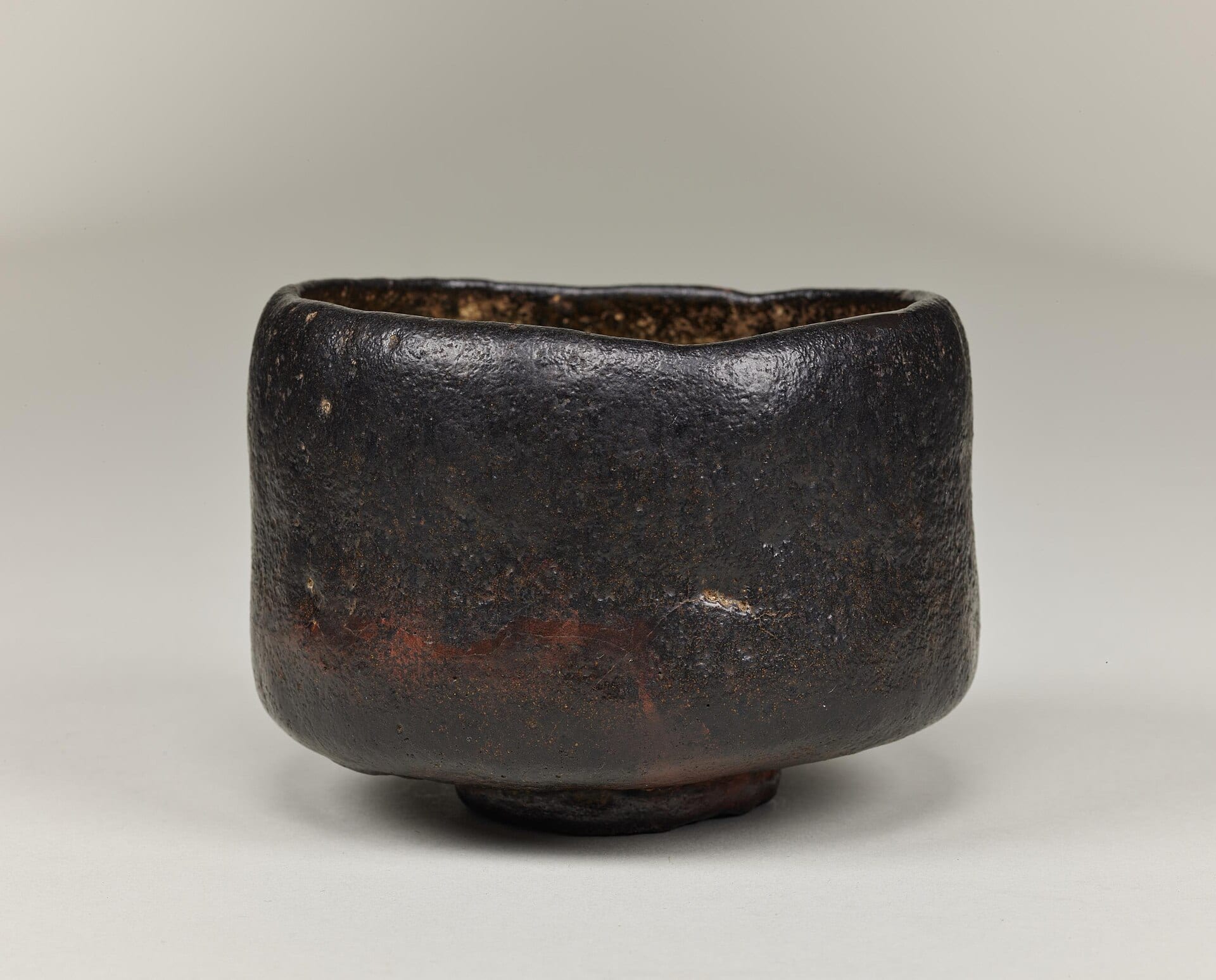
Sen no Rikyū. Urasenke's official English history says Rikyū began studying under Jōō at nineteen, served the warlords Oda Nobunaga and Toyotomi Hideyoshi, and "perfected the style of chanoyu based on the wabi aesthetic". His wabi showed in Raku tea bowls made with the potter Chōjirō, in bamboo flower vases and tea scoops, and in everyday objects put to new use. Hideyoshi ordered his death, and he died in 1591. Urasenke's Japanese pages say Rikyū's spirit is often summed up in a poem by Fujiwara no Ietaka: To those who wait only for blossoms, I would show the spring in the grass between patches of snow in a mountain village. Where Jōō's emblem is emptiness, Rikyū's is quiet life hidden inside it.
Nipponica makes a point worth keeping: early wabi tea was not simply about poverty. Jōō and Rikyū also owned superb pieces. Setting a famous object among rough ones, or giving it a humble guise, drew out a deeper beauty — and at the same time put the beauty of the rough things on show.
Where does sabi come from — what did Bashō mean by it?
Sabi was praised in court poetry from the twelfth century, but it was Matsuo Bashō's school of haikai that made it a central ideal. His disciple Mukai Kyorai called sabi "the colour of a verse".
Nipponica traces an early use of sabi as praise to the poet Fujiwara no Shunzei, who wrote of a poem's form as sabite in his judgements at poetry contests. The same entry says that Bashō turned what had been a verb into a noun, sabi, and that alongside shiori and hosomi it became a key value of his school.
The clearest statement comes from Kyoraishō, a record of Bashō's teachings compiled by Kyorai. Asked what sabi in a verse is, Kyorai answers that it is "the colour of the verse" and "not a matter of the verse being quiet and lonely". He compares it to an old man who puts on armour and goes to war, or dresses in brocade for a banquet: the old man's age still shows. Sabi, he says, can be found in lively verses as well as quiet ones. He then cites his own verse — The blossom-keepers, touching their white heads together — and records that Bashō praised it for showing sabi well.
That is a precise idea, and it differs from the popular one. For Bashō's school, sabi was not a subject (old things, lonely places) but a quality of the poet's perception that could colour any subject. Nipponica adds that Bashō himself rarely spoke of sabi, and his disciples disagreed about what he meant.
Is "wabi-sabi" as used in the West the same as the Japanese idea?
Not quite. The Western idea is broader and more unified — a general philosophy of imperfection — while in Japan wabi and sabi remain two historical terms tied to tea and poetry.
The turning point was Leonard Koren's Wabi-Sabi for Artists, Designers, Poets & Philosophers, published by Stone Bridge Press in Berkeley in 1994 (94 pages, according to the Internet Archive catalogue record). Koren's own website describes it as "the book that introduced the term 'wabi-sabi' to the non-Japanese world" — his claim, which we have not independently tested, but the book is widely cited. His best-known lines define wabi-sabi as "a beauty of things imperfect, impermanent, and incomplete", "a beauty of things modest and humble" and "a beauty of things unconventional".
Koren's framing is useful, and it is honest about being a synthesis. But three differences are worth knowing:
- One word versus two. Koren treats wabi-sabi as a single concept. Japanese sources keep wabi and sabi apart, with different roots and histories.
- "Imperfection" versus "lack" and "age". The Japanese sources above stress want, modesty and the depth of age. "Imperfection" is part of it, but a smaller part than English slogans suggest. The Stanford entry does note that in the wabi aesthetic a well-repaired cracked utensil can be valued above an intact one — imperfection matters, but inside a wider frame.
- A lifestyle versus a discipline. In Japan, wabi is anchored in a specific practice, tea, with texts, schools and teachers. Much Western writing presents wabi-sabi as a general life philosophy or interior-design style.
None of this makes the Western use "wrong". Words travel and change. But if you want to quote the Japanese meaning, the safest one-line version is the pair of glosses: wabi, austere beauty found in having little; sabi, the beauty that age and time bring out.
Which popular claims about wabi-sabi are myths?
The shakiest claims are that wabi-sabi is an ancient single concept, that every famous Rikyū saying is well documented, and that sabi simply means "old" or "rusty".
- "Wabi-sabi is an ancient Japanese word." The two words are old. The compound as a defined concept is modern, and it spread internationally through English-language writing in the 1990s.
- "Rikyū said…" Much of what is quoted as Rikyū's teaching comes from the Nanpōroku, a tea text said to record his words. All three major encyclopedias on Kotobank (Heibonsha, Shogakukan's Nipponica and Digital Daijisen) note that it surfaced in 1686–1690 through Tachibana Jitsuzan, a retainer of the Kuroda domain, and that there is a theory it was his own work. Heibonsha's entry goes further and says the tea-gathering records in it were clearly compiled later. Treat quotations that rest only on the Nanpōroku as tradition, not documented speech.
- "Sabi means rust." Sabi in the aesthetic sense (寂) and sabi meaning rust (錆) sound the same. The Stanford entry notes the overlap in connotation, but Kyorai's definition shows that for Bashō's school the word meant a quality of perception, not a surface.
- "Wabi-sabi comes from Zen." Zen shaped it, but it was not the only source. Omotesenke points to Jukō's link with the Zen monk Ikkyū, while also stressing the roots of wabi and sabi in classical waka and linked-verse poetry. Nipponica also credits Zen's influence on the medieval taste for the half-hidden moon.
A related word, mono no aware, the pathos of passing things, is often confused with wabi-sabi. We discuss it in why cherry blossoms are beautiful because they fall.
Timeline: how wabi and sabi took shape
| Period | Event | Sources |
|---|---|---|
| 8th century | Man'yōshū uses wabu/wabishi for the pain of unrequited love | Nipponica ("wabi") |
| 12th century | Fujiwara no Shunzei uses sabite as praise in poetry-contest judgements | Nipponica ("sabi") |
| 1423–1502 | Murata Jukō; Kokoro no fumi; "blur Japanese and Chinese" | Omotesenke; Nipponica; Digital Daijisen |
| 1502–1555 | Takeno Jōō defines wabi as honest, modest, not proud | Urasenke; Heibonsha; Britannica Japan |
| 1522–1591 | Sen no Rikyū completes wabi tea; Raku bowls with Chōjirō | Urasenke (EN/JA); Omotesenke |
| 1686–1690 | Nanpōroku surfaces via Tachibana Jitsuzan; authenticity disputed | Heibonsha; Nipponica; Digital Daijisen |
| late 17th century | Bashō's school makes sabi a key value; Kyorai's definition | Kyoraishō; Nipponica; Britannica Japan |
| 1994 | Leonard Koren's Wabi-Sabi published in Berkeley | Internet Archive record; leonardkoren.com |
Wabi-sabi: frequently asked questions
How do you write wabi-sabi in Japanese? It is usually written 侘び寂び (or わびさび, わび・さび). The first half is 侘び (wabi), the second 寂び (sabi). The 寂 in sabi is also read jaku or sabishii (lonely).
Is wabi-sabi the same as minimalism? No. Both prize simplicity, but wabi tea deliberately placed fine objects beside rough ones, and sabi values age and wear. Minimalism, as a modern design idea, often prizes the new and flawless.
Is kintsugi an example of wabi-sabi? Popular writing often pairs them. The Stanford Encyclopedia notes that in the wabi aesthetic, a broken utensil that has been well repaired can be valued above an intact one. The Japanese sources we used do not define kintsugi as wabi-sabi, so treat the pairing as a modern association.
Who invented wabi-sabi? No one person. Wabi as a tea ideal runs from Murata Jukō through Takeno Jōō to Sen no Rikyū; sabi as a poetic ideal runs from classical poets to Matsuo Bashō. The English compound spread through Leonard Koren's 1994 book.
Can I say "wabi-sabi" to Japanese people? Yes. They will understand it, usually as a loose phrase for a quiet, spare, aged beauty. If you mention tea or haiku, you may hear the two words explained separately.
Sources (checked 2026-09-23)
- Omotesenke Fushin'an, "Wabi and sabi" (roots of wabu and sabu; "the world of wabi and sabi") — https://www.omotesenke.jp/list2/list2-3/list2-3-1/ (primary: tea school founded by Rikyū's lineage)
- Omotesenke Fushin'an, "Murata Jukō" (Kokoro no fumi; clouded moon) — https://www.omotesenke.jp/list2/list2-2/list2-2-1/
- Omotesenke Fushin'an, "The formation of wabi tea" (Jukō, Jōō, Rikyū; Chōjirō) — https://www.omotesenke.jp/list2/list2-1/list2-1-4/
- Omotesenke Fushin'an, "Takeno Jōō" — https://www.omotesenke.jp/list2/list2-2/list2-2-2/
- Urasenke Konnichian, official English site, "About Urasenke Chado" (Rikyū 1522–91, study under Jōō, Raku bowls, death 1591) — https://www.urasenke.or.jp/texte/about/
- Urasenke, "Since when has there been tea?" (Jukō 1423–1502, Jōō 1502–1555, Teika and Ietaka poems) — https://www.urasenke.or.jp/textb/shiru/beginer/itu.html
- Mukai Kyorai, Kyoraishō, "Shugyō-kyō" section (text hosted by Yamanashi Prefectural University) — https://www2.yamanashi-ken.ac.jp/~itoyo/basho/reference/kyoraisyou/syugyokyo/kyoraisyou_3.htm (primary: original text)
- Stanford Encyclopedia of Philosophy, "Japanese Aesthetics" (rev. 2023) — https://plato.stanford.edu/entries/japanese-aesthetics/
- Kotobank, "わび" (Nipponica, Kumakura Isao; Britannica Japan) — https://kotobank.jp/word/%E3%82%8F%E3%81%B3-154286
- Kotobank, "侘" (Heibonsha World Encyclopedia, Hori Nobuo and Kumakura Isao) — https://kotobank.jp/word/%E4%BE%98-880085
- Kotobank, "さび" (Nipponica, Horikoshi Zentarō; Britannica Japan) — https://kotobank.jp/word/%E3%81%95%E3%81%B3-69542
- Kotobank, "村田珠光" (Digital Daijisen; Nipponica; Heibonsha) — https://kotobank.jp/word/%E6%9D%91%E7%94%B0%E7%8F%A0%E5%85%89-17039
- Kotobank, "南方録" (Digital Daijisen; Heibonsha; Nipponica) — https://kotobank.jp/word/%E5%8D%97%E6%96%B9%E9%8C%B2-108975
- Kotobank, "侘び茶" (Digital Daijisen) — https://kotobank.jp/word/%E4%BE%98%E3%81%B3%E8%8C%B6-665516
- Leonard Koren, official site (book description and excerpt) — https://www.leonardkoren.com/
- Internet Archive catalogue record, Koren, Wabi-sabi for artists, designers, poets & philosophers (Stone Bridge Press, 1994, 94 p.) — https://archive.org/details/wabisabiforartis0000kore
Written by the J-Times Editorial Team. Facts current as of 2026-09-23.
Featured image: Chōjirō and workshop, Tokyo National Museum (ColBase) / Wikimedia Commons / CC BY 4.0 (https://commons.wikimedia.org/wiki/File:Tea_Bowl,_Named_%E2%80%9CAmadera_(Nunnery)%E2%80%9D.jpg)
Written by
J-Times Editorial
J-Times 編集部 / J-Times Editorial Team