J-Times Editorial
J-Times 編集部 / J-Times Editorial Team
Japan's masks: a habit from the 1918–21 flu, hay fever affecting over 40%, and social reasons. Since 13 March 2023, wearing one is a personal choice.
Read this article to earn +5 MTC
Why do Japanese people wear face masks?
Short answer (as of 2026-09-23): Japanese mask-wearing is a century-old public-health habit, reinforced by hay fever that affects over 40% of people and by social reasons. Since 13 March 2023, wearing one has been a personal choice.
Visitors to Japan often notice masks long after the pandemic seems to have ended elsewhere: on commuter trains in February, in supermarkets, on teenagers in classrooms. It is easy to file this under "Japan is different". The reasons are more ordinary than that and better documented. There is a clear historical starting point, a very large allergy problem, a government policy with an exact date, and a body of survey research on why people keep masks on. This article takes those one at a time and marks where the evidence ends and interpretation begins.
When did Japanese people start wearing masks?
Masks in Japan date from the early Meiji period, when they were used mainly against dust. They became a public-health habit during the 1918–1921 influenza pandemic, when the Home Ministry's posters told people to wear them.
The Japan Hygiene Products Industry Association, the trade body for mask makers, says Japan's first masks appeared in the early Meiji period (from the late 1860s): a core of brass wire mesh with cloth attached as a filter, used mainly to keep out dust. A museum history compiled by the Kitatama Pharmacists' Association in Tokyo reproduces an 1879 newspaper advertisement from the medical-goods dealer Iwashiya for a domestically made "respirator", which, it says, claimed to be as good as imported ones and cheaper.
The turning point was the influenza pandemic usually called the Spanish flu. Japan's Home Ministry Hygiene Bureau published a detailed official report, Ryūkōsei Kanbō ("Epidemic Influenza"), in March 1922. As summarised by the Statistics Bureau's library, the report counted 23,804,673 cases and 388,727 deaths across three waves between August 1918 and July 1921. The government's vital statistics give a lower figure of 225,391 influenza deaths for the same period; the Statistics Bureau note explains that many flu deaths were recorded under pneumonia and other respiratory causes in the vital statistics, so the two numbers measure different things.
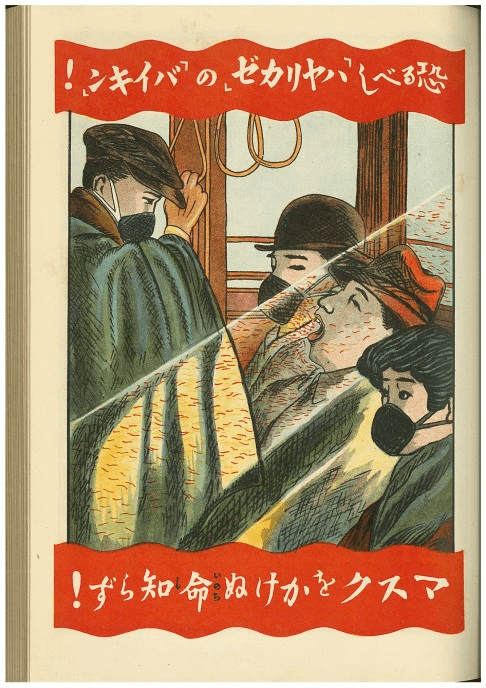
The same report reproduced the public-awareness posters the ministry had issued, and the National Institute of Public Health has scanned them in colour. One shows a crowded tram in which a man coughs a cloud of germs over fellow passengers, while those wearing masks are protected. Its caption reads: "Fear the germs of the 'hayari-kaze' [the epidemic cold]!" and "Reckless people who don't wear masks!" A century before COVID-19, the Japanese state was already telling citizens that a mask on a crowded train was a matter of life and death.
The industry association says the pandemic made masks a recognised preventive product, and traces the next steps: in 1923 the "Kotobuki Mask" became the first registered mask trademark; masks surged again during the 1934 flu, after which "every time influenza spread, mask shipments rose explosively"; the first gauze mask appeared in 1950; and in 1973 the prototype of today's pleated non-woven mask went into production in Japan.
Why do so many people in Japan wear masks in spring?
Because hay fever is extremely common: in a 2019 nationwide survey cited by Japan's Ministry of the Environment and the Cabinet, 42.5% of respondents had pollen allergy, and 38.8% had Japanese cedar pollen allergy specifically.
The industry association credits the spread of hay fever from the 1980s with pushing masks into ordinary households, in addition to their use against flu. The size of the problem is well measured. Otolaryngologists (the 2019 round was reported by Matsubara and colleagues in 2020, and the Cabinet Secretariat attributes the series to the Japanese academic society for immunology, allergy and infection in otorhinolaryngology) have surveyed ear-nose-and-throat doctors and their families nationwide roughly every ten years; the Cabinet Secretariat describes the survey as covering about 20,000 people. Pollen-allergy prevalence rose from 19.6% (1998) to 29.8% (2008) and 42.5% (2019); cedar pollen allergy reached 38.8% in 2019 — roughly one person in three. The Ministry of the Environment's Hay Fever Environmental Health Manual 2022 reports these figures, and a Cabinet-level ministerial meeting on hay fever cited them in May 2023 when it called hay fever "a social problem that continues to trouble many people". One caveat: the survey sample is doctors' families, not a random sample of the population.
Most of Japan's cedar forests are planted forests, the Environment Ministry notes, and cedar and cypress pollen fly mainly in spring. The same manual recommends masks, citing an experiment in which an ordinary mask cut the pollen reaching the nose by about 70%, and a mask designed for hay fever by about 84%.
This is the main answer to a common search: why do Japanese people wear masks outside? In spring, when cedar and cypress pollen is in the air, much of the reason is pollen — and outdoors is where people breathe it in.
What changed on 13 March 2023?
From 13 March 2023, the Japanese government stopped recommending masks as a general rule and left the decision to each individual, while still recommending them in specific situations.
On 10 February 2023, the government's COVID-19 response headquarters decided to drop its guidance that masks should basically be worn indoors. Instead, the government would respect "individual, voluntary choice" and leave wearing "to the judgement of the individual". The change took effect on 13 March 2023 (1 April for schools). On 8 May 2023, COVID-19 was moved to Class 5 under the Infectious Diseases Control Law, the same category as seasonal flu.
The Ministry of Health, Labour and Welfare (MHLW) still recommends masks in some situations: when visiting a medical institution; when visiting hospitals or care homes where many high-risk people live; and on crowded trains and buses at rush hour. People with symptoms are asked to stay home, and to wear a mask if they must go out. The ministry also asks that no one be forced to put on or take off a mask against their will, and notes that businesses may ask customers or staff to wear masks.
The policy logic here matters for understanding the culture: the official reasons for masks are mostly about protecting other people, especially those at high risk, rather than protecting the wearer.
Do Japanese people still wear masks, and how many?
Fewer than before, but many still do. In one tracking survey, 70.7% said they wore masks in public in March 2023; the lowest point since then was 38.2% in August 2025, with rates rising again in flu season.
The Nippon Research Center (NRC) has run a monthly online survey since March 2023 — about 150 people aged 20–69 a day, aggregated by week and weighted to Japan's population — asking whether they have worn a mask in public in the past two weeks as an infection-control measure. In its report published on 10 June 2026, covering up to May 2026, the share fell from 70.7% in March 2023 to the 60s in April–June 2023, the 50s through May 2024 and the 40s in June–November 2024. It returned to the 50s during the flu and COVID waves of winter 2024–25, dropped into the 30s in the summer of 2025 (38.2% in August 2025), and climbed back to the 50s during the next autumn–winter flu season. NRC changed the question wording in February 2025 to cover "COVID-19, influenza and other infections", so the series is not perfectly continuous.
| Year | Event | Source |
|---|---|---|
| Early Meiji (1879 advert) | Brass-mesh "respirators" sold, mainly against dust | Japan Hygiene Products Industry Association; Kitatama Pharmacists' Association |
| 1918–1921 | Influenza pandemic: 23.8 million cases, 388,727 deaths (Home Ministry count) | Statistics Bureau library note; Home Ministry report (1922) |
| 1922 (March) | Home Ministry report Epidemic Influenza published, with "wear a mask" posters | National Institute of Public Health; National Diet Library |
| 1923 | First registered mask trademark ("Kotobuki Mask") | Japan Hygiene Products Industry Association |
| 1934 | Flu epidemic; masks become widely popular | Japan Hygiene Products Industry Association |
| 1950 / 1973 | First gauze mask / first pleated non-woven prototype | Japan Hygiene Products Industry Association |
| 2019 | Pollen allergy prevalence 42.5% (cedar 38.8%) | Ministry of the Environment (2022); Cabinet Secretariat (2023) |
| 13 March 2023 | Masks become "individual judgement" | MHLW; COVID-19 HQ decision of 10 Feb 2023 |
| 8 May 2023 | COVID-19 moved to Class 5 | MHLW |
| March 2023 → Aug 2025 | Mask wearing in public 70.7% → 38.2% (low point) | Nippon Research Center |
Is it about consideration for others, or about hiding your face?
Surveys point to both — plus a strong pull to do what others around you are doing. In the largest early-pandemic study, conformity to the mask norm was the strongest predictor of wearing one.
It is tempting to explain Japanese masks with a single cultural trait. The evidence supports a mix, and it differs by age.
Following the norm. In a nationwide online survey of 1,000 people in late March 2020, social psychologist Kazuya Nakayachi and colleagues tested six possible reasons for mask-wearing. The strongest was agreeing with the statement that seeing others wear masks means you should wear one too (standardised coefficient 0.44). Relief from anxiety also mattered (0.16), while people's beliefs about how much a mask reduced their own risk had little effect. The study was published in Frontiers in Psychology in 2020.
Protecting yourself first. After the rules changed, the main stated reason was infection. In a LINE Research survey of 10,450 people aged 15–69 on 9 May 2023, about 70% of those who wanted to keep wearing masks said the reason was "I don't want to get infected", the top answer in every age group.
Not wanting to show your face. The same LINE survey found that among teenagers who wanted to keep masks on, 48.8% chose "I'm embarrassed to take it off / I don't want my face seen" — the second most common reason for that age group — and the figure was over 60% for teenage girls and over 40% for women in their twenties. An October 2022 survey by Sankei Research & Data of 2,498 people (mostly readers aged 50 and over) found 13.9% of those who rarely removed masks outdoors hesitated to show their bare face in public — 22.6% of women against 5.2% of men — while 31.0% of women who planned to keep wearing masks said a mask meant they did not need make-up.
Caring what others think — and then not. Macromill's thirteen surveys of 1,000 people each between April and October 2023 found that "many people around me wear them" dropped quickly as a reason to keep a mask on after May 2023, while "I no longer mind how others see me without one" and "fewer people around me wear them" rose as reasons to stop. Loyalty Marketing's monthly survey of 1,000 people found the same direction: by September 2023, 67% had stopped wearing masks at least in some places; the top reason for stopping was that masks felt stuffy or hot (71%), with "people around me don't wear them" among the next group at around 30%. In Macromill's data, infection-related reasons for keeping a mask on rose again with that autumn's flu season.
Our interpretation, flagged as such: in Japan a mask sits where public health, courtesy and self-presentation overlap. The 1920s posters framed it as protecting fellow passengers; today's government guidance frames it as protecting high-risk people; and everyday etiquette values not burdening others, a theme J-Times has explored in why Japanese politeness is a system for coexistence and in how "reading the air" shapes behaviour. None of this makes masks mandatory or universal. Plenty of people in Japan stopped wearing them in 2023, and the surveys above show that choice is now common.
Japanese mask culture: frequently asked questions
Are masks required in Japan? No. Since 13 March 2023 the government has left mask-wearing to individual judgement. It still recommends masks in situations such as hospital visits and crowded rush-hour trains, and businesses may ask customers to wear them.
Why do Japanese people wear masks outside? In spring the main reason is pollen: 42.5% of respondents in a 2019 nationwide survey had pollen allergy. In winter, flu and colds matter more.
Do I need to wear a mask as a tourist in Japan? Not as a rule. Follow requests at hospitals, care facilities or individual businesses, and consider one on packed trains or if you have symptoms, as the health ministry recommends.
When did mask-wearing start in Japan? Masks were sold from the early Meiji period, mainly against dust. They became a public-health habit during the 1918–1921 flu pandemic, when Home Ministry posters urged people to wear them.
Is wearing a mask in Japan considered polite? Often, yes, when you have a cough or cold, because it protects others; the government's own advice asks people with symptoms to wear one if they go out. Wearing one without symptoms is simply a personal choice.
Sources (checked 2026-09-23)
- Ministry of Health, Labour and Welfare, "On wearing masks" (individual judgement from 13 March 2023; recommended situations) — https://www.mhlw.go.jp/stf/seisakunitsuite/bunya/kansentaisaku_00001.html (primary)
- MHLW leaflet, "From 13 March 2023, mask-wearing is basically individual judgement" — https://www.mhlw.go.jp/content/10900000/001067758.pdf (primary)
- COVID-19 Response Headquarters decision, "Review of the approach to mask-wearing", 10 February 2023 — https://www.mhlw.go.jp/content/10900000/001056912.pdf (primary)
- MHLW, response after the move to Class 5 (from 8 May 2023) — https://www.mhlw.go.jp/stf/corona5rui.html (primary)
- Home Ministry Hygiene Bureau, Ryūkōsei Kanbō (March 1922), posters scanned by the National Institute of Public Health — https://www.niph.go.jp/toshokan/koten/Statistics/10008882-p.html (primary); bibliographic record, National Diet Library — https://ndlsearch.ndl.go.jp/en/books/R100000002-I000000600999 (primary)
- Statistics Bureau of Japan, Statistical Library Mini-Topics No. 30, "Spanish flu damage in Japan seen through statistical reports" — https://www.stat.go.jp/library/pdf/minitopics30.pdf (primary)
- Japan Hygiene Products Industry Association, masks Q&A (history from Meiji to 2000s) — https://www.jhpia.or.jp/product/mask/mask3.html (primary: industry body)
- Kitatama Pharmacists' Association Medicine Museum, history of masks in Japan (1879 Iwashiya advertisement) — https://www.tpa-kitatama.jp/museum/museum_yowa2.html (secondary)
- Ministry of the Environment, Hay Fever Environmental Health Manual 2022 (prevalence 1998/2008/2019; mask effect) — https://www.env.go.jp/chemi/anzen/kafun/2022_full.pdf (primary)
- Cabinet Secretariat, "Overall picture of hay fever measures", Ministerial Meeting decision, 30 May 2023 — https://www.cas.go.jp/jp/seisaku/kafun/pdf/230530_honbun.pdf (primary)
- Matsubara A. et al., nationwide epidemiological survey of nasal allergy 2019, Nippon Jibiinkoka Gakkai Kaiho 123(6) — https://www.jstage.jst.go.jp/article/jibiinkoka/123/6/123_485/_pdf (primary: academic)
- Nippon Research Center, "Mask-wearing rate, March 2023 – May 2026", 10 June 2026 — https://www.nrc.co.jp/report/260610.html (primary: survey)
- Nakayachi K., Ozaki T., Shibata Y., Yokoi R. (2020), "Why Do Japanese People Use Masks Against COVID-19, Even Though Masks Are Unlikely to Offer Protection From Infection?", Frontiers in Psychology 11:1918 — https://doi.org/10.3389/fpsyg.2020.01918 (primary: academic)
- LINE Corporation, LINE Research survey on mask-wearing (9 May 2023, n=10,450) — https://prtimes.jp/main/html/rd/p/000004375.000001594.html (primary: survey release); summary by nippon.com — https://www.nippon.com/ja/japan-data/h01701/ (secondary)
- Sankei Shimbun / Sankei Research & Data, "Survey on masks" (21–31 Oct 2022, n=2,498) — https://prtimes.jp/main/html/rd/p/000001321.000022608.html (primary: survey release)
- Macromill, thirteen surveys April–October 2023 on mask-wearing after the Class 5 move (9 Nov 2023) — https://note.com/macromill/n/n4face87d6566 (primary: survey report)
- Loyalty Marketing, "Survey of 1,000 people on mask-wearing (6th)", March–September 2023 — https://biz.loyalty.co.jp/report/094/ (primary: survey)
Written by the J-Times Editorial Team. Facts current as of 2026-09-23.
Featured image: Japanese Ministry of Home Affairs (Hygiene Bureau), c.1920 / Wikimedia Commons / Public domain (https://commons.wikimedia.org/wiki/File:Poster_from_the_Japanese_Ministry_of_Interior_calls_for_public_health_awareness_during_Spanish_Flu,_1920.png). Same poster is scanned by the National Institute of Public Health: https://www.niph.go.jp/toshokan/koten/Statistics/10008882-p.html
Written by
J-Times Editorial
J-Times 編集部 / J-Times Editorial Team