Why do Japanese people bow? Discover the hidden philosophy behind 15, 30, and 45 degree bows.
Transcript
The full conversation of each episode, as text. The voices are AI-generated.
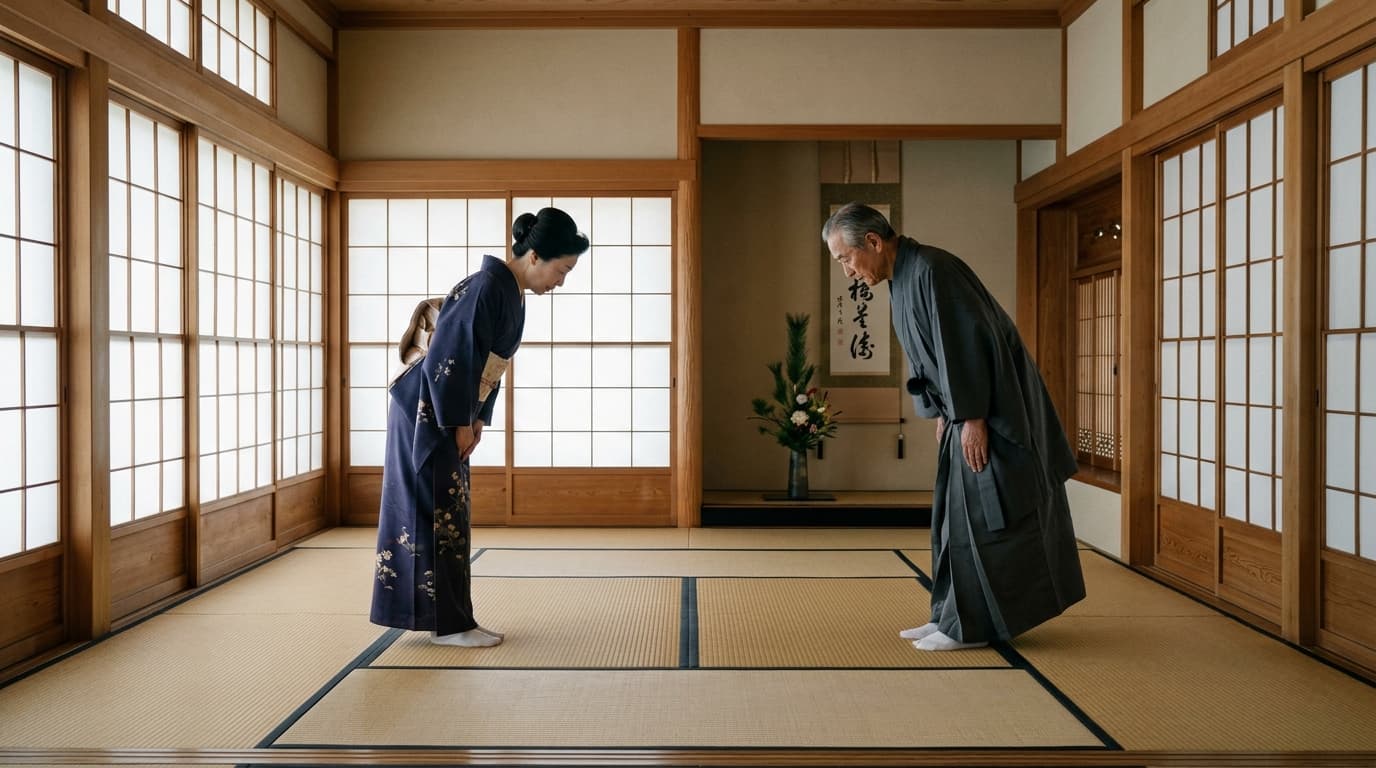
Welcome to J-Times! I'm Akira. Today on Japanese Manners Decoded, we dive into 'The Art of Bowing' — why 15 degrees changes everything. Kyoko here. Bowing is the first thing foreigners notice about Japan. But most don't realize there's an entire science behind it. Kenzo here. The bow, or 'ojigi,' is one of Japan's most important non-verbal communication tools. The angle, duration, and context all carry specific meanings. There are three main types. The 'eshaku' at about 15 degrees — a casual greeting for passing acquaintances. The 'keirei' at 30 degrees — the standard business bow. And the 'saikeirei' at 45 degrees — the deepest bow for apologies or showing utmost respect. In business, the person of lower status bows deeper and longer. When exchanging business cards, you'll see people trying to bow lower than each other — it's almost like a polite competition. I've seen some hilarious situations where two people keep bowing lower and lower, neither wanting to be the first to stop. It's actually quite endearing. The bow conveys so much without words: respect, gratitude, apology, greeting. A deep bow from a company president during a scandal carries more weight than any press release. For foreigners visiting Japan, a slight head nod or a 15-degree bow is perfectly acceptable. Japanese people don't expect perfect form from visitors — the effort itself is appreciated. One important thing: you don't shake hands and bow at the same time. If someone extends their hand, shake it. If they bow, bow back. Don't try to do both simultaneously. In retail and service industries, employees practice their bows to perfection. Department store greeters bow at exactly the right angle, held for exactly the right duration. It's a trained art. Even on the phone, Japanese people bow! You can't see it, but they do it instinctively. It shows how deeply embedded the bow is in the cultural psyche. The bow also has a spiritual dimension. In shrines and temples, the bow is part of worship. Two bows, two claps, one bow — that's the standard prayer ritual at Shinto shrines. What I love about bowing is that it's a moment of mutual respect. Both people acknowledge each other. There's something beautiful about that compared to just saying 'hey.' In martial arts, the bow before and after practice or a match is essential. It represents respect for your opponent, your teacher, and the art itself. Without the bow, there is no martial art. As Japan becomes more international, the bow is evolving too. Many young Japanese people now combine a slight bow with a wave or handshake. The form changes, but the spirit of respect remains. So remember: when in Japan, a sincere bow — even an imperfect one — shows that you respect and appreciate Japanese culture. That's what matters most. Thanks for listening to J-Times! Bow with respect and catch those Matsuri Coins. See you next time!