J-Times Editorial
J-Times 編集部 / J-Times Editorial Team
Tori-no-ichi is a November fair at Tokyo's Otori shrines where people buy decorated kumade rakes to 'rake in' luck. In 2026 it falls on 7 and 19 November. Venues, hours, how to buy a kumade, and etiquette, from the shrines' own pages.
Read this article to earn +5 MTC
Tori-no-ichi in Tokyo: 2026 dates and how to buy a kumade rake
Short answer (as of 2026-10-02): Tori-no-ichi is a fair held on the Rooster days of November at Tokyo's Otori shrines, where people buy decorated bamboo rakes (kumade) to "rake in" good fortune for the coming year. In 2026 the Rooster days are Saturday 7 November and Thursday 19 November. There is no third one this year.
Disclosure: J-Times and Matsuri are both operated by Jon&Coo Inc. This article mentions a Matsuri event once, near the end. Everything else comes from the shrines' and temple's own pages, the Tokyo Convention & Visitors Bureau, the Tokyo Fire Department and the encyclopedias listed at the end, all checked on 2 October 2026.
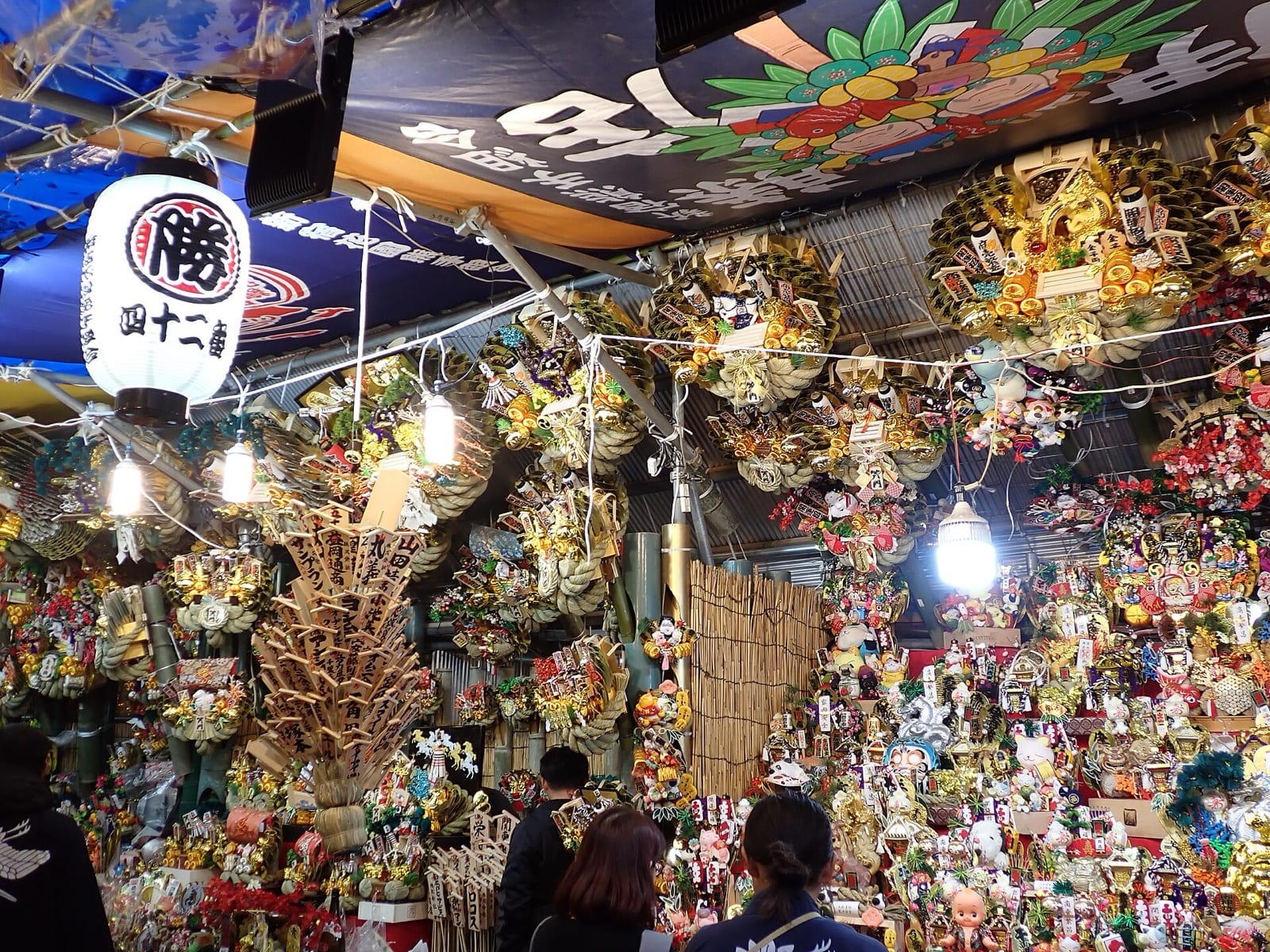
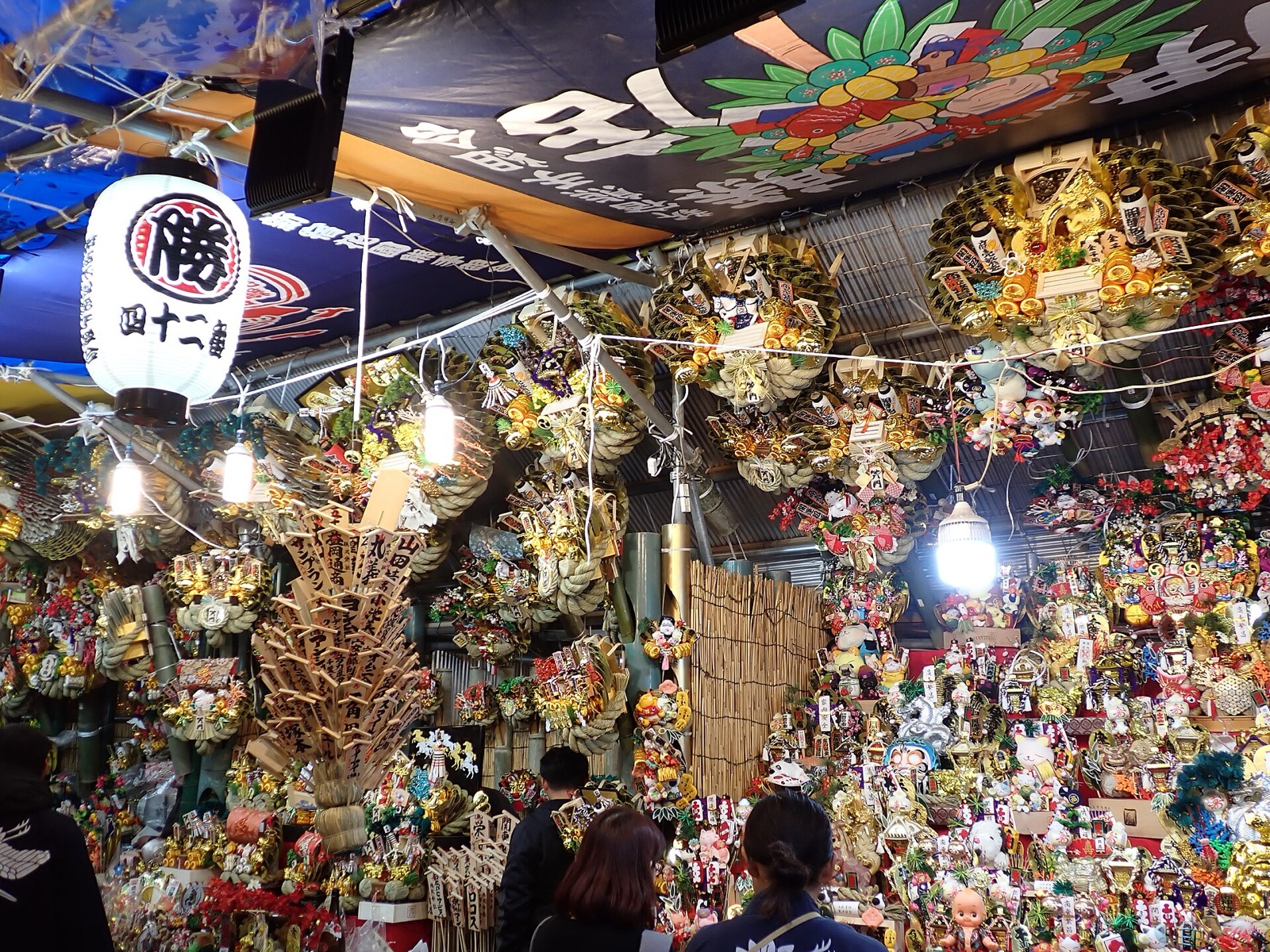
On a November night at an Otori shrine, every stall is stacked to the roof with gold: rakes covered in paper coins, rice bales, treasure ships and the smiling mask of Okame. Now and then a burst of rhythmic clapping means someone has just bought one. Tori-no-ichi has been part of the Tokyo year since the Edo period and is still held on fixed calendar days, weekday or not. This guide covers the 2026 dates, the main venues and how buying a kumade works.
What is Tori-no-ichi?
Tori-no-ichi ("Rooster fair") is the November festival of shrines dedicated to the Otori (eagle or "great bird") deity, at which stalls sell kumade rakes and other good-luck charms for business and household fortune.
The Nipponica encyclopedia defines it as the festival of Otori shrines on the Rooster days of November, once called tori no machi, honouring Yamato Takeru as a deity of luck and business. Asakusa's Otori Shrine (known locally as Otori-sama) says on its history page that the proper name of its festival is tori no machi, and that a market grew up around it.
It is mainly a Kanto custom: the Britannica Japan encyclopedia describes it as held in Tokyo and the surrounding region, so expect few options in Kyoto or Osaka.
When is Tori-no-ichi in 2026?
In 2026 the first Rooster day (ichi-no-tori) is Saturday 7 November and the second (ni-no-tori) is Thursday 19 November. There is no third Rooster day (san-no-tori) this year.
The twelve zodiac animals are applied to days as well as years, so a Rooster day comes round every 12 days and November has either two or three of them, as the Asakusa temple's Q&A explains. In 2026 the next one after 19 November is 1 December.
The Asakusa Otori Shrine, the neighbouring Chōkokuji temple, Meguro's Ōtori Shrine and Hanahata's Ōwashi Shrine all publish these two dates, and the Asakusa shrine states that 2026 runs only to the second Rooster day. The Tokyo Convention & Visitors Bureau's GO TOKYO page, updated on 1 October 2026, lists the same days.
Where are the main Tori-no-ichi fairs in Tokyo, and what are the hours?
Asakusa is the largest and runs for 24 hours on each day. Meguro, Shinjuku (Hanazono Shrine) and Hanahata in Adachi publish shorter hours. All dates and hours below were checked on the official pages on 2 October 2026.
| Venue | 2026 dates | Hours (as published) | Nearest station (official access page) |
|---|---|---|---|
| Otori Shrine and Chōkokuji temple, Asakusa (Senzoku 3-chome, Taitō) | 7 and 19 Nov | Shrine: midnight to midnight (0:00-24:00) each day | Iriya (Hibiya Line) exit 3, about 7 min; Tsukuba Express Asakusa, about 8 min |
| Ōtori Shrine, Meguro (Shimo-Meguro 3-chome) | 7 and 19 Nov | 8:00-22:00 | JR Meguro, west exit, 7 min |
| Hanazono Shrine, Shinjuku | Eve 6 Nov, main day 7 Nov; eve 18 Nov, main day 19 Nov | Stalls about 15:00-24:00 on the eves, about noon-24:00 on the main days (announced 7 October 2026); about 260 stalls | Shinjuku-sanchome exit E2, 0 min; JR Shinjuku east exit, 7 min |
| Ōwashi Shrine, Hanahata (Adachi) | 7 and 19 Nov | Gates 5:00 to about 24:00, closed late at night | Bus from Yatsuka (Tobu) or Rokuchō (TX); shuttle bus from temporary parking 9:00-21:00 |
| Okunitama Shrine, Fuchū (its Ōwashi sub-shrine) | 7 and 19 Nov (festival calendar) | Not listed on the calendar page | — |
Asakusa. The Otori Shrine and Chōkokuji temple stand side by side. According to the shrine, the festival starts with the "first drum" at midnight and runs for 24 hours. The temple's Q&A adds that some stalls open from about 19:00 the evening before and many stay open until about 2:00 the morning after, and that its charm counter closes from about 2:00 to 9:00. The two were one institution until Shinto and Buddhism were separated in the early Meiji era, which is why a shrine and a temple share one fair (see Shrine vs temple: Shinto and Buddhism in Japan explained).
Meguro. Ōtori Shrine performs sacred kagura dances, including a "kumade dance", at 19:00 on both days, and on 19 November the Edo Firefighting Memorial Society sings kiyari work songs at about 10:10.
Shinjuku. Hanazono Shrine calls its fair the Ōtori-sai and holds an eve (zenyasai) the night before each main day. Its notice of 7 October 2026 gives stall hours of about 15:00 to midnight on the eves (6 and 18 November) and about noon to midnight on the main days (7 and 19 November), with about 260 stalls; lanterns go out around midnight. Entry to the grounds may be restricted when crowded (after 18:00), the shrine's own hana-kumade are offered in limited numbers on the main days only, and goshuin are pre-written during the fair.
How did Tori-no-ichi begin?
There are several origin stories. The sources agree that it was a major Edo event by the second half of the 1700s, first at Hanamata (today's Hanahata in Adachi) and then, most famously, in Asakusa.
- The shrine's legend. Asakusa's Otori Shrine says that Yamato Takeru, returning from his eastern campaign, gave thanks at the shrine and hung a kumade (then also a weapon) on a pine in front of it. That day was a Rooster day in November, and it became the shrine's festival day. The Britannica Japan encyclopedia records the same story.
- The harvest festival at Hanamata. Chōkokuji's site says the fair began as a harvest festival for the deity of Hanamata village, today's Hanahata in Adachi. Farmers offered live chickens, which were then released in front of Sensōji in Asakusa. The Nipponica encyclopedia also describes Hanahata as the "original" Tori of the Edo period, with the same chicken offering. Hanahata's shrine dates its festival to the Ōei era (1394-1428).
- The move to Asakusa. According to Chōkokuji, a gambling ban in the An'ei era (1772-1781) ended the street gambling that drew crowds to Hanamata, and the crowds moved to Asakusa, which had enshrined the Otori deity around 1771. The shrine and the Heibonsha encyclopedia give another reason: the Yoshiwara pleasure quarter was next door.
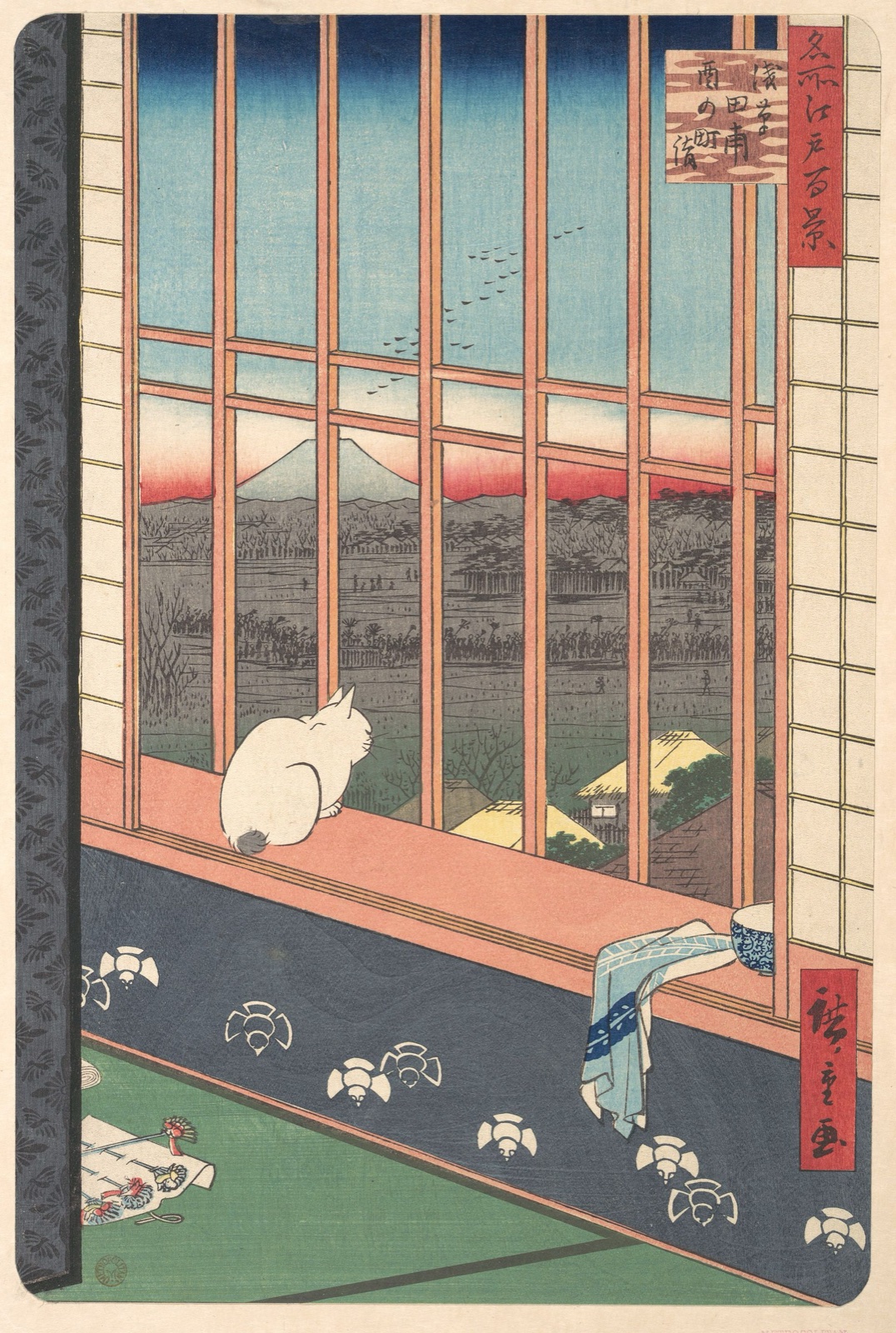
The poet Takarai Kikaku, a disciple of Bashō, wrote haru wo matsu / koto no hajime ya / tori no ichi: "waiting for spring, the first thing of all: the Rooster fair." Both the shrine and the temple quote it: Tori-no-ichi was the first event of the new-year season.
What is a kumade, and why do people buy one?
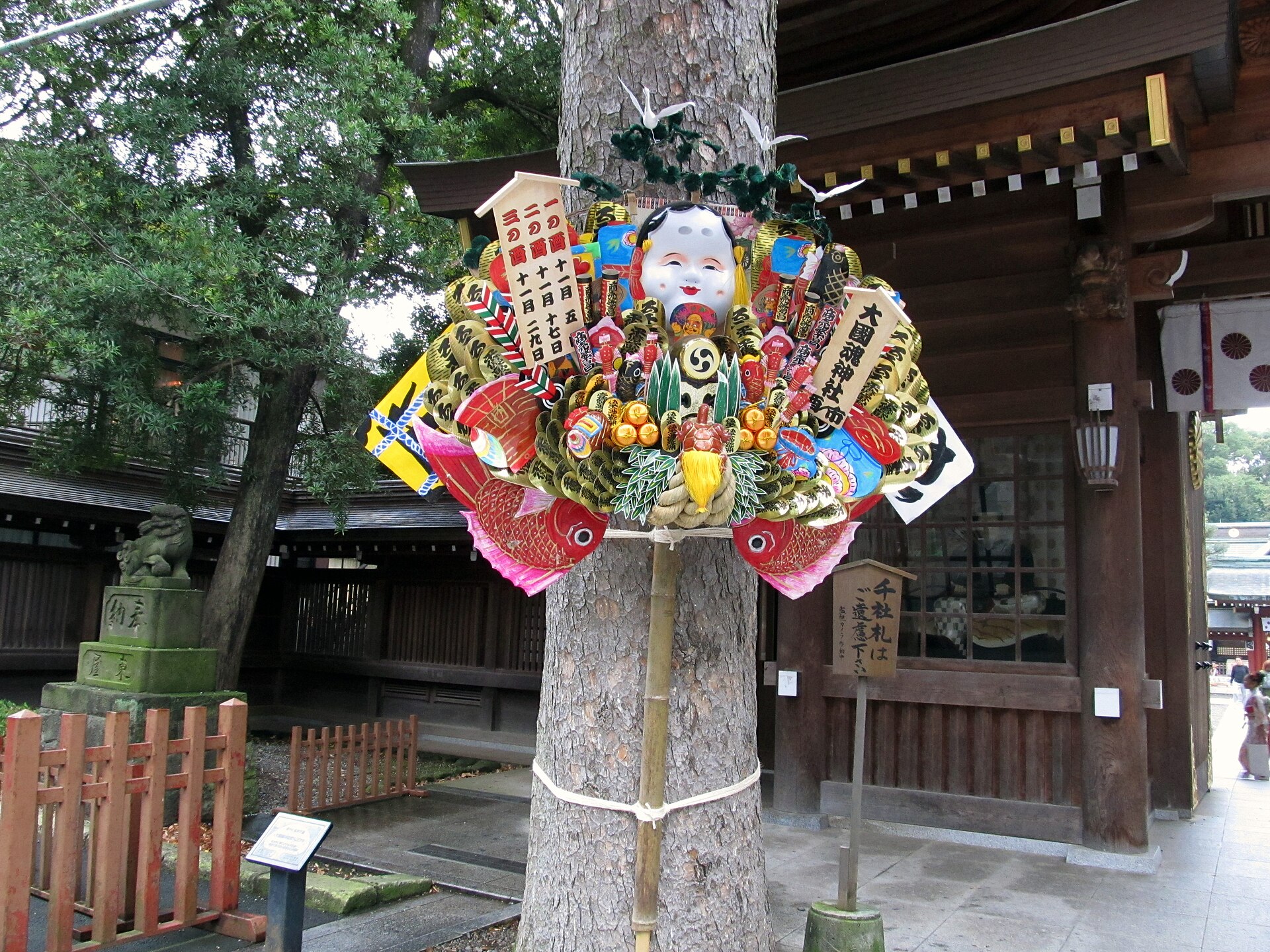
A kumade is a bamboo rake. At Tori-no-ichi it becomes a lucky charm that "rakes in" fortune and wealth, decorated with Okame masks, gold coins, rice bales and treasure ships.
The Nipponica entry on kumade describes the farm tool for gathering leaves and notes that the decorated versions sold at the November fairs "gather in good fortune"; Meguro's Ōtori Shrine says the rake sweeps treasure into the house. You will see two kinds:
- The charm rake (kumade omamori, nicknamed kakkome). A small bamboo rake with a talisman and ears of rice, given out by the shrine or temple itself. Asakusa's Otori Shrine gives its kakkome only at Tori-no-ichi.
- The decorated rake (engi kumade). The big rakes sold by craftsmen at the stalls. Chōkokuji's site lists the main styles, from the treasure-ship rake with the Seven Lucky Gods and the Okame-mask rake to fan-shaped and basket-style ones, down to palm-sized miniatures.
How do you buy a kumade?
Pray at the shrine first, walk the whole fair before choosing, then agree a price with the stallholder. Paying the discount back as a tip (goshugi) and the closing round of clapping (tejime) are customs, not rules.
Here is the order Asakusa's Otori Shrine suggests on its own trivia page, with what Chōkokuji's Q&A adds:
- Visit the shrine first. The usual order, the shrine says, is to pray, receive the shrine's own kumade omamori, then buy a decorated rake. For the basics, see how to visit a Japanese shrine, step by step.
- Set a budget and look around. The shrine recommends walking the whole grounds first: the number and type of decorations change the price even at the same size.
- Start small. The shrine says the custom is to begin with a small rake and buy a bigger one each year as your business or household prospers. On prices, it says small rakes start at about ¥1,000, large ones can cost hundreds of thousands of yen, and the best sellers are "reportedly" around ¥20,000-50,000.
- Haggle, if you like, and give the discount back. The shrine calls the bargaining part of the fun and says the old "stylish" way was to leave the amount knocked off with the stall as a tip. Chōkokuji's Q&A agrees but says the tip is a custom, not a requirement, and that some stalls today simply quote a price by size and decoration. Treat it as play, not a hard bargain.
- Join the clapping. When a sale is agreed, the stallholders lead a tejime, a rhythmic round of hand-clapping that seals the deal and wishes the buyer a prosperous year. The shrine and the Heibonsha encyclopedia both describe it.
- Bring last year's rake back. Chōkokuji asks visitors to leave the previous year's kumade at the return points at the temple and the shrine entrance. If you cannot, it suggests a local shrine's New Year bonfire for a very small one, or taking a large one apart and disposing of it under local rubbish rules, with thanks.
Where to hang it: Chōkokuji's Q&A suggests a high spot by the front door facing inward, so fortune comes in, or a high spot facing south, east or west. It is said to be better not to face it north.
Is a year with a third Rooster day really a fire year?
There is a well-known saying that years with a san-no-tori have more fires, but the Tokyo Fire Department says there is no evidence for it. 2026 has no third Rooster day anyway.
The Tokyo Fire Department's reference page, quoting a 2001 firefighting encyclopedia, finds no proof and suggests that wives spread the saying to stop their husbands slipping off to the Yoshiwara after the fair. Asakusa's Otori Shrine lists the same Yoshiwara story, a warning for the cold, dry season when people light more fires, and an old belief that a rooster crowing in the evening means fire. The Britannica Japan and Heibonsha encyclopedias record the saying as a folk belief. The next year with three Rooster days in November is 2027, on 2, 14 and 26 November by the calendar cycle.
What else is sold at Tori-no-ichi?
Besides kumade, look for yatsugashira taro and kiri-zanshō sweets. Both are traditional lucky foods of the fair.
- Yatsugashira (also tō-no-imo). A large taro root. Asakusa's Otori Shrine says it is a charm for rising to the "head" of others and, because one root sprouts many shoots, for having children.
- Kiri-zanshō. A thin rice-flour sweet flavoured with Japanese pepper (sanshō), lucky, the shrine says, because every part of the sanshō tree is useful.
- Kogane-mochi. Golden millet cakes, sold as a charm for wealth in the Edo period. The shrine says they are no longer sold at its fair.
The Nipponica and Britannica entries also list the taro and the golden millet cakes among the fair's lucky goods.
How crowded does it get, and when should you go?
Very. Asakusa's shrine reports 700,000 to 800,000 visitors a year, and Hanazono Shrine has restricted entry at busy times after 18:00. If you want room to look at the rakes, our suggestion is to go earlier in the day.
The shrine's own figures also count about 150 kumade stalls and about 750 stalls in all. In 2025 Chōkokuji reshaped its queue along Kokusai-dōri for safety because it expected more visitors than the year before, and asked visitors to follow staff directions. Hanazono Shrine's 2025 notice said entry could be restricted when crowded after 18:00.
In 2026 the first day is a Saturday and the second a Thursday. The temple says the Asakusa fair goes ahead in rain or snow unless the weather is dangerous. Check each venue's page before you go, since hours can change.
For everything else on in Tokyo that month, see Tokyo festivals and cultural events in November 2026. For the wider festival calendar, see Japanese festivals: the ultimate cultural experiences and Japan's four seasons: when to visit in 2026.
The Matsuri feature
The day after ichi-no-tori, on Sunday 8 November 2026, 16:00-22:00, Matsuri holds a release event in Ebisu, Tokyo (Matsuri and J-Times are both run by Jon&Coo Inc.). Details will be on the Matsuri event page. Start from the hub: What is Matsuri? A guide to finding cultural experiences in Japan.
Sources and dates checked (all checked on 2026-10-02)
- Asakusa Otori Shrine, "This year's Tori-no-ichi" (2026 dates, held up to ni-no-tori, 0:00-24:00, midnight drum) — https://otorisama.or.jp/kotoshi.html (primary)
- Asakusa Otori Shrine, "History" (Yamato Takeru legend, tori no machi, Kikaku's haiku, san-no-tori belief, kakkome) — https://otorisama.or.jp/yuisyo.html (primary)
- Asakusa Otori Shrine, "Tori-no-ichi trivia" (Edo's three fairs, Yoshiwara, about 150 kumade stalls and 700,000-800,000 visitors, yatsugashira, kiri-zanshō, how to buy a kumade, prices, tejime, san-no-tori explanations) — https://otorisama.or.jp/mame.html (primary)
- Asakusa Otori Shrine, English page and access page — https://otorisama.or.jp/english.html , https://otorisama.or.jp/access.html (primary)
- Chōkokuji temple, official Asakusa Tori-no-ichi site: home (2026 dates), Q&A (Rooster-day cycle, hours, stalls, tips, returning and hanging a kumade, rain), history, origin of the kumade, kinds of kumade, 2025 queue notice — https://torinoichi.jp/ , https://torinoichi.jp/qa/ , https://torinoichi.jp/about/ , https://torinoichi.jp/about/kumade/ , https://torinoichi.jp/about/kumade-kinds/ , https://torinoichi.jp/674/ (primary)
- GO TOKYO (Tokyo Convention & Visitors Bureau), "Tori-no-ichi Fair", updated 1 October 2026 (2026 dates for Asakusa) — https://www.gotokyo.org/en/spot/ev090/index.html
- Ōtori Shrine, Meguro, "Tori-no-ichi" (2026 dates, 8:00-22:00, kagura, kiyari, meaning of the kumade) and access — https://www.ootorijinja.or.jp/%e9%85%89%e3%81%ae%e5%b8%82/ , https://www.ootorijinja.or.jp/access/ (primary)
- Hanazono Shrine, events calendar 2026 (Ōtori-sai 6-7 and 18-19 November), 2026 Ōtori-sai notice posted 7 October 2026 (stall hours, about 260 stalls, entry restriction; checked 25 October 2026) and access — http://hanazono-jinja.or.jp/ceremony/ , http://hanazono-jinja.or.jp/news/%e4%bb%a4%e5%92%8c%e4%ba%94%e5%b9%b4%e5%a4%a7%e9%85%89%e7%a5%ad/ , http://hanazono-jinja.or.jp/access/ (primary)
- Ōwashi Shrine, Hanahata (2026 dates, 5:00 to about 24:00, shuttle bus), festivals page (Ōei-era origin, chicken offerings) and access — http://www.ootori-jinja.or.jp/ , http://www.ootori-jinja.or.jp/saiji.html , http://www.ootori-jinja.or.jp/access.html (primary)
- Okunitama Shrine, festival calendar (Ōwashi Shrine festival 7 and 19 November) — https://www.ookunitamajinja.or.jp/matsuri/ (primary)
- Tokyo Fire Department, "Are there more fires in a year with a san-no-tori?" (quoting Shin Shōbō Zatsugaku Jiten, 2001) — https://www.tfd.metro.tokyo.lg.jp/learning/elib/qa/qa_35.html (primary)
- Kotobank, "酉の市" (Nipponica; Heibonsha World Encyclopedia; Britannica Japan) — https://kotobank.jp/word/%E9%85%89%E3%81%AE%E5%B8%82-106482
- Kotobank, "熊手" (Nipponica) — https://kotobank.jp/word/%E7%86%8A%E6%89%8B-484953
- Wikipedia (Japanese), "酉の市" (list of Rooster days by year, cross-check only) — https://ja.wikipedia.org/wiki/%E9%85%89%E3%81%AE%E5%B8%82
- Images: Wikimedia Commons file pages (licences checked) — https://commons.wikimedia.org/wiki/File:Hanazono_shrine_tori_no_ichi_fair20251124.jpg , https://commons.wikimedia.org/wiki/File:Rake.Kumade_Torino-ichi-Festival_of_Ootori-Shrine_at_Ookunitama-Shrine_Fuchu-city_Tokyo_Japan_2024.no1.jpg , https://commons.wikimedia.org/wiki/File:%E5%90%8D%E6%89%80%E6%B1%9F%E6%88%B8%E7%99%BE%E6%99%AF_%E6%B5%85%E8%8D%89%E7%94%B0%E5%9C%83%E9%85%89%E3%81%AE%E7%94%BA%E8%A9%A3-Revelers_Returned_from_the_Tori_no_Machi_Festival_at_Asakusa,_from_the_series_One_Hundred_Famous_Views_of_Edo_MET_DP121510.jpg
By J-Times Editorial (information as of 2026-10-02)
Written by
J-Times Editorial
J-Times 編集部 / J-Times Editorial Team