J-Times Editorial
J-Times 編集部 / J-Times Editorial Team
Most Japanese festivals are run by the neighbourhood: mikoshi are carried by members of the local association, and many bon odori circles welcome anyone. What a matsuri means in Shinto, the carriers' rules, what to wear, what it costs and where to find a way in, in Tokyo.
Read this article to earn +5 MTC
How to join a Japanese festival: carrying a mikoshi, dancing bon odori and helping out (2026 guide)
Short answer (as of 2026-10-25): You can take part in many Japanese festivals, but mostly through the neighbourhood that runs them. Mikoshi (portable shrines) are usually carried by members of the local neighbourhood association, wearing that association's coat. Many bon odori dances, on the other hand, let anyone step into the circle.
Disclosure: J-Times and Matsuri are both operated by Jon&Coo Inc. This article mentions Matsuri once, at the end. Everything else comes from the Association of Shinto Shrines (Jinja Honchō), Asakusa Shrine, Kanda Myojin, Shinjuku City, encyclopedias and the other sources listed at the end, all checked on 25 October 2026.
A Japanese festival can look like a show put on for spectators. For the people inside it, it is something else: a year of meetings, a shared coat, and a few hours in which the neighbourhood carries its deity through its own streets. This guide is about stepping from the pavement into that circle: what a matsuri means, who decides who carries, what is expected of you, and where to find a way in, in Tokyo. If you want to know which big festivals to watch, start with Experiencing Japanese festivals: Gion Matsuri, Nebuta and Awa Odori.
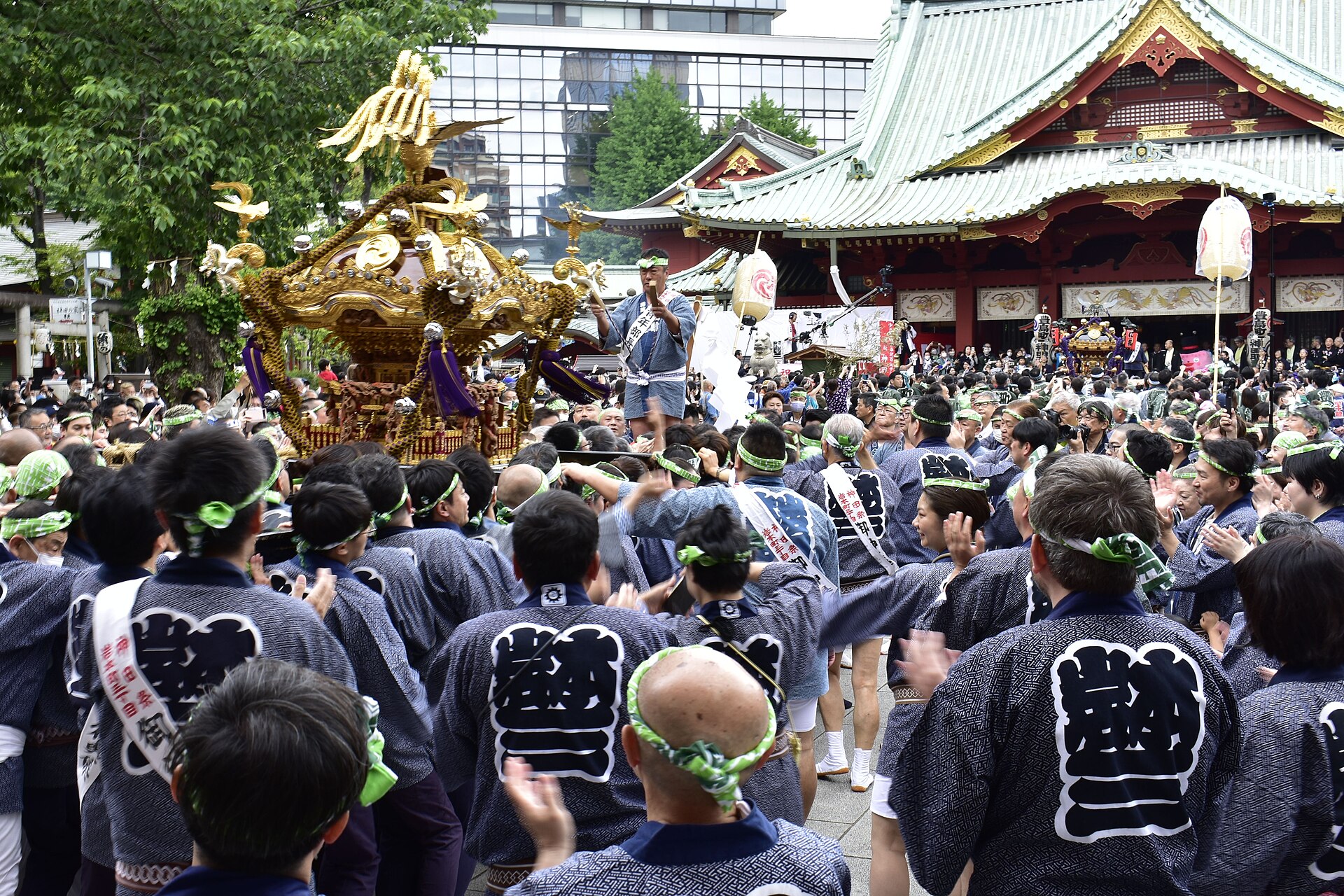
Photo: 江戸村のとくぞう (Edomura no Tokuzō) / Wikimedia Commons / CC BY-SA 4.0
What is a matsuri, from the Shinto point of view?
In Shinto, a matsuri is service offered to a deity (kami): the shrine welcomes the kami, offers food and prayers, and the people take part. During a mikoshi procession, the kami and the people are said to become one.
The Association of Shinto Shrines (Jinja Honchō), the national body of shrines founded in 1946, explains on its official site that a shrine is a place where a kami is invited and settled, and that serving that kami is what a "matsuri" is. It adds that the words for government and duty can also be read matsurigoto, so in a wider sense matsuri means serving society.
The same site describes the togyo-sai, the procession in which the kami moves into a mikoshi or float and is carried around its parish "by the hands of the parishioners". Through this festival, it says, the kami and the people become one; the people regain their energy, and the kami, pleased to see them, is believed to give its blessing to each household along the route.
After the ritual comes the naorai, when priests and participants share the food and sacred sake that were offered to the kami. Jinja Honchō calls this "eating together with the kami" (shinjin kyōshoku) and describes it as the root meaning of the festival. That is why a matsuri is often described as time that the kami and the people spend together.
Who runs a local festival?
A shrine festival is carried out by its ujiko, the people who live in the area the shrine protects, organised in practice through neighbourhood associations (chōkai).
Jinja Honchō's FAQ defines the ujigami shrine as the shrine of the area you live in, and the people living around it as its ujiko. The word once meant a blood-related clan, it explains, but today it is used for people connected by place. The same FAQ says that when you move house, your ujigami becomes the shrine of your new area. By the shrine world's own definition, then, belonging is a matter of where you live, not of where you were born.
Asakusa Shrine's Sanja Matsuri shows how this works in practice. The shrine says the festival is held mainly by its 44 parish neighbourhoods; on the second day about 100 neighbourhood mikoshi gather at the shrine, are purified one by one and then go back to tour their own streets. nippon.com's 2012 report on the festival describes how the 44 parish neighbourhoods share the carrying of the shrine's own mikoshi, on a schedule that took a year of meetings to set. On the day, each neighbourhood's youth group (seinenkai) runs the procession, and younger members follow behind to sweep and pick up rubbish.
For a newcomer, this means the festival has no general box office. The way in is the neighbourhood, or a group the neighbourhood has invited.
Can a foreigner carry a mikoshi?
Nationality is not what decides it. What usually matters is whether a neighbourhood association or carriers' group has taken you in, and whether you follow its rules.
None of the official rules quoted in this article mention nationality. The Sanja Matsuri carriers' rules (2023 edition, below) require every carrier to wear the coat specified by their neighbourhood association, so carriers take part as members of a neighbourhood's team.
Who carries has also changed over time. The Nipponica encyclopedia notes that in recent years some mikoshi are carried by women, and that in areas with fewer young people some mikoshi now travel on trucks. nippon.com's 2012 feature notes that, as the number of parishioners falls, many areas can no longer hold their festival without outside helpers known as katsugite (carriers). Many neighbourhoods need extra hands. They still expect those hands to come with an introduction and to follow the team's rules.
How do people actually get to carry one?
There are three realistic routes: through the association where you live, through a friend or workplace already in a team, or through a session a local association runs with an outside organiser.
- Where you live. If you live in Japan, you are already inside some shrine's parish. Shinjuku City's newsletter for foreign residents (July 2023) says the city alone has about 200 town councils and community groups, which run events, crime patrols and clean-ups, and tells readers to check their local notice board for upcoming community events. The same issue reported a bon odori held by the Shimo-Ochiai town council, which foreign students from a Japanese language school joined. A January 2019 issue invited foreign residents to join their local town council and said pamphlets were available in English, Chinese, Korean and Japanese.
- A friend, colleague or landlord. Many carriers join because they know someone in the team. nippon.com's 2012 feature notes that the carriers supporting one Sanja neighbourhood came from all over Japan, for reasons such as having friends in the neighbourhood association or liking its mikoshi or coat design.
- An organised session. Some associations work with outside organisers. For example, on 14 September 2025 the share-house operator Oakhouse ran a mikoshi session with a local association in Mukojima, Sumida-ku: three time slots of eight people, ¥1,500 per carrier including hanten coat rental and cleaning, with your own jikatabi shoes. Its page showed at least two of the three slots full before the application deadline. J-Times did not find a 2026 edition, so treat this as an example of the format, not a current offer.
If a mikoshi passes you in the street, do not just join it. Every carrier around it belongs to a team that has planned the route and the timing, and is wearing that team's coat.
What are the rules when you carry a mikoshi?
The mikoshi is the vehicle of the kami. Do not ride on it, do not carry it after drinking, wear your team's coat, keep to the planned route and times, and follow the organisers, police and fire service.
Jinja Honchō describes a mikoshi as the vehicle (norimono) in which the spirit of the kami is enshrined; its shape follows the shrine buildings, and it grew out of the palanquins used by emperors and nobles. Asakusa Shrine explains that carriers shake and swing the mikoshi on purpose. This is tamafuri, "shaking the spirit", which is believed to strengthen the kami's power and bring good harvests and catches and drive away disease. The roughness is part of the ritual, which is why the rules around it are strict.
Asakusa Shrine and its supporters' association set these rules for the 2023 Sanja Matsuri, and asked each neighbourhood to follow them on its own processions too:
- Never climb on top of the mikoshi.
- Always wear the coat (hanten) specified by your neighbourhood association.
- No violence.
- Do not carry the mikoshi after drinking alcohol.
- Follow the supporters' association's guidelines.
- Keep to the times applied for by the association and each neighbourhood.
- Follow the planned route and do not block main roads.
- Follow the instructions of the association, police and fire service.
The rules end with a penalty: neighbourhoods that break them may have their routes limited in later years. Climbing on the mikoshi was once treated as a show of bravado. According to nippon.com, in 2006 a mikoshi collapsed under the weight of 15 people and a hard oak pole snapped, and riding has been strictly limited ever since, except for designated people giving signals while the mikoshi rests on its stand.
Sake has a real place in Shinto ritual: at the naorai, sharing the sacred sake is one way of receiving the kami's blessing. The rule is about carrying, not about the festival as a whole. A mikoshi weighs a great deal, the crowd is dense (nippon.com counted more than 3,000 carriers at the Sanja miyadashi), and a drunk carrier puts everyone under the pole at risk.
Before the festival, it is good manners to visit the shrine whose kami you will be carrying. See How to visit a Japanese shrine, step by step.
What should you wear?
Wear what your team specifies. Usually that is the team's hanten coat, which it often lends or hands out, plus split-toe jikatabi shoes with rubber soles and a headband. Ask the team for its list.
The Nipponica encyclopedia describes young parishioners carrying in matching happi coats and twisted headbands (nejiri hachimaki). At Sanja, the coat is required: it must be the one specified by your neighbourhood association. The 2025 Mukojima session gave carriers a hanten at check-in and asked them to bring a plain T-shirt, black or grey trousers and jikatabi. It specified the outdoor type with rubber soles, not soft sock-style tabi.
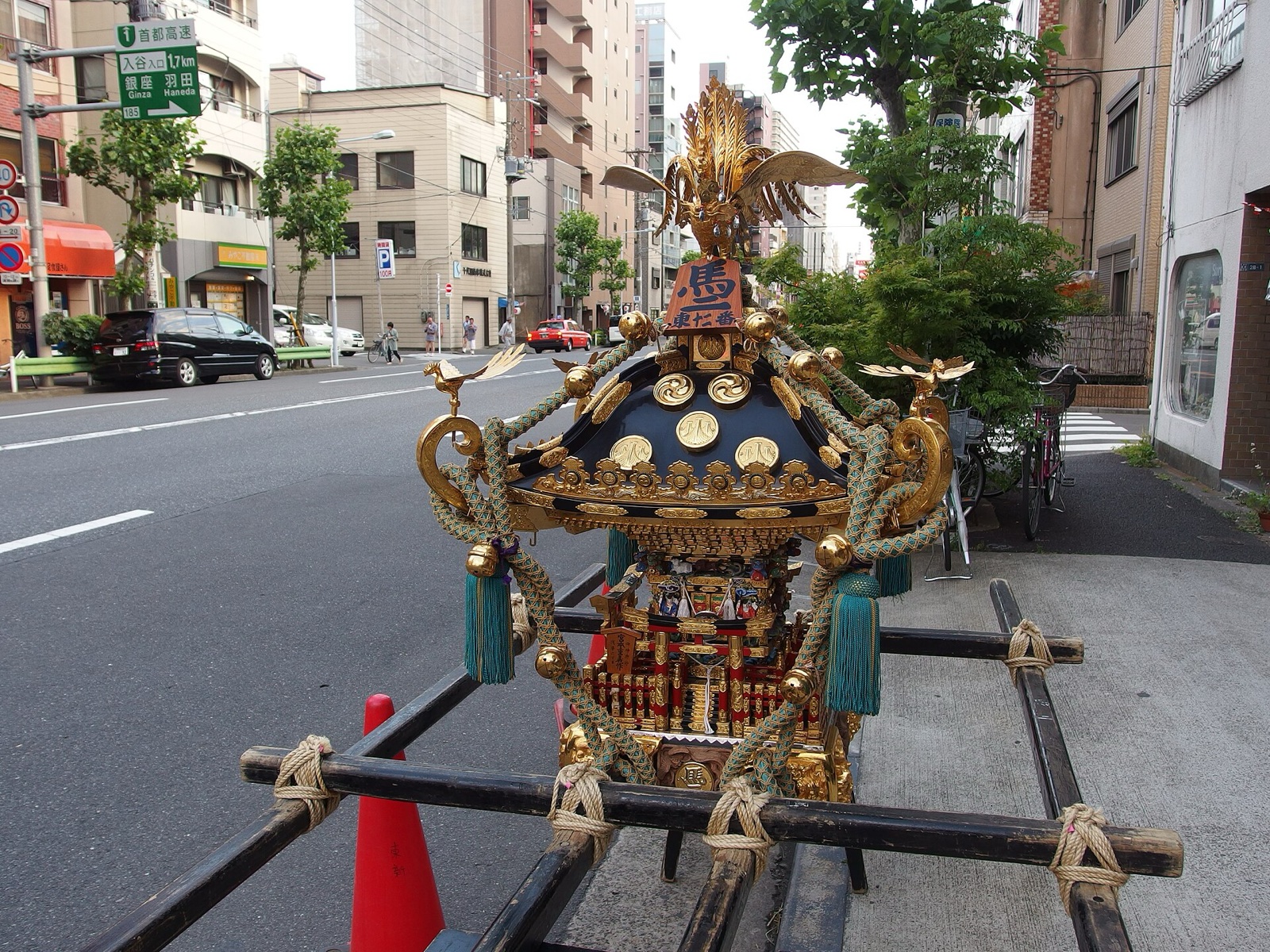
Photo: Guilhem Vellut / Wikimedia Commons / CC BY 2.0
A team's coat carries its name or crest, so wearing it means you represent that team for the day. Do not buy a random happi and turn up in it expecting to carry.
How does bon odori work, and can anyone join?
Bon odori is a circle dance held around the Obon season of remembering ancestors. Dancers circle a raised stand (yagura) where the musicians play, and many events invite anyone to join.
The Yamakawa Dictionary of Japanese History defines bon odori as the general name for dances held around Urabon (Obon), found all over Japan, usually as a circle dance around a yagura in temple grounds, at crossroads or in open spaces. It traces the dance to rites for sending off spirits and to the nenbutsu dances of medieval Buddhism. The Britannica Japan encyclopedia calls it a group dance to console the spirits of the dead that became more of an entertainment from the Muromachi period on. Bon odori therefore has Buddhist roots rather than Shinto ones, and it is held at temples, shrines and parks alike. On how the two traditions sit side by side, see Shrine vs temple: Shinto and Buddhism in Japan explained.
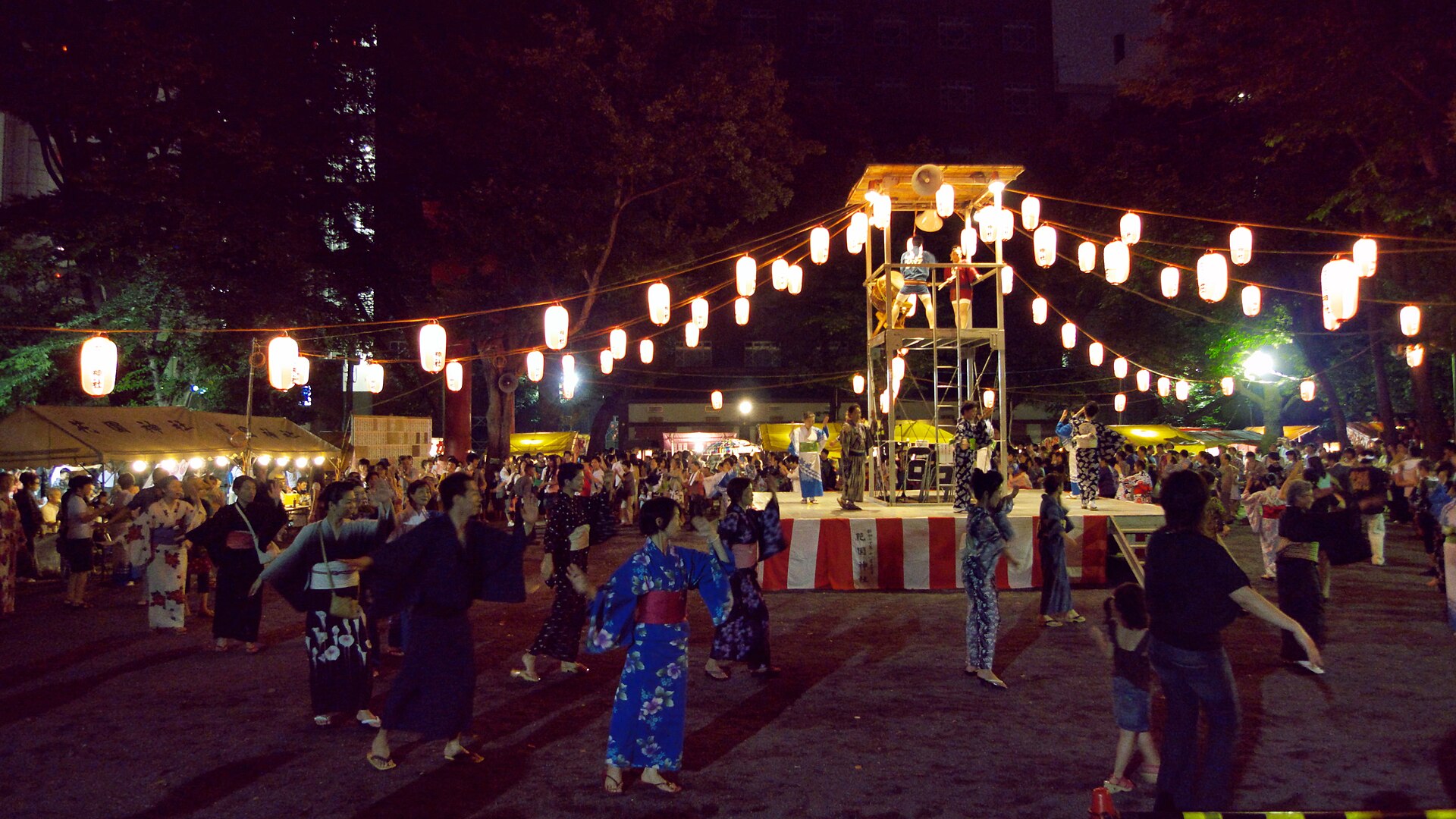
Photo: Yasu / Wikimedia Commons / public domain
Two Tokyo examples show how open these dances usually are:
- Nakano Ekimae Bon Odori (Nakano Central Park). Walkerplus listed the 14th edition for Saturday 1 and Sunday 2 August 2026, free, with folk songs including "Nakano Ondo" played live by the Nakano Ward folk song federation, and an invitation to join the dance circle.
- Marunouchi Ondo Bon Odori (Hibiya Park). The Chiyoda City Tourism Association's event page called it "drop-ins welcome", and explained that shopkeepers in Marunouchi, Yūrakuchō and Hibiya started it in 1932 to lift spirits in hard times; the song written for it became the basis of "Tokyo Ondo". Walkerplus says the 2026 edition was cancelled.
Our suggestion for a first time: join the outer ring and follow the dancer in front of you. The people in the circle are neighbours dancing for the season, not performers on a stage.
For the big dance festivals elsewhere in Japan, such as Awa Odori, see our festival guide.
Can you volunteer or help at a festival?
Yes, but mostly as part of a neighbourhood association, not through a public volunteer sign-up. On the official pages of Sanja Matsuri and Kanda Matsuri, J-Times found no open call for general festival volunteers as of 2026-10-25.
Much of the work behind a festival is done by residents for their neighbourhood. Shinjuku City describes its town councils as volunteer organisations that run events, patrols and clean-ups, and the 2012 nippon.com feature shows youth-group members managing the schedule and sweeping up behind the mikoshi. If you join your local association, these are the jobs you are likely to be offered first: setting up, clearing up, keeping the route clear. They are also how a team gets to know you.
Shrines themselves sometimes recruit seasonal helpers, but that is employment with conditions, not a festival experience. Asakusa Shrine's call for New Year shrine-maiden helpers, posted on 23 October 2026, is paid by the day, sets age and residence conditions, requires attendance at a briefing on 20 December 2026, and closes applications on 25 November 2026.
Where can you find a way in, in Tokyo?
Start with your own neighbourhood's notice board and association. For the big festivals, follow the shrine's official pages, and expect to join through a neighbourhood or its carriers' groups rather than as an individual.
| Where | Official status (as of 2026-10-25) | How people take part |
|---|---|---|
| Your local town council (chōkai) | Shinjuku alone has about 200 town councils and community groups (city newsletter, July 2023) | Local notice boards and the ward office's community section. Shinjuku said in 2019 that it has pamphlets in four languages. |
| Sanja Matsuri, Asakusa Shrine | Held over the Friday-Sunday based on the third Saturday of May; 2026 ran 15-17 May. 2027 dates not yet announced | Through the 44 parish neighbourhoods, under the carriers' rules above |
| Kanda Matsuri, Kanda Myojin | Held every two years; 2025 was a main year (procession on Saturday 10 May). 2026 is a "quiet year" with no procession or mikoshi entry. 2027 dates not yet announced | Through parish neighbourhood associations, which carry their own mikoshi into the shrine |
| Bon odori in summer | Most Tokyo dances are July-August; 2027 dates not yet announced | Join the circle. Check each event's own page for that year |
| Sessions run with an outside organiser | Past example: Mukojima, 14 September 2025 | Booked in advance, small groups, fee includes coat rental |
Tokyo's mikoshi season is spring and summer, so late October is the time to start getting to know people for next year. For what is on in Tokyo next month, see Tokyo festivals and cultural events in November 2026. Tori-no-ichi and the autumn shrine festivals there are for visiting and praying rather than carrying.
FAQ
Can foreigners carry a mikoshi?
Yes, if a neighbourhood association or carriers' group takes them in. The rules this article quotes do not mention nationality; they require carriers to wear their team's coat and follow its directions. Most people get in by living in the area or through a friend in a team.
What should I wear to carry a mikoshi?
Whatever your team specifies: usually its hanten coat, rubber-soled jikatabi and a headband. Sanja Matsuri requires the coat specified by your neighbourhood association. The 2025 Mukojima session lent the coat and asked for a plain T-shirt, dark trousers and outdoor jikatabi.
Does it cost money to take part?
Watching and joining a bon odori circle are often free. Organised mikoshi sessions charge a fee: ¥1,500 per carrier at the 2025 Mukojima session, including coat rental. You will usually need your own jikatabi; the same session charged an extra ¥1,500 if it supplied them.
Can women carry a mikoshi?
At many festivals, yes. The Nipponica encyclopedia notes that women now carry some mikoshi, and the 2025 Mukojima session was open to everyone. Practice still varies by neighbourhood and by mikoshi, so ask the team.
Can I drink while carrying?
Not at Sanja Matsuri: its rules forbid carrying a mikoshi after drinking. Sacred sake is shared at the naorai after the ritual, but carrying a heavy mikoshi in a dense crowd is not the time for it.
Can I join a bon odori if I do not know the dance?
Yes, at events that welcome drop-ins, such as those described above. Join the outer ring and follow the person in front of you.
The Matsuri feature
Carrying a mikoshi starts with getting to know people. If you are new to Tokyo and want somewhere to start, Matsuri (run by Jon&Coo Inc., like J-Times) lists community meetups and cultural walks in Tokyo. It does not arrange mikoshi carrying.
Sources and dates checked (all checked on 2026-10-25)
- Association of Shinto Shrines (Jinja Honchō), "What is a shrine festival?", "Mikoshi and floats", "Togyo-sai", "Naorai", "Ancestral rites (Obon)" — https://www.jinjahoncho.or.jp/omatsuri/jinjanoomatsuritoha/ , https://www.jinjahoncho.or.jp/omatsuri/mikoshi_dashi/ , https://www.jinjahoncho.or.jp/omatsuri/togyosai/ , https://www.jinjahoncho.or.jp/omatsuri/naorai/ , https://www.jinjahoncho.or.jp/omatsuri/obon/ (primary)
- Jinja Honchō, FAQ (ujigami and ujiko, moving house) — https://www.jinjahoncho.or.jp/faq/ (primary)
- Asakusa Shrine, "What is the Sanja Matsuri?" (44 parish neighbourhoods, about 100 neighbourhood mikoshi, about 1.8 million visitors, tamafuri) — https://asakusajinja.jp/sanjamatsuri/about/ (primary)
- Asakusa Shrine and Asakusa Shrine Hōsankai, "2023 Asakusa Shrine Grand Festival: mikoshi procession participation rules" (24 April 2023) — https://www.sanjasama.jp/img/202305/r5_kiyaku_choukai.pdf (primary)
- Asakusa Shrine Hōsankai, Sanja Matsuri official information (2026 schedule, 15-17 May) — https://www.sanjasama.jp/ (primary)
- Asakusa Shrine, "Call for New Year shrine-maiden helpers, 2027" (posted 23 October 2026) — https://asakusajinja.jp/2026/10/23/%e4%bb%a4%e5%92%8c9%e5%b9%b4%e6%ad%a3%e6%9c%88%e5%b7%ab%e5%a5%b3%e5%8a%a9%e5%8b%a4%e5%8b%9f%e9%9b%86/ (primary)
- Kanda Myojin, Kanda Matsuri pages (every two years; 2025 schedule; 2026 is a quiet year) — https://www.kandamyoujin.or.jp/ , https://www.kandamyoujin.or.jp/kandamatsuri/ , https://kandamatsuri.com/ (primary)
- nippon.com, "Sanja Matsuri in nine keywords" and "The Sanja Matsuri story: Komagata's 40 minutes" (2012) — https://www.nippon.com/ja/views/b01205/ , https://www.nippon.com/ja/views/b01204/
- Kotobank, "神輿" (Nipponica; Sekai Dai-Hyakka Jiten) — https://kotobank.jp/word/%E7%A5%9E%E8%BC%BF-138437
- Kotobank, "盆踊" (Yamakawa Dictionary of Japanese History; Britannica Japan) — https://kotobank.jp/word/%E7%9B%86%E8%B8%8A-134976
- Shinjuku City, Shinjuku News No. 70 (1 July 2023, "Have fun at events in your community") and No. 55 (1 January 2019, "Town councils and community groups") — https://www.foreign.city.shinjuku.lg.jp/en/wp-content/uploads/sites/3/2023/08/Shinjuk2307_E.pdf , https://www.foreign.city.shinjuku.lg.jp/en/wp-content/uploads/sites/3/2023/08/Shinjuku1901E.pdf (primary)
- Chiyoda City Tourism Association (Visit Chiyoda), "Hibiya Park Marunouchi Ondo Bon Odori" (event page) — https://visit-chiyoda.tokyo/app/event/detail/7 (primary)
- Walkerplus, "Hibiya Park Marunouchi Ondo Bon Odori [2026 cancelled]" (information as of May 2026) and "14th Nakano Ekimae Bon Odori" (as of August 2026) — https://summer.walkerplus.com/odekake/detail_e/ar0313e04791/ , https://summer.walkerplus.com/odekake/detail_e/ar0313e605647/
- Oakhouse, "[2025.9.14] Carry the Mikoshi, feel the Festival!" — https://www.oakhouse.jp/eng/event/1522
- Matsuri events page (read-only check, HTTP 200) — https://matsuri.group/en/events/
- Images: Wikimedia Commons file pages (licences checked) — https://commons.wikimedia.org/wiki/File:Kanda_Matsuri_20230514b.jpg , https://commons.wikimedia.org/wiki/File:Mikoshi_@_Sanja_Matsuri_@_Asakusa_(14208074606).jpg , https://commons.wikimedia.org/wiki/File:Bon_odori_at_Hanazono_Shrine.jpg
By J-Times Editorial (information as of 2026-10-25)
Written by
J-Times Editorial
J-Times 編集部 / J-Times Editorial Team