J-Times Editorial
J-Times 編集部 / J-Times Editorial Team
KFC became Japan's Christmas meal after KFC Japan's first Christmas campaign in December 1974. The origin stories are anecdotes; the sales are on record.
Read this article to earn +5 MTC
Why do Japanese people eat KFC on Christmas?
Short answer (as of 2026-09-23): Because KFC Japan made it a habit. Its first Christmas campaign ran in December 1974, and the famous origin stories behind it are company and founder anecdotes, not documented history.
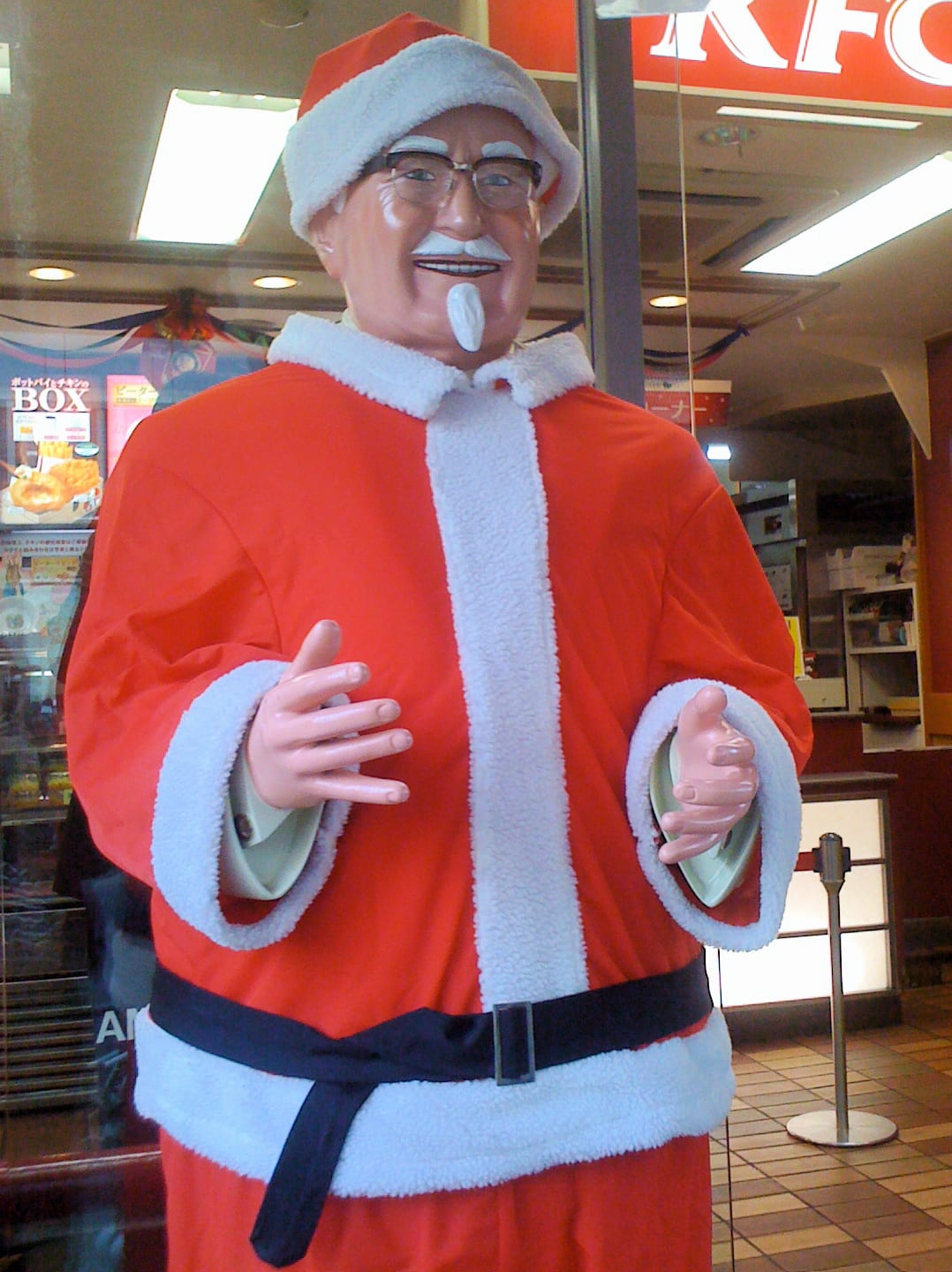
Every December, KFC stores across Japan dress their Colonel Sanders statues in Santa suits, families pre-order buckets weeks in advance, and queues form on 24 December. To many visitors it looks like an ancient custom. It is about fifty years old, and it began as a marketing campaign. What makes the story worth telling carefully is that three different "how it started" versions circulate, told by the company and by the manager who launched it, and they do not agree. This article separates what KFC Japan's own records show from what rests only on anecdote, and gives the sales figures the company has actually published.
When did KFC become a Christmas tradition in Japan?
KFC Japan's official company timeline records its "first Christmas campaign" in December 1974, four years after the company was founded.
KFC arrived in Japan in 1970. According to the company's own history page, an experimental American KFC stand at the Osaka World Expo in March 1970 took up to 2.8 million yen in a single day. In July 1970 Kentucky Fried Chicken Japan was set up as a 50–50 joint venture between the US KFC Corporation and Mitsubishi Corporation, and the first store opened in Nishi Ward, Nagoya, in November 1970. Tokyo followed in July 1971 with the Aoyama store, the chain's fifth. Television advertising began in October 1973, and the 100th store opened in December 1973.
The next entry is the one that matters here: "December 1974 — first Christmas campaign." The BBC, reporting in 2016, gives the campaign's slogan as Kurisumasu ni wa Kentakkii — "Kentucky for Christmas" — and Business Insider (Japanese edition, 2018) also dates the nationwide rollout to 1974. The company timeline itself records only the campaign, not the slogan wording, so we attribute the slogan to those reports.
Two more dates come straight from KFC Japan's press releases. The Christmas Party Barrel — the red-and-white bucket that is now the symbol of the season — was launched in 1985; the company marked its 40th anniversary with a new TV commercial on 1 December 2025. And the collectible Christmas plate that came with the Party Barrel ran from 1995 to 2024, when the company announced its 29th edition would be the last.
Where did the idea come from? Three versions of the story
There is no single documented origin. The company and the manager credited with the idea have told at least three different versions, and all of them are anecdotes.
The central figure is Takeshi Okawara, an early KFC Japan store manager who later ran the company. The BBC describes him as Harvard-educated and says he was president and CEO of KFC Japan from 1984 to 2002; Business Insider also dates his appointment as president to 1984. The versions differ on what inspired him.
Version 1: foreign customers who missed turkey. In the BBC's 2016 article, KFC Japan spokesperson Motoichi Nakatani said Okawara, "the manager of the first KFC in the country", overheard foreign customers saying they missed turkey at Christmas, and came up with the idea of a Christmas "party barrel". A long-running Japanese food-industry series on the website Gaishoku.biz tells a similar story set at the Aoyama store in Tokyo in 1971 or 1972: a foreign customer said he was holding a Christmas party but could not get turkey in Japan, so he would serve KFC instead. Business Insider reports that KFC's global parent, Yum! Brands, also credits a foreign visitor who suggested chicken in place of turkey.
Version 2: a kindergarten Christmas party. In a 2018 Business Insider podcast (Household Name), Okawara himself told a different story: a mission (Christian) kindergarten near his store asked him to come to its Christmas party dressed as Santa, with fried chicken. He danced through the classrooms with a bucket, the party was a hit, and other kindergartens asked for the same.
Version 3: "I lied." In the same podcast, Okawara said that when NHK interviewed him and asked whether fried chicken was really a Western Christmas custom, he said yes — knowing that people in the West ate turkey. "I lied," he said, adding that he still regretted it. Business Insider set his account beside Yum! Brands' different version without choosing between them, and we cannot either.
Note also a small contradiction inside the stories themselves. English-language versions say Okawara managed "the first" KFC in Japan; the company timeline puts the first store in Nagoya, while the Japanese retelling puts the turkey conversation in Aoyama, the fifth store. We could not find a document that settles which store it was. The product timing is also loose: the BBC's version has Okawara dreaming up a Christmas "party barrel" shortly after 1970, while KFC Japan's 2025 press release dates the launch of the Party Barrel product to 1985. Both can be true — an idea in the 1970s, a named product later — but no document we found connects them.
Is it true that foreigners thought KFC was turkey?
No record shows that. The turkey story is an anecdote told by KFC Japan and its parent company, and it is about foreigners choosing chicken because turkey was hard to find — not mistaking one for the other.
This is the part most often garbled online. In every version we could trace, the foreign customers knew perfectly well that KFC was fried chicken; the point of the story is that it was the nearest thing to a Christmas roast they could buy. Even so, the story reaches us only through company spokespeople and industry retellings, decades after the fact. Treat it as the company's founding legend.
The other common myth runs the other way: that fried chicken is a normal Christmas meal in America. It is not, and the man credited with the campaign has said on record that he knowingly let that impression stand.
What is documented is modest but solid: a first Christmas campaign in December 1974 (company timeline), a Party Barrel launched in 1985 (company press release), and, from 2021 onwards, the company's own year-end sales announcements.
How big is Christmas for KFC Japan?
Very big. KFC Japan's own announcements put store sales at 7.2 billion yen over seven days in December 2021, 6.4 billion yen over three days in 2022, and 7.0 billion yen over three days in 2023 — all preliminary figures.
Each year from at least 2021 to 2023, KFC Japan published a short thank-you notice on 28 December giving Christmas sales across its stores. The periods are not the same length, so the figures should not be read as a trend:
| Year | What KFC Japan published | Period | Source |
|---|---|---|---|
| 1970 | Expo test store; company founded (July); first store, Nagoya (November) | — | KFC Japan company history |
| 1971 | Aoyama store opens (fifth store, first in Tokyo) | July | KFC Japan company history |
| 1974 | First Christmas campaign | December | KFC Japan company history |
| 1984 | Takeshi Okawara becomes president | — | BBC (2016); Business Insider (2018) |
| 1985 | Christmas Party Barrel launched | — | KFC Japan press release, 1 Dec 2025 |
| 1995–2024 | Party Barrel Christmas plate (ended 2024) | — | KFC Japan press release, 1 Nov 2024 |
| 2021 | Store sales ¥7.2 billion (preliminary) | 7 days, 20–26 Dec | KFC Japan, 28 Dec 2021; Ryutsu News |
| 2022 | Store sales ¥6.4 billion (preliminary) | 3 days, 23–25 Dec | KFC Japan, 28 Dec 2022 |
| 2023 | Store sales ¥7.0 billion (preliminary) | 3 days, 23–25 Dec | KFC Japan, 28 Dec 2023; FDN Foodrink News |
For scale: the FDN trade news service, summarising KFC Holdings Japan's results for April–December 2023, reported that the 7.0 billion yen came from all 1,229 company-run and franchised stores. We did not find a comparable sales announcement for Christmas 2024 or 2025 on KFC Japan's news-release pages as of 2026-09-23. In 2024 the company became a subsidiary of Crispy Inc., according to its timeline.
Two figures you will often see are not in the table on purpose. The BBC wrote in 2016 that "an estimated 3.6 million Japanese families" eat KFC at Christmas, and that Christmas packages make up about a third of annual sales "according to KFC". We could not trace either number to a KFC Japan publication, so we do not repeat them as fact.
What the company's releases do show is how the Christmas machine works. For Christmas 2024, KFC Japan took reservations from 1 November, with pick-up from 20 to 25 December and an early-booking discount on Party Barrels until 12 December. For 2025 it added off-peak reservation slots, discounted if collected away from the busiest hours of 24 and 25 December. In other words, the company now plans its Christmas around managing demand rather than creating it.
Why did it stick in a country where few people are Christian?
Because Christmas in Japan is a secular celebration without a set meal, and KFC offered one at exactly the moment Japan was adopting Western-style consumer holidays — this is an interpretation, but it is well supported.
Some context is factual. Christianity is a small minority in Japan: religious groups reported 1,246,742 Christian adherents at the end of 2023 to the Agency for Cultural Affairs, against a total population of 124.35 million on 1 October 2023 in the Statistics Bureau's estimate — roughly 1 percent (adherent numbers are self-reported by each religious body and counted in different ways). Christmas is not a public holiday; it does not appear on the Cabinet Office's list of national holidays. So there was no inherited menu to compete with.
The rest is interpretation, and we flag it as such. Joonas Rokka, a marketing professor at emlyon business school who has studied the campaign, told the BBC: "It filled a void. There was no tradition of Christmas in Japan, and so KFC came in and said, this is what you should do on Christmas." Rokka also pointed out to the BBC that, with Christmas not an official holiday, spending a whole day cooking a turkey or ham was never practical for Japanese families. The same BBC article notes that some people in Japan treat Christmas as a romantic occasion, closer to Valentine's Day, with couples dining out, while families gather at home. A bucket of chicken — bought, not cooked — suits the family version.
Advertising did the rest. The company began TV commercials in October 1973, the year before its first Christmas campaign, and its December 2025 commercial was built entirely around forty years of Party Barrels, set to Mariya Takeuchi's song "Suteki na Holiday", which the company calls the standard song of its Christmas ads. A parent quoted by the BBC summed up what the ritual became: "It's not about the chicken. It's about getting the family together."
For other everyday things visitors find unexpected in Japan, see 15 things about Japan that quietly astonish foreign visitors.
KFC at Christmas in Japan: frequently asked questions
Do Japanese people really eat KFC on Christmas? Many do, but not everyone. KFC Japan's own figures show store sales of 7.0 billion yen over 23–25 December 2023 (preliminary). There is no official count of how many households take part.
Who started the KFC Christmas tradition? KFC Japan ran its first Christmas campaign in December 1974. Takeshi Okawara, an early store manager who became president in 1984, is usually credited, but the accounts of how he got the idea are anecdotes and differ from one another.
Did foreigners mistake KFC for turkey? No evidence says so. The company's anecdote is that foreign customers bought KFC as a substitute because turkey was hard to find in Japan.
Do you need to reserve KFC for Christmas in Japan? It is strongly advised. For Christmas 2024, KFC Japan opened reservations on 1 November for pick-up between 20 and 25 December. Dates for 2026 had not been announced as of 2026-09-23.
Is KFC a Christmas tradition in America? No. The man credited with Japan's campaign has said he knowingly let Japanese media believe it was.
Sources (checked 2026-09-23)
- KFC Japan, company history (1970 founding, first store in Nagoya, Aoyama store 1971, first Christmas campaign December 1974, subsidiary of Crispy Inc. 2024) — https://japan.kfc.co.jp/company/history (primary)
- KFC Japan, "Thank you for Kentucky Christmas 2021" (¥7.2 billion, 20–26 Dec, preliminary), 28 Dec 2021 — https://japan.kfc.co.jp/news_release/3462 (primary)
- KFC Japan, "Thank you for Kentucky Christmas 2022" (¥6.4 billion, 23–25 Dec, preliminary), 28 Dec 2022 — https://japan.kfc.co.jp/news_release/5562 (primary)
- KFC Japan, "Thank you for Kentucky Christmas 2023" (¥7.0 billion, 23–25 Dec, preliminary), 28 Dec 2023 — https://japan.kfc.co.jp/news_release/7503 (primary)
- KFC Japan, Christmas 2024 reservations and end of the Christmas plate (1995–2024), 1 Nov 2024 — https://japan.kfc.co.jp/news_release/7985 (primary)
- KFC Japan, Party Barrel 40th anniversary (launched 1985) and off-peak reservations, 1 Dec 2025 — https://japan.kfc.co.jp/news_release/8101 (primary)
- KFC Holdings Japan, Communication Report (timeline including "December 1974: first Christmas campaign") — https://japan.kfc.co.jp/cmr/221222.pdf (primary)
- Agency for Cultural Affairs, 2024 Religious Statistics Survey summary (Christian adherents 1,246,742 as of 31 Dec 2023) — https://www.bunka.go.jp/tokei_hakusho_shuppan/hakusho_nenjihokokusho/shukyo_nenkan/pdf/r06nenkan_gaiyo.pdf (primary)
- Statistics Bureau of Japan, Population Estimates as of 1 October 2023 (124,352,000) — https://www.stat.go.jp/data/jinsui/2023np/index.html (primary)
- Cabinet Office, national holidays — https://www8.cao.go.jp/chosei/shukujitsu/gaiyou.html (primary)
- BBC Worklife, "Why Japan celebrates Christmas with KFC" (16 Dec 2016; KFC Japan spokesperson's account, Okawara's tenure, Rokka interview) — https://www.bbc.com/worklife/article/20161216-why-japan-celebrates-christmas-with-kfc (secondary)
- Business Insider Japan, on Okawara's Household Name podcast account (kindergarten story, "I lied", Yum! Brands' version), 2018 — https://www.businessinsider.jp/article/181888/ (secondary)
- CNN (Japanese edition), 25 Dec 2019, on competing origin stories — https://www.cnn.co.jp/business/35147384.html (secondary)
- Gaishoku.biz, "KFC Japan" industry history series (Aoyama store version) — https://gaisyoku.biz/article/story/kfc/25/ (secondary)
- Ryutsu News, on KFC Japan's 2021 Christmas sales — https://www.ryutsuu.biz/sales/n122801.html (secondary)
- FDN Foodrink News, 14 Feb 2024, on April–December 2023 results (¥7.0 billion across 1,229 stores) — https://www.foodrink.co.jp/news/2024/02/1475402.html (secondary)
Written by the J-Times Editorial Team. Facts current as of 2026-09-23.
Featured image: rumpleteaser from Nagoya, Japan / Wikimedia Commons / CC BY 2.0 (https://commons.wikimedia.org/wiki/File:Colonel_Sanders_Santa_(4137712229).jpg)
Written by
J-Times Editorial
J-Times 編集部 / J-Times Editorial Team