J-Times Editorial
J-Times 編集部 / J-Times Editorial Team
In Japan, 4 is unlucky because its reading shi sounds like the word for death. Where the number is still avoided, where it is not, and what the evidence says.
Read this article to earn +5 MTC
Why is 4 unlucky in Japan?
Short answer (as of 2026-09-23): The number 4 is unlucky in Japan because one of its readings, shi, sounds the same as the word for death (死, shi). The number 9 is avoided for a similar reason: its reading ku sounds like 苦, "suffering".
That is the whole superstition in one sentence, and it is well documented. The more useful questions for a visitor are the next ones: where is the number actually avoided today, where is it not, and which popular claims about it stand up. This article answers those from dictionaries, a hospital's own room list, a department store's gift guide, a Hong Kong government building code and two papers in the BMJ. Where the evidence is thin, we say so.
Why is the number 4 considered unlucky in Japan?
Because 四 (four) can be read shi, the same sound as 死 (death), Japanese tradition treats it as an imikazu (忌み数), a "number to be avoided". Nine is treated the same way because ku (九) sounds like 苦, suffering.
The idea has a name. Japanese dictionaries define imikazu as a number people dislike and avoid, and give 4 (death) and 9 (suffering) as the standard examples. That definition appears in the Digital Daijisen and the Seisenban Nihon Kokugo Daijiten, two of Japan's main dictionaries, both available on Kotobank. The Nipponica encyclopedia (Shogakukan) adds that most number taboos in Japan work through sound: a number is avoided because its pronunciation echoes something unlucky.
The same Nipponica entry lists how far the word-play goes in folk belief. Starting a journey or moving house on the 4th of the month was considered bad luck, and so was taking to your sickbed on the 4th, which was said to mean a long illness. Some combinations were avoided too: 49 can be read shi-ku, "death and suffering". Heibonsha's Encyclopedia Mypaedia adds 42, which can be read shi-ni, "to die".
The pun only works with one reading. Like most Japanese numbers, 4 has two common readings: the Sino-Japanese shi and the native Japanese yon. A Ministry of Education (MEXT) sheet for learners of Japanese lists both, "yon / shi", and 9 as "kyū / ku". In everyday speech, yon is very common. A column by Naoto Yoshikai, a professor at Doshisha Women's College, notes that 4 is often read yon and suggests one practical reason: shi is hard to hear clearly. People often explain yon as a way to avoid saying "death". That may be part of it, but the dictionary and university sources we checked do not say it is the reason, so we don't either.
Where are 4 and 9 actually avoided in Japan today?
You will most often see 4 and 9 avoided in hospital room numbers and in gifts for happy occasions. It is a common custom, not a rule, and plenty of buildings have a fourth floor.
Hospitals. A hospital's own room list is the clearest evidence we could find. Hitachi Medical Center, a hospital in Ibaraki Prefecture, publishes the room numbers of its wards on the 4th, 5th and 6th floors. So there is a fourth floor. But on that floor the published rooms run 401, 402, 403, 405, 406, 407, 408, 410 and so on, with no 404, 409, 414 or 419, and the 5th and 6th floors skip the same endings. The page does not explain why. The pattern matches the 4-and-9 custom exactly.
It is not universal. In 2020 the Japanese nursing site Kango-roo asked nurses whether their hospital used numbers some people consider unlucky, such as a "4th floor", "No. 9" or "Room 13". Of 1,688 votes, 65% said yes, 24% said no and 9% chose "other". This was an online poll of the site's readers, not a random sample, but it points the same way as the Hitachi list: many hospitals do use these numbers, and some skip them.
Gifts. This is where the custom matters most to visitors. The Daimaru Matsuzakaya department store group's gift guide says that 4 and 9 bring to mind "death" and "suffering" and should be avoided for celebrations. The same guide says 3, 5, 7 and 8 are lucky, and that even numbers can suggest "splitting" or "parting", although a pair, a half-dozen or a dozen counts as one set and is fine for a celebration. Nipponica makes a similar point more broadly: when giving gifts, Japanese custom avoids 4, 6 and 8 and favours 3, 5, 7 and 9. The two sources don't fully agree on 8 and 9, and customs vary by region and occasion. Both agree about 4. The Daimaru guide also says it is not necessary to be excessively afraid of breaking these rules. It is simply worth knowing that the idea exists.
What we did not find. Many English-language articles say Japanese apartment blocks and hotels skip 4. We could not find an official source to confirm how common that is, so we make no claim about it. The same goes for the widely repeated story that car licence plates ending in 42 or 49 are withheld unless requested. Several Japanese outlets report it, but we could not find the rule in a Ministry of Land, Infrastructure, Transport and Tourism document, so we leave it out.
How does Japan's fear of 4 compare with China, Korea and the West's 13?
The fear of 4 is shared across East Asia because Chinese, Korean and Japanese all say "four" and "death" alike. Where the West avoids 13, Hong Kong's building code officially allows both 4 and 13 to be skipped.
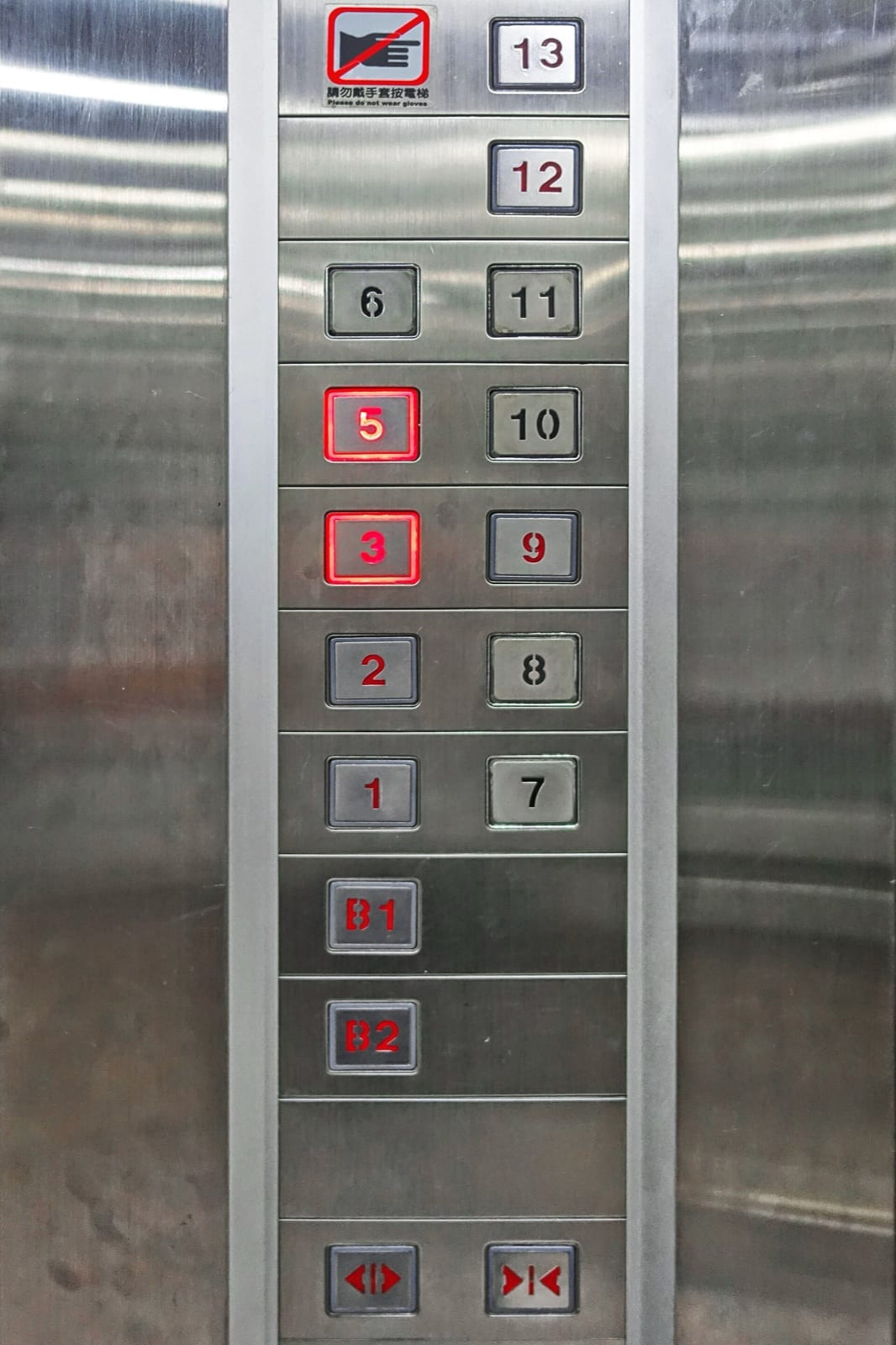
Japan is not alone. In Mandarin and Cantonese, the words for four and death also sound alike, as McGill University's Office for Science and Society explains, and the BMJ study discussed below chose its subjects because "Chinese and Japanese people consider the number 4 unlucky". In Korean, the Sino-Korean word for four and the word for death are both pronounced sa. Articles on Korea.net, the South Korean government's official portal, say that many buildings label the fourth floor "F" instead of 4 and that Korean hospitals often have no fourth floor. Both articles are written by contributors to the portal, not issued as government policy.
Hong Kong gives the strongest official evidence. Its Buildings Department wants floors numbered logically, because gaps in the numbering can slow emergency services and confuse residents. Even so, a Buildings Department practice note accepts the omission of floor numbers "4", "13" and those ending in "4", "the long established local practice and custom". No other gaps are allowed. So a Hong Kong tower can go from 3/F to 5/F, and from 12/F to 15/F, with the government's approval.
The West's 13 works differently. It is not a pun. Nipponica says the dislike of 13 in the West is attributed to the Last Supper, where 13 people sat at the table. Japan picked up some of this: the same entry notes that 13 appears among traditional yakudoshi (unlucky ages) and that in some places boat crews avoided sailing with 13 aboard. Today's Japanese dislike of 4 and 9, though, comes from sound.
| Where | Numbers usually avoided | Why | Where you notice it | Sources |
|---|---|---|---|---|
| Japan | 4, 9 (also 42, 49) | 4 = shi = death; 9 = ku = suffering | Hospital room numbers, gifts for happy occasions | Nipponica, Daijisen (Kotobank); Hitachi Medical Center; Daimaru Matsuzakaya |
| Mainland China / Hong Kong | 4, and in Hong Kong 13 too | 四 and 死 sound alike in Mandarin and Cantonese | Hong Kong floor numbering, allowed by the building code | HK Buildings Department; McGill OSS |
| South Korea | 4 | Sino-Korean sa = four and death | Lift panels with "F", hospital floors | Korea.net contributor articles |
| Western countries | 13 | Linked to the 13 at the Last Supper (traditional explanation) | Some buildings skip a 13th floor | Nipponica; Korea.net contributor article |
Do more people really die on the 4th? What the research says
A 2001 study in the BMJ found a spike in cardiac deaths among Chinese and Japanese Americans on the 4th of the month, but a 2002 re-analysis in the same journal did not find it in other years. It is best treated as unproven.
The 2001 paper, "The Hound of the Baskervilles effect", by David Phillips and colleagues, looked at US death certificates from 1973 to 1998. That covered 209,908 Chinese and Japanese Americans and 47,328,762 white Americans. Deaths from chronic heart disease among the Chinese and Japanese group were 13% higher than expected on the 4th of the month (ratio 1.13, 95% confidence interval 1.06 to 1.21). There was no such peak among white Americans. The authors read this as a sign that psychological stress can bring death forward.
In 2002 Gary Smith of Pomona College published "Scared to death?" in the BMJ. As McGill's Office for Science and Society summarises it, Smith found no 4th-of-the-month peak in the same heart-disease category for 1969–1988 or 1999–2001, and no rise in accidents or suicides on the 4th. He also questioned how the original study grouped its causes of death. Put simply, the "death day" effect showed up in one period of one data set, chosen in one particular way. The superstition is real. The claim that it kills people is not established.
What should travellers in Japan do about the number 4?
Avoid sets of four, and of nine, in gifts for weddings, births and other celebrations. Otherwise relax: there is no need to worry about staying on a fourth floor.
- Buying a gift set. Choose three or five items rather than four. The Daimaru Matsuzakaya gift guide lists 3, 5 and 7 as lucky and 4 and 9 as numbers to avoid at celebrations. The same guide says a pair, such as two glasses for a couple, counts as one set, so it is fine for a wedding.
- Giving money. The same guide mentions that 80,000 yen is sometimes given as a wedding gift, because 8 is considered lucky. Amounts beginning with 4 or 9 are best avoided.
- Staying in hospital or a hotel. Don't be surprised if room 404 or 409 doesn't exist. Hitachi Medical Center's published list shows this pattern. It is a courtesy to patients and guests, not a sign of anything wrong with the building.
- Everyday life. Saying yon instead of shi when you count is normal Japanese in most contexts, so you don't need to worry about it.
For the wider picture of gift etiquette, including the two-handed hand-over and how omiyage work, see our complete guide to Japanese etiquette. Other customs rooted in avoiding reminders of death, such as never standing chopsticks upright in rice, are covered in the unspoken taboos nobody warns you about.
The number 4 in Japan: frequently asked questions
Is 4 unlucky in Japanese culture? Yes. Japanese dictionaries define 4 as an imikazu, a number to avoid, because it can be read shi, like "death". The custom is still followed in some hospital room numbers and in gifts for celebrations, as of 2026-09-23.
Why is 9 also unlucky in Japan? Because 九 can be read ku, the same sound as 苦, "suffering". Dictionaries list 9 alongside 4 as the two standard imikazu.
Do Japanese buildings skip the fourth floor? Plenty of them have one. Hitachi Medical Center, for example, has a 4th-floor ward but leaves out room numbers ending in 4 and 9. In a 2020 poll of nurses on Kango-roo, 65% said their hospital used numbers such as a 4th floor, No. 9 or Room 13.
Is 13 unlucky in Japan? Less clearly than 4. Nipponica notes that 13 was traditionally counted among the yakudoshi (unlucky ages) and that some boat crews avoided sailing 13 aboard. Kango-roo's 2020 nurse poll grouped "Room 13" with the 4th floor and No. 9 as numbers some people dislike. The Japanese taboo on 4 and 9, though, comes from sound, not from the Western story of 13.
Is it rude to give four of something as a gift? For celebrations, it is best avoided; department-store gift guides list 4 and 9 as numbers to steer clear of. The same guide says there is no need to be excessively afraid of getting it wrong, but choosing three or five is the safe option.
Sources (checked 2026-09-23)
- Kotobank, "忌み数" — Nihon Daihyakka Zensho (Nipponica), Shogakukan (entry by Ōtō Tokihiko): 4 = death, 9 = suffering; folk beliefs about the 4th; gifts; 13 and the Last Supper — https://kotobank.jp/word/%E5%BF%8C%E3%81%BF%E6%95%B0-1505837
- Kotobank, "忌数" — Digital Daijisen; Seisenban Nihon Kokugo Daijiten; Britannica International Encyclopedia; Encyclopedia Mypaedia (42, 49; 13 in the West) — https://kotobank.jp/word/%E5%BF%8C%E6%95%B0-32261
- Ministry of Education, Culture, Sports, Science and Technology (MEXT), "Tsunagaru" learning resource, Numbers sheet (4 = yon / shi; 9 = kyū / ku) — https://tsunagarujp.mext.go.jp/assets/download/numbers_ver202404.pdf
- Doshisha Women's College of Liberal Arts, faculty column by Naoto Yoshikai (17 February 2020), on the on- and kun-readings of numbers — https://www.dwc.doshisha.ac.jp/research/faculty_column/12393
- Hitachi Medical Center (Social Medical Corporation Aisenkai), "Ward rooms" (room numbers on floors 4–6) — https://www.hitachi-mch.or.jp/pages/31/
- Kango-roo, nurses' poll "Does your hospital have 4, 9 or 13?" (31 January – 21 February 2020, 1,688 votes) — https://www.kango-roo.com/yn/details/622/
- Daimaru Matsuzakaya Online Store, catalogue-gift FAQ (lucky and unlucky numbers for gifts) — https://www.daimaru-matsuzakaya.jp/gift/cataloggift/chishiki20/
- Hong Kong Buildings Department, Practice Note ADV-3, "Floor numbering" (omission of 4, 13 and floors ending in 4 accepted) — https://www.bd.gov.hk/doc/en/resources/codes-and-references/practice-notes-and-circular-letters/pnap/ADV/ADV003.pdf
- Hong Kong Buildings Department, press release "New guidelines on floor numbering in buildings proposed" (16 April 2010) — https://www.bd.gov.hk/en/whats-new/press-releases/2010/0416-new-guidelines-on-floor-numbering-in-buildings-proposed.html
- Korea.net (official portal of the Republic of Korea), "The Number 4 in Korean Culture" by Sherry Osborne (contributor article) — https://www.korea.net/Events/Overseas/view?articleId=17767
- Korea.net, "11 Korean superstitions that persist to this day" by Honorary Reporter Dovletoglou Eftychia (contributor article) — https://www.korea.net/NewsFocus/HonoraryReporters/view?articleId=191095
- Phillips DP, Liu GC, Kwok K, Jarvinen JR, Zhang W, Abramson IS. "The Hound of the Baskervilles effect: natural experiment on the influence of psychological stress on timing of death." BMJ 2001;323:1443–1446. doi:10.1136/bmj.323.7327.1443 — https://pmc.ncbi.nlm.nih.gov/articles/PMC61045
- Smith G. "Scared to death?" BMJ 2002;325:1442–1443. doi:10.1136/bmj.325.7378.1442 — https://pmc.ncbi.nlm.nih.gov/articles/PMC139029
- McGill University Office for Science and Society, Jonathan Jarry, "The Number Four Kills Again… Or Does It?" (4 January 2018) — https://www.mcgill.ca/oss/article/general-science/number-four-kills-again-or-does-it
Written by the J-Times Editorial Team. Facts current as of 2026-09-23.
Featured image: Mk2010 / Wikimedia Commons / CC BY-SA 4.0 (https://commons.wikimedia.org/wiki/File:Tetraphobia_(no_button_for_4th_floor_in_an_elevator).jpg)
Written by
J-Times Editorial
J-Times 編集部 / J-Times Editorial Team