J-Times Editorial
J-Times 編集部 / J-Times Editorial Team
Tsukiji Outer Market stayed in Tsukiji when the wholesale market moved to Toyosu in 2018. Its hours, its closed days, why you should not eat while walking, cash or card, and what to eat, from the market's official site.
Read this article to earn +5 MTC
Tsukiji Outer Market guide: opening hours, closed days, eating rules and what to eat
Short answer (as of 2026-10-02): Tsukiji Outer Market is the district of food shops and small restaurants that stayed in Tsukiji when the wholesale market moved to Toyosu in October 2018. Go between 9:00 and 14:00 on a day the wholesale markets are open, eat at the shop rather than while walking, and carry cash.
Disclosure: J-Times and Matsuri are both operated by Jon&Coo Inc. This article mentions a Tsukiji tour listed on Matsuri. Everything else comes from the Tsukiji Outer Market's official site, the Tokyo Metropolitan Government and the other sources listed at the end, checked on 2 October 2026.
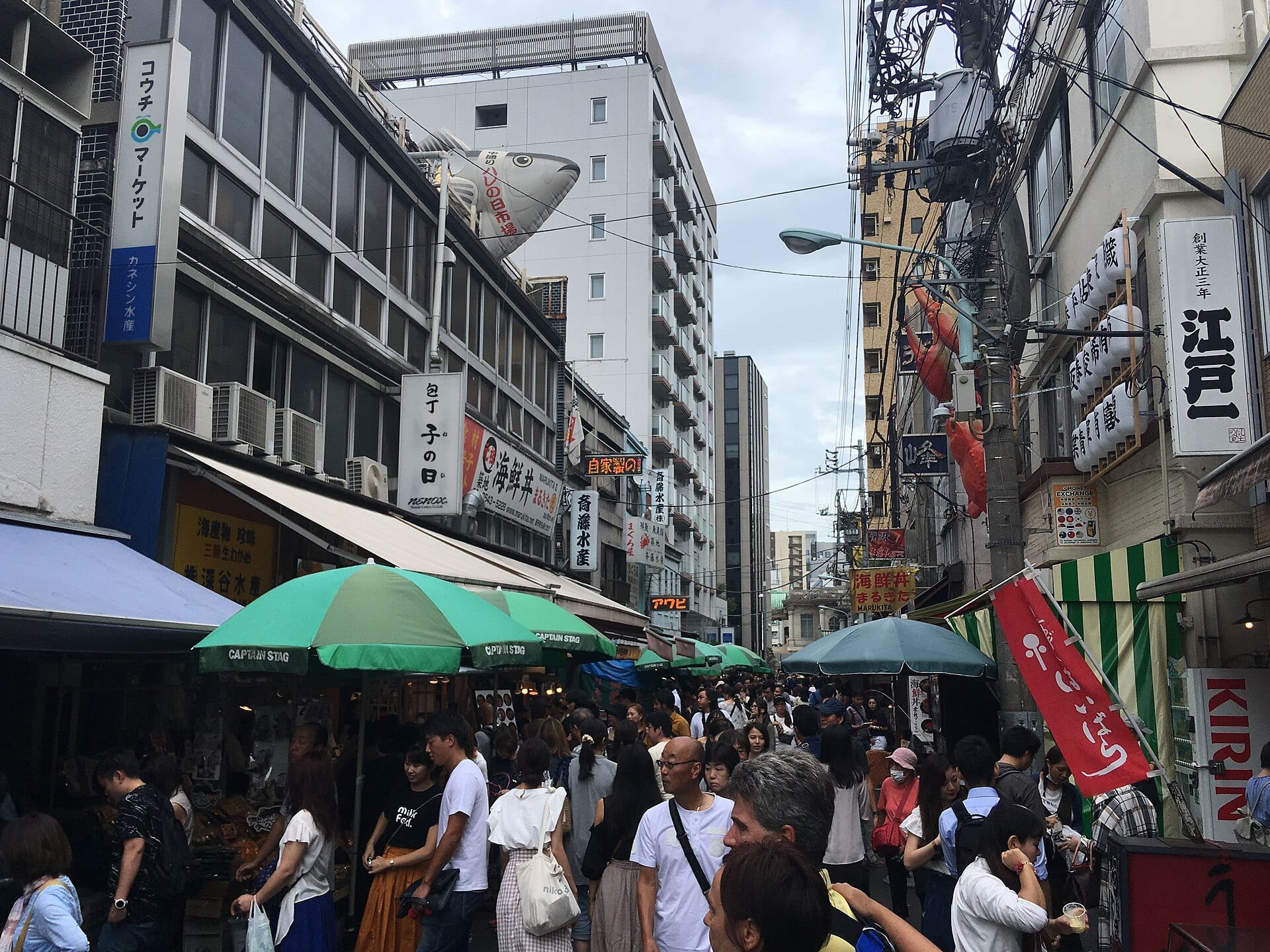
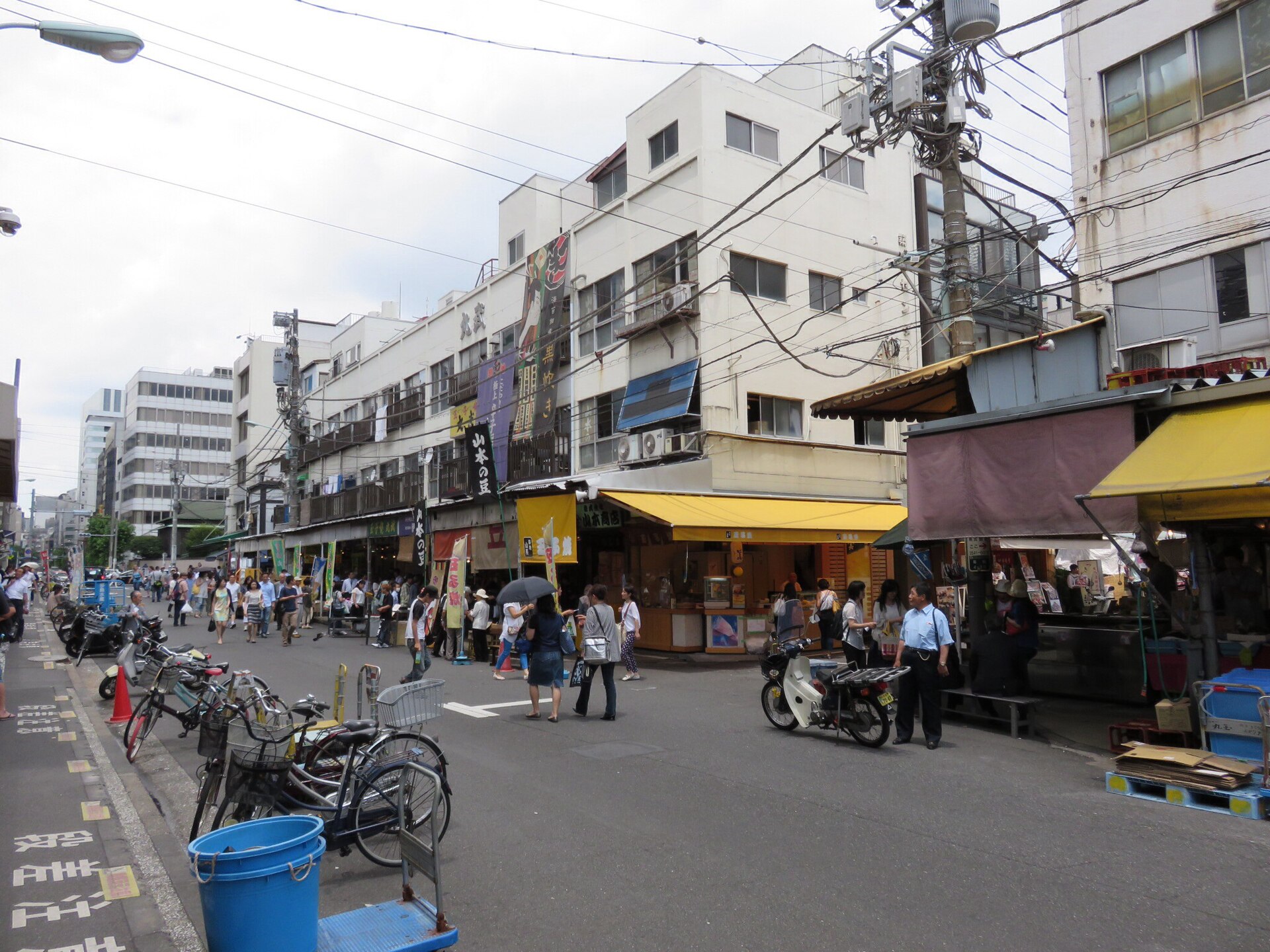
Many travellers still picture Tsukiji as the giant fish market with the dawn tuna auction. That market closed in 2018. What you can visit in Tsukiji today is the jōgai shijō, the "outer market": a few blocks of narrow streets with fishmongers, knife shops, tamagoyaki stalls, sushi counters and kitchen-supply stores that grew up next to the old wholesale market. It is still a working market for chefs, and it publishes its own rules for visitors. This guide sets them out, along with the hours and closed days that catch many people out.
Why did the Tsukiji fish market move to Toyosu?
Because the old market had become too old and too cramped. The Tokyo Metropolitan Government decided in 2001 to move it to Toyosu; Tsukiji Market closed on 6 October 2018 and Toyosu Market opened on 11 October 2018.
Tsukiji Market opened in 1935, when the Nihonbashi fish market and the Kyobashi vegetable market moved there, according to the Tokyo Metropolitan Central Wholesale Market. By the late 1980s its buildings were ageing and overcrowded. Rebuilding on the same site was studied and dropped, and in December 2001 the Tokyo Metropolitan Government's 7th wholesale market plan chose Toyosu.
The Toyosu Market Association's history page gives the closing date of Tsukiji Market as 6 October 2018 and the opening of Toyosu as 11 October 2018. The Governor of Tokyo's activity report from the Toyosu opening ceremony (13 September 2018) and Koto City's guide to Toyosu give the same opening date. Koto City adds that Toyosu covers about 40.7 hectares, about 1.7 times the size of Tsukiji.
So the wholesale "inner market" (jōnai shijō), with its auctions and middlemen, is now in Toyosu. The outer market did not move. Its official site states it plainly: Tsukiji Outer Market is not relocating; only the inner market moved.
What is still at Tsukiji?
The outer market's shops and restaurants, the Tsukiji Uogashi building of market stalls, Namiyoke Shrine and Tsukiji Hongwanji temple.
The outer market grew up by itself after the 1923 Great Kantō Earthquake, when the central market opened on the neighbouring former navy land, according to the outer market's history page. Part of it stands on what were once the grounds of Tsukiji Hongwanji temple. Today it sells everything a professional kitchen needs: fresh fish, tuna, dried bonito, nori, tea, pickles, tamagoyaki, knives, tableware and packaging.
- Tsukiji Uogashi is a market building with stalls selling fresh seafood, fruit and vegetables. GO TOKYO says it has about 60 shops. The outer market's English site says shopping there before 9:00 is limited to buyers with advance permission; after 9:00 it is open to everyone.
- Namiyoke Shrine, the market's guardian shrine, dates from 1659, according to the outer market's history page.
- Tsukiji Hongwanji, a Buddhist temple a short walk away, was rebuilt in 1934 in a style modelled on ancient Indian architecture, according to GO TOKYO.
What are Tsukiji Outer Market's opening hours?
The market's official hours are 6:00–9:00 for professional buyers, 9:00–14:00 for general shoppers, and "flexible hours" after 14:00, when each shop decides.
The outer market's official calendar page sets out three time bands:
| Time | What it is for |
|---|---|
| 6:00–9:00 | Mainly professional buyers stocking restaurants |
| 9:00–14:00 | Normal sales hours, open to everyone |
| From 14:00 | Flexible hours: each shop chooses whether to stay open |
The official FAQ recommends 9:00 to 14:00 for visitors. GO TOKYO's guide suggests 9:00 to 13:00, "when it's most lively", and notes that most stores close before evening. Some restaurants do open at night, according to the official FAQ, but they set their own hours.
Which days is Tsukiji Outer Market closed?
Many shops close on the days the Tokyo wholesale markets close: Sundays, national holidays and some Wednesdays. In October 2026 those days are the Sundays, Monday 12 October and Wednesdays 7, 21 and 28 October.
The outer market follows the Tokyo Metropolitan Central Wholesale Market calendar. Its official calendar page shows the wholesale market's closed days and adds that individual shops may still be closed on other days, so check with a shop if you are going for one place in particular. The outer market's English page for overseas visitors says "Many shops are closed on Sundays and on some Wednesdays."
For October 2026, the calendar on the outer market's site marks these days as closed: 4, 11, 18 and 25 October (Sundays), 12 October (Sports Day, a national holiday), and 7, 21 and 28 October (Wednesdays). Wednesday 14 October is an open day. The Tokyo Metropolitan Central Wholesale Market's 2026 calendar for seafood counts 251 open days and 114 closed days in the year.
"Closed" does not mean every shutter is down. The official FAQ says about a third of the shops, mainly restaurants, open on Sundays and holidays, and that the streets are busy with visitors either way. If you want the full market, with fishmongers and knife shops trading, go on an open weekday.
Two seasonal notes from the official FAQ: the end of December is very crowded with New Year shopping (watch for pickpockets), and most shops stay closed until 4 January.
When is the best time to visit Tsukiji?
On a market-open weekday between 9:00 and 14:00. Before 9:00, the market asks visitors to give way to professional buyers.
The first of the market's eight etiquette rules is "Professional buyers take priority in the morning! Priority should be given to professional buyers until 9:00 a.m." So arriving at dawn, as visitors did when the tuna auction was in Tsukiji, no longer gets you anything special and puts you in the way of people working. Aim for mid-morning.
If you want to watch a tuna auction, that now happens at Toyosu. Koto City says Toyosu has a visitors' course where you can watch the auctions up close, and the Toyosu Market Association's site has a page on early-morning auction viewing. Toyosu is next to Shijō-mae Station on the Yurikamome line.
Can you eat while walking in Tsukiji?
No. The outer market asks visitors not to eat while walking. Eat inside the shop, in front of the shop where you bought the food, or in a designated eating space.
This is the second of the market's eight etiquette rules: "Stay inside the eatery or in front of the store when eating! Wandering around while eating can bother passerby." GO TOKYO's guide says the same: "Tsukiji Outer Market doesn't allow visitors to eat while walking, so please eat your purchases in designated areas, such as in front of the store where you bought them."
The streets are narrow and crowded, and delivery carts and motor-driven trolleys still move through them. So buy, step to the side of the stall that sold it to you, and finish it there.
The full list of the market's eight rules:
- Professional buyers have priority until 9:00.
- Eat inside the shop or in front of it, not while walking.
- Leave large bags in a coin locker. Strollers can be left at the Plat Tsukiji information centre (¥500 per stroller, according to the English site).
- Move in small groups. Hold children's hands.
- Ask before taking photos of a shop. Some shops post no-photo signs.
- Do not touch the food. If you need to check something, ask.
- Do not bargain. Goods are sold at wholesale prices.
- Smoke only in designated smoking areas.
The English site adds two restaurant rules: places are small and often have a queue, so eat at a steady pace to free the seat, and at busy times it is generally taboo to split one meal between several people. It also asks guides not to block shopfronts and reminds visitors that free samples are offered to people who are thinking of buying. For sushi-counter manners, see our guide to dining manners in Japan and our chopsticks etiquette guide.
Do Tsukiji shops take credit cards, or should you bring cash?
Bring cash in yen. Whether a shop takes cards depends on the shop, and GO TOKYO says most stores are cash only.
The outer market's English shopping page says card acceptance "depends on each shop", so ask before you buy. It also says most shops accept only Japanese yen and that there is no currency exchange counter inside the market. GO TOKYO's guide is blunter: "Most stores in Tsukiji Outer Market are cash only. It's best to prepare lots of cash in advance."
If you run short, the official FAQ says there is a Seven Bank ATM at the Plat Tsukiji information centre.
What should you eat at Tsukiji?
Sushi, sashimi rice bowls (kaisendon), tuna, and tamagoyaki, a sweet rolled omelette. There is also ramen, tempura, rice balls and sweets.
The outer market's official site lists sushi, sashimi rice bowls and other eateries, and says that besides seafood you will find tempura, deep-fried food, ramen, rice balls and sweets. GO TOKYO recommends fresh sushi for breakfast and mentions both tamagoyaki, "known for its sweet, dessert-like flavor", and rice bowls topped with tuna sashimi.
Tsukiji is also a good place to shop for things that are not food. The same shops that supply restaurants sell kitchen knives, tableware, cooking tools, dried bonito, nori and green tea. If you plan to take food home, the official shopping page reminds you that customs rules differ by country, so check before you buy.
What should you wear and bring?
Closed-toe shoes, cash, and as little luggage as possible.
The outer market's English page warns that floors are often wet and slippery and that bikes and carts move through the streets, so it asks visitors to wear safe shoes that cover the toes, and no high heels or sandals. Big suitcases and strollers are a problem in the narrow streets. There are lockers near Plat Tsukiji, but the official page notes only a limited number fit suitcases.
Is there a guided Tsukiji food walk?
Matsuri lists one, but as of 2 October 2026 it has no dates you can book. You can also visit on your own with the rules above.
The listing is "【Tsukiji】8:00 AM Departure · Tsukiji Outer Market Food-Walking Tour | Sample 10+ Dishes". According to the listing, an English-speaking guide takes up to eight people around the market for about two hours from 8:00, with more than ten tastings included. The meeting point is Exit 1 of Tsukiji Station on the Tokyo Metro Hibiya Line.
Two honest notes. First, the market asks visitors to give way to professional buyers until 9:00 and asks guided groups not to block shopfronts, so any group that starts at 8:00 should keep to the side. Second, "food walk" in Tsukiji means walking between stalls and eating at each one, not eating on the move.
When we checked on 2 October 2026, the listing had no bookable dates. In place of a calendar its booking panel shows "schedule currently being arranged", even though a date appears on the listing card, and you cannot book until dates are published. Dates appear on the listing page when they open; the final price is shown at checkout. For how booking works, see how to book an experience on Matsuri.
The Matsuri feature
- What is Matsuri? — the hub: what the service offers and how to read its pages
- How to book an experience on Matsuri
- Shinjuku Golden Gai for first-timers — cover charges, photo rules and choosing a bar
- Tsukiji Outer Market guide (this page)
Sources and dates checked
All checked on 2026-10-02.
- Tsukiji Outer Market official site (NPO Tsukiji Shoku no Machizukuri Kyōgikai / Tsukiji Outer Market Shopping Street Promotion Association), home ("only the inner market moved") — https://www.tsukiji.or.jp/ (primary)
- Same, "Calendar and business hours" (Japanese and English pages) (time bands 6–9 / 9–14 / from 14; closed days follow the central wholesale market calendar; October 2026 calendar; eight etiquette rules) — https://www.tsukiji.or.jp/calendar/ and https://www.tsukiji.or.jp/english/calendar/ (primary)
- Same, "How to tour Tsukiji" (eight rules in English; stroller ¥500; requests to guides) — https://www.tsukiji.or.jp/english/guide/ and https://www.tsukiji.or.jp/guide/ (primary)
- Same, "Hints for Shopping" (Sundays and some Wednesdays; cards depend on shop; yen only; no exchange; restaurant rules; shoes; lockers; Tsukiji Uogashi before 9:00) — https://www.tsukiji.or.jp/english/shopping/ (primary)
- Same, "How to enjoy the Tsukiji Outer Market" (what to eat; Tsukiji and Tsukiji-shijō stations) — https://www.tsukiji.or.jp/english/how-to-enjoy/ (primary)
- Same, "Tsukiji Q&A" (Japanese) (9:00–14:00 recommended; a third of shops open Sundays/holidays; year-end; closed until 4 January; ATM; card payment) — https://www.tsukiji.or.jp/ordinary/faq/ (primary)
- Same, "History" (Japanese) (outer market formed after 1923; Hongwanji grounds; Namiyoke Shrine 1659; 2018 move) — https://www.tsukiji.or.jp/know/history/ (primary)
- Tokyo Metropolitan Central Wholesale Market, "About the former Tsukiji Market" (Japanese) (opened 1935; Nihonbashi and Kyobashi markets; December 2001 decision to move to Toyosu) — https://www.shijou.metro.tokyo.lg.jp/tsukiji (primary)
- Tokyo Metropolitan Central Wholesale Market, 2026 market calendar (seafood: 251 open days, 114 closed days) — https://www.shijou.metro.tokyo.lg.jp/calendar/2026 (primary)
- Office of the Governor of Tokyo, "Toyosu Market opening ceremony" (Japanese) (13 September 2018; opening on 11 October) — https://www.metro.tokyo.lg.jp/governor/action/katsudo/2018/9/13_00 (primary)
- Toyosu Market Association, "History of the market" (Japanese) (Tsukiji closed 6 October 2018; Toyosu opened 11 October 2018) — https://www.toyosu-market.or.jp/history/
- Koto City, "Waterfront and Toyosu area" (Japanese) (Toyosu opened 11 October 2018; 40.7 ha, 1.7 times Tsukiji; visitors' course; Shijō-mae Station) — https://www.city.koto.lg.jp/103010/bunkasports/kanko/spot/rinkaitoyosu.html (primary)
- GO TOKYO (Tokyo Convention & Visitors Bureau), "Tsukiji Outer Market" guide (updated 20 August 2026: closed days, 9:00–13:00, no eating while walking, mostly cash, tamagoyaki, tuna bowls) — https://www.gotokyo.org/en/story/guide/tsukijioutermarket/
- GO TOKYO, "Tsukiji" area guide (1935–2018; inner market moved to Toyosu; Tsukiji Uogashi about 60 shops; Tsukiji Hongwanji 1934) — https://www.gotokyo.org/en/destinations/central-tokyo/tsukiji/index.html
- Matsuri listing 272 and public API
/api/matsuri/events/272/schedules/(empty schedule list) — https://matsuri.group/en/events/272 , queried 2026-10-02 - Images: Aw1805, "Tsukiji Outer Market 1.jpg", CC BY-SA 3.0 — https://commons.wikimedia.org/wiki/File:Tsukiji_Outer_Market_1.jpg ; Christophe95, "Tsukiji Outer Market.jpg", CC BY-SA 4.0 — https://commons.wikimedia.org/wiki/File:Tsukiji_Outer_Market.jpg
Written by the J-Times Editorial Team. Facts current as of 2026-10-02.
Written by
J-Times Editorial
J-Times 編集部 / J-Times Editorial Team