
J-Times Editorial
J-Times 編集部 / J-Times Editorial Team
Language exchange builds speaking when you split time 50/50, use one language at a time, prepare ten phrases and three topics, ask for corrections, then review with shadowing and a phrase notebook. Check progress with CEFR can-do statements.
Read this article to earn +5 MTC
How to improve your speaking through language exchange
Short answer (as of 2026-10-25): A language exchange builds speaking skill when both partners split the time equally, use one language at a time, and each decide what help they want. Prepare ten phrases and three topics, ask for corrections out loud, then review with a phrase notebook and shadowing. The JLPT does not test speaking, so track progress with CEFR can-do statements.
Disclosure: J-Times and Matsuri are both operated by Jon&Coo Inc. This guide mentions one Matsuri meetup once, at the end. Everything else comes from universities, the Council of Europe and EU, the Japan Foundation, the JLPT organisers, Japan's National Police Agency and National Consumer Affairs Center, and the research listed at the end, all checked on 25 October 2026.
Most people leave their first language exchange with a warm feeling and very little new language. They talked for two hours, but mostly in the language they already speak well, and nobody corrected anything. This guide is about closing that gap. It is written for both sides of the table in Tokyo: international residents and visitors learning Japanese, and Japanese people learning English. Where to find a meetup is covered in our companion guide, how to join a language exchange in Tokyo. This one is about what to do once you are sitting down.
What is the tandem principle in language exchange?
The tandem principle says that two people with different first languages learn from each other on equal terms: each gives the same time to the other's language, and each decides what help they need.
"Tandem learning" is the name researchers and universities use for a structured language exchange. A tandem learning project hosted on Kyushu University's international centre website quotes Helmut Brammerts' definition: "two people with different mother tongues work together in order to learn from each other." The same project names two principles, citing David Little and Helmut Brammerts' 1996 guide (Trinity College Dublin): reciprocity, meaning the two partners help each other, and learner autonomy, meaning each partner decides what to learn, how, and what help to ask for. The Japanese version of the page draws the line clearly: tandem learning is not simply "language exchange", because it rests on those two principles.
The University of Münster language centre turns the principles into rules that work at any café table:
- "Each language should be given an equal amount of time."
- "Both languages are practised separately and not mixed together."
In practice this means a timer. In a one-to-one exchange, 20 minutes in Japanese and then 20 minutes in English works better than drifting between the two. In a group meetup, agree on halves: the first hour in one language, the second in the other. Without a split, conversation slides into whichever language is easiest for the group, which in Tokyo is often English.
How should you prepare before a language exchange?
Prepare ten phrases you can use in any conversation and three topics you can talk about for five minutes each. That is enough to keep you speaking your target language instead of switching back.
This is our editorial suggestion, not a rule from the literature, but it follows from how the Council of Europe describes beginners. The CEFR self-assessment grid (published by the Council of Europe and the EU's Europass service) describes the lowest level of spoken interaction, A1, like this: "I can interact in a simple way provided the other person is prepared to repeat or rephrase things at a slower rate of speech and help me formulate what I'm trying to say." In other words, at the start, the phrases that matter most are the ones that ask for help.
Ten phrases to have ready
| Purpose | Japanese (for learners of Japanese) | English (for learners of English) |
|---|---|---|
| Ask to repeat | もう一度お願いします。 | Sorry, could you say that again? |
| Ask to slow down | もう少しゆっくり話してもらえますか? | Could you speak a little more slowly? |
| Ask for a word | 「○○」は日本語で何と言いますか? | How do you say "○○" in English? |
| Ask what a word means | 「○○」ってどういう意味ですか? | What does "○○" mean? |
| Check you understood | つまり、○○ということですか? | So you mean ○○, right? |
| Buy time | ええと、ちょっと待ってください。 | Let me think for a second. |
| Ask if it sounded natural | 今の言い方、自然ですか? | Did that sound natural? |
| Ask for a better way | もっと自然な言い方はありますか? | Is there a more natural way to say that? |
| Ask to write it down | メモしてもいいですか? | Do you mind if I write that down? |
| Hand the turn back | ○○さんはどうですか? | What about you? |
Say each one aloud a few times before you go, so they come out without thinking.
Three topics to prepare
The CEFR grid's B1 level (an intermediate stage) describes someone who "can enter unprepared into conversation on topics that are familiar, of personal interest or pertinent to everyday life (e.g. family, hobbies, work, travel and current events)." Below B1, you can get the same effect by preparing. Pick three of those everyday topics, and for each one:
- Write three or four sentences you would like to say (for example, what you do at work and one thing you like about it).
- Look up the two or three words you are missing.
- Prepare one question to ask back, so the conversation does not stop with you.
Glancing at the list on your phone is fine; this is practice, not an exam.
How do you run a language exchange session on the day?
Agree on three things in the first five minutes: how long each language gets, what you each want to practise, and how you want to be corrected. Then keep to one language at a time and take notes.
Learner autonomy, in the tandem sense, means saying out loud what help you want. A simple opening:
- In Japanese: 「今日は日本語で20分、英語で20分にしませんか? 私は旅行の話を練習したいです。間違いは、最後にまとめて教えてもらえますか?」
- In English: "Shall we do 20 minutes in English and 20 in Japanese? I'd like to practise talking about my job. Could you save corrections for the end?"
During the session (our suggestions): keep to the language of the half, using your ten phrases when stuck; note new words and corrections without stopping; let the learner do most of the talking, since the native speaker's job is to ask and listen; and end with a two-minute recap in which each person reads back the three most useful things they noted.
How do you ask for corrections politely in Japanese and English?
Ask directly and say how you want to be corrected. Many people will not correct you unless you ask, because they do not want to seem rude.
The companion guide's etiquette rule is "correct only when asked", so the asking is your job. These phrases work at a café table or in a group circle.
When you are learning Japanese:
- 「今の言い方、自然ですか?」 — Did that sound natural?
- 「間違っていたら、遠慮なく直してください。」 — If I make a mistake, please correct me; don't hold back.
- 「もっと自然な言い方はありますか?」 — Is there a more natural way to say that?
- 「友だちに言うときと、目上の人に言うときで違いますか?」 — Is it different with a friend and with someone senior? (Japanese changes with politeness level.)
When you are learning English:
- "Did that sound natural?"
- "Please correct me if I say something wrong. I really don't mind."
- "Is there a more natural way to say that?"
- "Would a native speaker say it like that?"
How to give corrections. The University of Münster's tandem guidance suggests correcting "by repeating the phrase correctly." Language teachers call this a recast: you do not explain the grammar, you simply say the sentence back the right way, and the learner hears the difference. In Japanese, a soft way to offer it is 「〜って言うと、もっと自然かも。」 ("It might sound more natural if you say ..."). In English: "You could also say ..." Correct only the things your partner asked about, and leave the rest.
What should you do after a language exchange?
Within a day, record yourself saying the corrected sentences, practise them by shadowing, and copy them into a phrase notebook. Review is where the session turns into skill.
Shadowing
Shadowing means repeating speech as you hear it. A 2014 paper from Gifu University's international student centre, on shadowing materials for learners of Japanese, quotes Tamai's (2005) definition: reproducing speech aloud "almost at the same time as you hear it, or with a short delay", and notes that the method began as training for simultaneous interpreters.
Much of the research is about listening: Yo Hamada's 2016 paper in Language Teaching Research is subtitled "a booming EFL teaching technique for listening comprehension." A government-funded (KAKEN) project at Seinan Gakuin University (2023-2027) reports that after 10 shadowing sessions, learners' rhythm variability fell significantly. So shadowing trains your ear and rhythm between sessions; it does not replace talking to a person.
A simple routine (our suggestion):
- Take three to five sentences from your notes, in their corrected form.
- If your partner agrees, record them saying the sentences on your phone. Always ask first, and never post another person's voice.
- Listen once, then say each sentence along with the recording, as close behind it as you can. Repeat five times.
- Record yourself saying the same sentences alone and compare. Listen for rhythm and where the stress falls, not only for the words.
Keep a phrase notebook
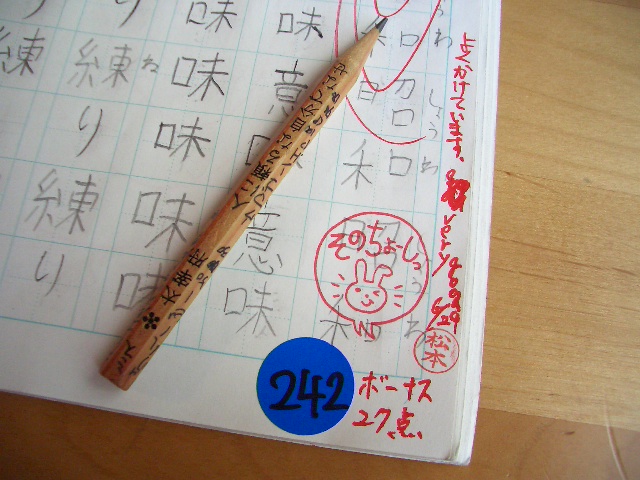
A phrase notebook is a list of things you actually wanted to say, in the form a native speaker would say them. Ours has four columns:
| Date | What I wanted to say | What I said | Natural version (and when to use it) |
|---|---|---|---|
| 25 Oct | That I was tired after work | 仕事の後、疲れるでした | 仕事の後で、疲れていました (casual: 仕事終わりで、疲れてた) |
| 25 Oct | 遠慮しないで | Please don't do reserve | Please don't hold back / Feel free |
Read the notebook again before your next exchange. A list made of your own mistakes beats any textbook list, because every line is something you needed to say.
How often should you go to a language exchange?
There is no official number. Our suggestion is once a week with the same partner or group, plus 10 to 15 minutes of shadowing and notebook review on other days.
A weekly rhythm gives you enough time to review the last session before the next. Going back to the same group also means your partners remember your level and goals, so corrections build on each other.
How do you handle silence and kuuki in a Japanese conversation?
Japanese listeners give frequent short responses (aizuchi) and often leave sentences unfinished, letting the listener fill in the rest. Knowing both habits makes silences and half-sentences far less confusing, in either direction.
Aizuchi. The Japanese dictionary Daijisen traces the word to blacksmiths: two smiths striking the iron in turn. In conversation it means nodding along and matching the speaker's rhythm. A 2007 paper by Yukiko Abe Hatasa (Hiroshima University), published by the University of Hawaii's National Foreign Language Resource Center, summarises the research: Senko Maynard (1993) found Japanese speakers used about twice as many aizuchi as Americans, and Mizutani (1988) counted about 15 to 20 a minute among native speakers. Hatasa also notes, citing Maynard (1986), that English back-channels tend to come only after a point of grammatical completion. Learners of Japanese therefore often use too few verbal aizuchi and rely on nodding.
What this means at the table:
- If you are learning Japanese, use short responses while your partner talks: はい, ええ, うん (casual), そうですね, なるほど, へえ. Silence while someone talks can feel to a Japanese speaker like you are not following.
- If you are learning English, know that frequent "yes, yes" while someone is mid-sentence can sound to an English speaker as if you want them to hurry. Responses usually come at the end of a sentence or idea: "Oh, really?", "That makes sense", "Right."
Unfinished sentences. In everyday Japanese, people often stop after a "because" or "but" clause and let the listener supply the rest: 「ちょっとお願いがあるんだけど……」 ("I have a small favour to ask, but…"). A 2019 Hokkaido University doctoral review describes these iisashi sentences as conventional and frequent in spoken Japanese. A Nagasaki University thesis summary adds that learners often think a sentence ending in a connecting particle is wrong, while native speakers find it natural. If your Japanese partner trails off, they have usually said what they mean. A soft refusal often arrives this way: 「その日はちょっと……」 ("That day is a bit…") means no.
Silence. A pause in a Japanese conversation is not always a gap to fill. Our essay on reading the air in Japan explains why. A practical rule for mixed groups: after you ask a question, count to three before you rephrase it. The other person may simply be building the sentence in their second language.
How do you keep a language exchange safe and respectful?
Meet in public places, keep personal details to what the meetup needs, and leave if a conversation turns into a sales pitch, an investment offer or romantic pressure. Japan's police and consumer agencies warn about all three.
Most language partners just want to practise. For the few who do not, the warning signs are well documented:
- Investment and "side business" pitches. Japan's National Consumer Affairs Center (Kokusen) warned in July 2019 about "mono-nashi multi-level marketing": schemes that sell investment, side-job or affiliate income instead of goods, where you earn by recruiting others. It says the invitations come from friends, acquaintances and people met through social media and apps, and advises refusing firmly, even when the person is a friend.
- Romance fraud. Japan's National Police Agency describes "SNS-type romance fraud" as building feelings over messages without meeting, then taking money. Its warning signs include money talk from someone you have not met in person, and being moved quickly from a matching app to LINE. It says about 80% of cases involve an investment pitch.
- A language exchange is not a date. Some people join hoping for romance, and Google's autocomplete for the Japanese term even suggests "出会い" (meeting someone). Be clear about why you are there, and say no plainly if someone pushes.
So: meet in a café, a park or a hosted meetup, not at someone's home; share only a name and a messaging ID, never your address; never send money or join an investment group introduced by a language partner; and ask before you record, photograph or post anyone.
If something goes wrong in Tokyo, call 110 in an emergency (Minato City notes that foreign-language operators are available). For non-urgent crime, the Tokyo Metropolitan Police runs a foreign-language consultation line, 03-3503-8484, Monday to Friday 8:30 to 17:15 except public holidays (Chuo City and Minato City). For contracts and scams, Japan's consumer hotline is 188.
How do you measure progress in speaking?
Use the CEFR "can-do" statements for spoken interaction, and record yourself once a month. The JLPT and TOEIC Listening & Reading do not test speaking, so a pass or a score tells you little about conversation.
CEFR can-do statements
The Common European Framework of Reference for Languages (CEFR), published by the Council of Europe in 2001, describes ability in six levels, A1 to C2, as things you "can do". Its self-assessment grid gives a "Spoken interaction" line for each level:
| Level | Spoken interaction (CEFR self-assessment grid, abridged) |
|---|---|
| A1 | Can interact simply if the other person repeats or rephrases slowly and helps; can ask and answer simple questions on very familiar topics. |
| A2 | Can handle simple, routine exchanges of information on familiar topics and very short social exchanges, but usually cannot keep the conversation going alone. |
| B1 | Can manage most travel situations; can enter unprepared into conversation on familiar, everyday topics such as family, hobbies, work, travel and current events. |
| B2 | Can interact with a degree of fluency and spontaneity that makes regular interaction with native speakers quite possible; can take part in discussion and sustain views. |
Every month or two, read the next level up and ask your partner whether you did those things in your last session.
For Japanese, the Japan Foundation's JF Standard for Japanese-Language Education (2010) uses the same six CEFR levels. It publishes a searchable database of Japanese-specific can-do statements (jfstandard.jp/cando) and a role-play test that teachers can use to assess spoken interaction.
What the JLPT does and does not measure
The Japanese-Language Proficiency Test (JLPT) measures "Language Knowledge" (vocabulary and grammar), "Reading" and "Listening". Its official FAQ answers the question of whether there is a speaking or writing section with "No, neither is currently included", and says there are no current plans to add them. In 2026 the test is held on Sunday 5 July and Sunday 6 December.
Since the December 2025 test, JLPT score reports show a CEFR level as reference information for those who pass. The JLPT site and the Japan Foundation both say that this reference does not cover "Production (speaking and writing)" or "Interaction", because the JLPT does not test them. In short, an N2 tells you a lot about your reading and listening and nothing direct about how you talk.
For learners of English in Japan
The same goes for English. IIBC, which runs TOEIC in Japan, describes the TOEIC Listening & Reading Test as a mark-sheet test of listening and reading (200 questions); speaking is measured by the separate computer-based TOEIC Speaking & Writing Tests (speaking: 11 questions, about 20 minutes).
Our suggestion for a monthly self-check: record a two-minute answer to the same question ("Tell me about your weekend") and, after three months, play the first and latest back to back.
Does language exchange really work?
Yes, when it is structured. Decades of research on conversational interaction support learning by talking, and language exchange works best when it adds what that research stresses: a real need to communicate, feedback, and follow-up.
Second-language researchers have studied conversation for decades. Michael Long's Interaction Hypothesis holds that working out meaning with another person helps acquisition, and Merrill Swain has long argued that learners need to produce language ("output"), not only hear it. A 2007 Oxford University Press volume edited by Alison Mackey collected 16 new studies on interaction, and closed with a meta-analysis and synthesis by Mackey and Jaemyung Goo of 26 studies published between 1990 and 2006 (as described in a 2008 review by Roger Barnard). Our caveat: an exchange without corrections or review tends to drift into the language you already speak. The tandem rules and the follow-up routine are what turn conversation into learning.
Can beginners join a language exchange?
Yes. The CEFR's lowest level, A1, already describes interaction "provided the other person is prepared to repeat or rephrase things." A good partner does exactly that.
Bring your ten phrases, choose a one-to-one pairing or a small group, and pick a meetup that says how the languages are split. If you can say only a few sentences, spend your half asking simple questions, and give your partner full help in theirs.
What should we talk about at a language exchange?
Start with the familiar topics the CEFR lists for everyday conversation (family, hobbies, work, travel and current events), then follow whatever your partner gets excited about.
Some prompts that work in both languages:
- Food: 「地元のおすすめの食べ物は何ですか?」 / "What's a dish from your hometown I should try?"
- Weekends: 「週末は何をしていましたか?」 / "What did you do last weekend?"
- Work or study: 「どうして今の仕事(勉強)を選んだんですか?」 / "How did you end up in your job?"
- Language itself: 「日本語(英語)で一番難しいところは?」 / "What's the hardest part of Japanese (English) for you?"
The last one is often the best. Talking about the difficulty of each other's language is where respect for learners grows. Steer away from topics that put one person on the spot, such as income, age, relationships or politics, unless your partner raises them.
Where can you put this into practice in Tokyo?
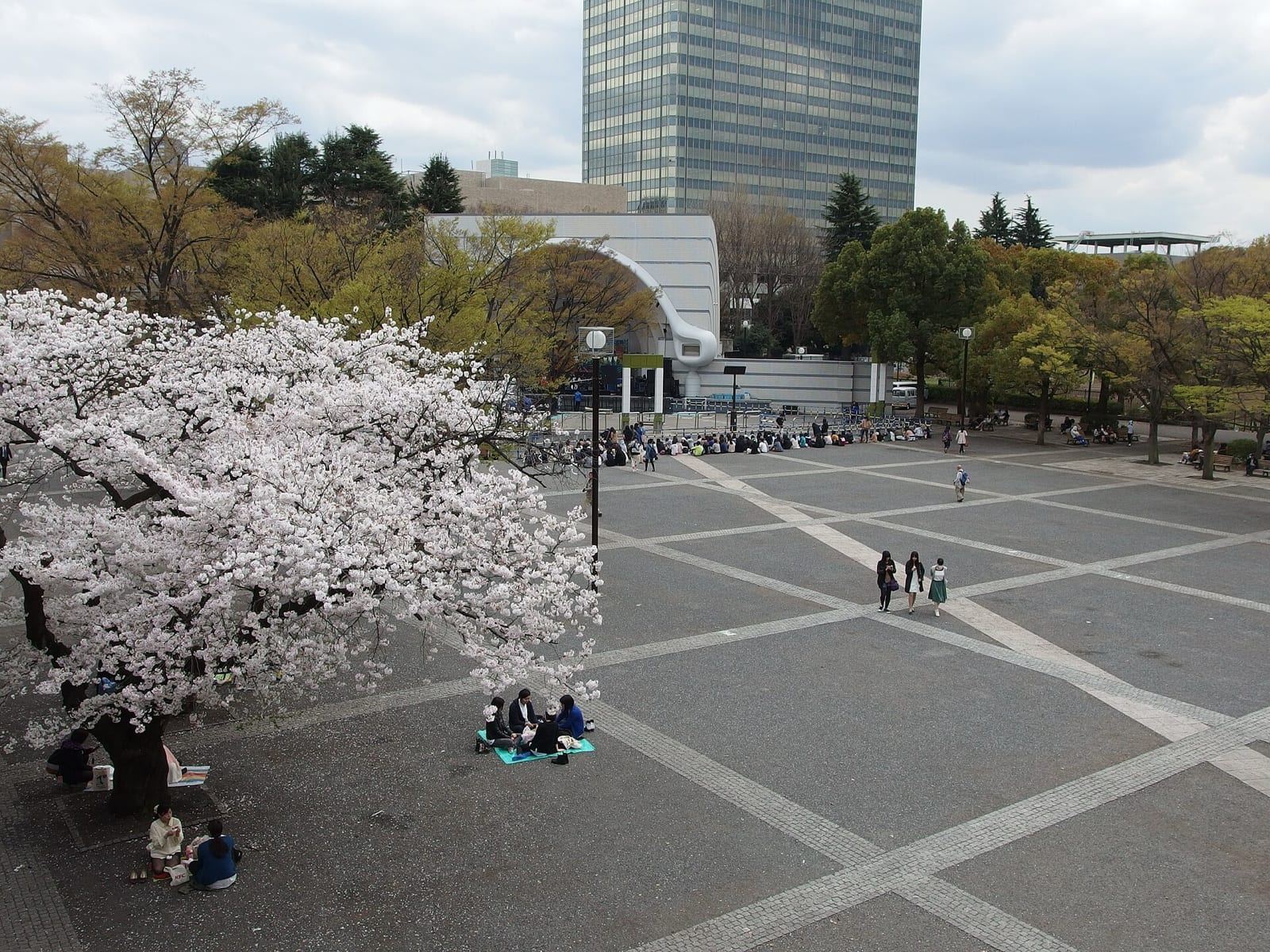
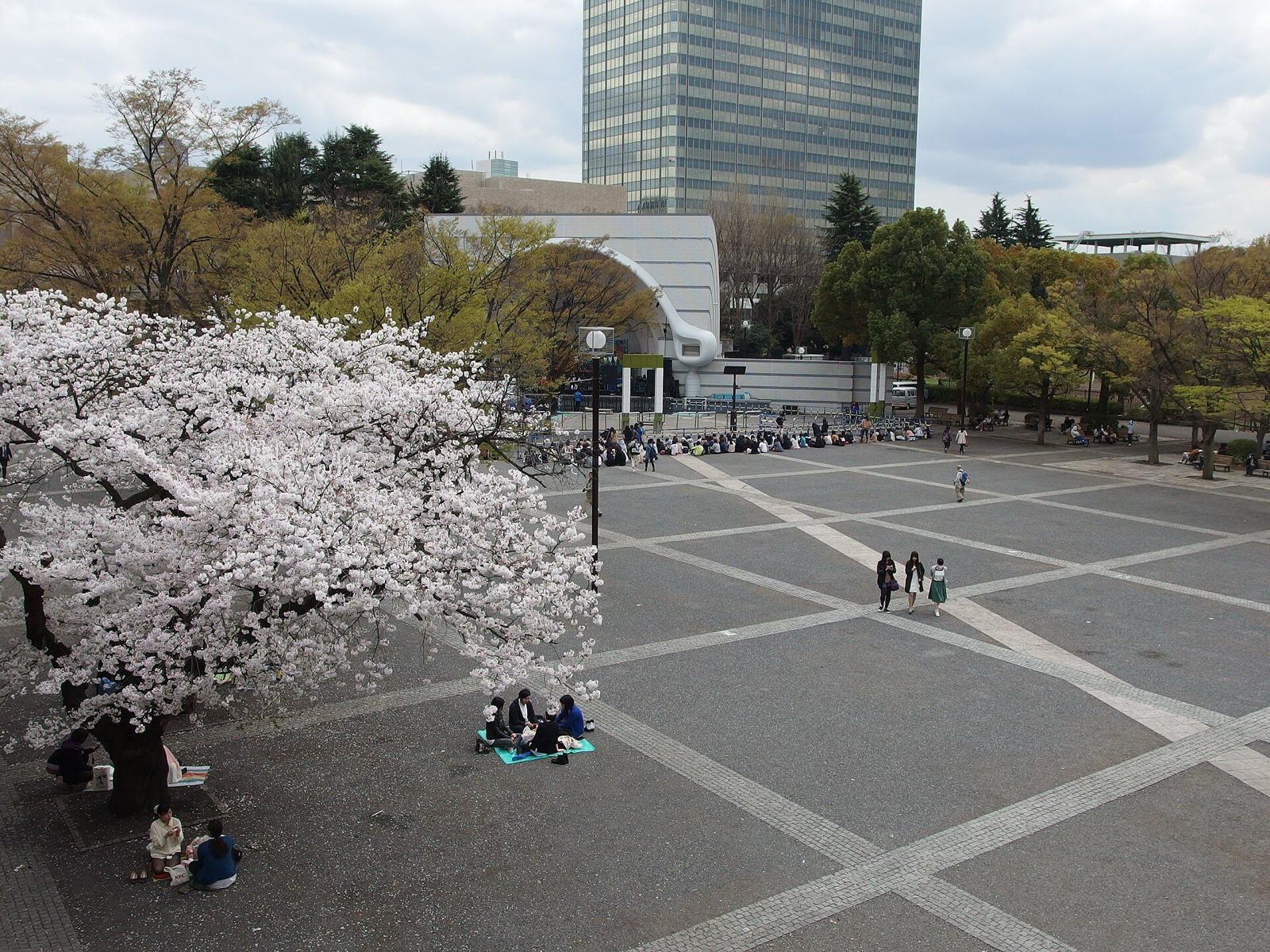
If you would like somewhere to try these steps, Matsuri (matsuri.group, run by Jon&Coo Inc., like J-Times) lists an English × Japanese language-exchange picnic in Shinjuku Central Park on Sunday 1 November 2026, 11:00-14:00, which could be booked when we checked on 25 October 2026. The listing gives the price as ¥3,500, with light food, a drink and a picnic mat included, and says first-timers and people coming alone are welcome (listing page). Check the listing for current details before you go. If you are reading this after 1 November 2026, that date has passed. Our companion guide explains how to choose a language exchange in Tokyo.
Sources and dates checked (all checked on 2026-10-25)
- Tandem Learning Project (Kyushu University international centre website), "What is Tandem learning?" (Brammerts' definition; reciprocity and learner autonomy, citing Little & Brammerts 1996; 1994 International E-Mail Tandem Network, Ruhr University Bochum) — https://isc.kyushu-u.ac.jp/center/tandem/e-about.html , Japanese version https://isc.kyushu-u.ac.jp/center/tandem/about.html
- University of Münster Language Centre, "The basic principles of language learning in Tandem" (equal time, languages kept separate, correcting by repeating correctly) — https://www.uni-muenster.de/Sprachenzentrum/en/tandem/tipps.html
- Little, D. & Brammerts, H. (eds.) (1996), A guide to language learning in tandem via the Internet, CLCS Occasional Paper 46, Trinity College Dublin — catalogue record, National Library of Ireland: https://catalogue.nli.ie/Record/vtls000049800
- Council of Europe / European Union (Europass), "Common European Framework of Reference for Languages: self-assessment grid" (Spoken interaction A1-C2) — https://europass.europa.eu/system/files/2020-05/CEFR%20self-assessment%20grid%20EN.pdf (primary)
- The Japan Foundation, JF Standard for Japanese-Language Education 2010 pamphlet (six CEFR levels, CEFR and JF Can-do, role-play test) — https://www.jfstandard.jpf.go.jp/pdf/jfs2020_pamphlet_ja.pdf ; Can-do database https://jfstandard.jp/cando/ (primary)
- JLPT official site (Japan Foundation and JEES), FAQ (no speaking or writing section; 2026 test dates), level summary, and "CEFR reference levels" — https://www.jlpt.jp/e/faq/index.html , https://www.jlpt.jp/e/about/levelsummary.html , https://www.jlpt.jp/e/about/cefr_reference.html (primary)
- The Japan Foundation, "CEFR level to be added for reference to JLPT score reports" (April 2026; thresholds; excludes production and interaction) — https://www.jpf.go.jp/e/project/japanese/teach/tsushin/news/202601.html (primary)
- IIBC, TOEIC Listening & Reading Test and TOEIC Speaking & Writing Tests (Japanese) — https://www.iibc-global.org/toeic/test/lr.html , https://www.iibc-global.org/toeic/test/sw.html (primary)
- Tanabe, J. (2014), "A Study on Shadowing Materials for Japanese Language Learners: Aiming for Development of Conversational Proficiency", Gifu University International Student Center bulletin (definition quoting Tamai 2005; interpreter-training origin) — https://www.glocal.gifu-u.ac.jp/docs/2014_tanabe.pdf
- Hamada, Y. (2016), "Shadowing: Who benefits and how? Uncovering a booming EFL teaching technique for listening comprehension", Language Teaching Research 20(1): 35-52 — bibliographic record via Akita University researcher database: https://akitauinfo.akita-u.ac.jp/html/300000214_ronbn_gencho_en.html
- KAKEN (JSPS), project 23K00786, Seinan Gakuin University, prosody shadowing (rhythm variability after 10 sessions) — https://kaken.nii.ac.jp/grant/KAKENHI-PROJECT-23K00786 (primary)
- Hatasa, Y. A. (2007), "Aizuchi responses in JFL classrooms: Teacher input and learner use", in Yoshimi & Wang (eds.), Selected Papers from Pragmatics in the CJK Classroom, NFLRC, University of Hawaii (summarising Maynard 1986, 1993; Mizutani 1988) — https://nflrc.hawaii.edu/CJKProceedings/hatasa/hatasa.html
- Kotobank, "相槌" (Digital Daijisen; Seisen-ban Nihon Kokugo Daijiten) — https://kotobank.jp/word/%E7%9B%B8%E6%A7%8C-421558
- Ohyama, T. (2019), doctoral dissertation review, Hokkaido University, on iisashi sentences in Japanese — https://eprints.lib.hokudai.ac.jp/dspace/bitstream/2115/74492/1/Takako_Ohyama_abstract.pdf
- Luo, X., thesis summary, Nagasaki University, on learners' use of iisashi sentences — https://www.hss.nagasaki-u.ac.jp/wp/wp-content/uploads/2020/03/paper_ra.pdf
- Barnard, R. (2008), review of Mackey (ed.) (2007), Conversational interaction in second language acquisition, Oxford University Press (Long, Swain; Mackey & Goo synthesis of 26 studies, 1990-2006) — University of Waikato Research Commons: https://researchcommons.waikato.ac.nz/handle/10289/3326
- National Consumer Affairs Center of Japan, "Can you say no when a friend invites you? Beware of 'mono-nashi' multi-level marketing spreading among young people" (25 July 2019) — https://www.kokusen.go.jp/news/data/n-20190725_1.html (primary)
- National Police Agency, "SNS-type romance fraud" (warning signs; consultation #9110, 188) — https://www.npa.go.jp/bureau/safetylife/sos47/case/sns-romance/romance/ (primary)
- Minato City, "Crime" (110 foreign-language operators; MPD consultation 03-3503-8484) — https://www.city.minato.tokyo.jp/easyjp/en/accidentanddisaster/crime.html ; Chuo City, "Accidents" (MPD consultation hours) — https://www.city.chuo.lg.jp/en/accident.html (primary)
- Matsuri public API and listing page (meetup listings and booking status, read-only) — https://matsuri.group/en/events/288
- Google autocomplete (ja/en), queried 2026-10-25
- Images: Wikimedia Commons file pages (licences checked) — https://commons.wikimedia.org/wiki/File:Picnic_@_Hanami_@_Yoyogi_Park_(13607042833).jpg , https://commons.wikimedia.org/wiki/File:KanjiPractice.jpg
By J-Times Editorial (information as of 2026-10-25)
Written by
J-Times Editorial
J-Times 編集部 / J-Times Editorial Team