J-Times Editorial
J-Times 編集部 / J-Times Editorial Team
Japan's 2026 travel rule changes, checked against government pages: the 3,000 yen departure tax (from 1 July), the refund-based tax-free system (purchases from 1 November), new visa fees, and JESTA, which is law but not yet running. Airport steps and common mistakes included.
Read this article to earn +5 MTC
Short answer (as of 26 October 2026): Three changes affect almost every visitor. The departure tax went up from 1,000 to 3,000 yen on 1 July 2026 and is already in your ticket price. From 1 November 2026, tax-free shopping changes to a refund system: you pay the full price including consumption tax, have your purchases confirmed by customs when you leave Japan, and then get the tax back from the shop. Visa fees rose on 1 July for people who need a visa. JESTA, Japan's planned online travel authorization, became law in May 2026 but has not started. You cannot and do not need to apply for it yet.
This page replaces our April 2026 version. We rechecked every rule against government pages on 26 October 2026; the change log is at the end.
What is decided, what is scheduled, and what is still open?
| Change | Status on 26 Oct 2026 | Date | Who it affects |
|---|---|---|---|
| Departure tax (International Tourist Tax) 3,000 yen | In force | Departures from 1 Jul 2026 | Everyone leaving Japan, including Japanese nationals (some exemptions) |
| Tax-free shopping becomes a refund system | Decided, starts in days | Purchases from 1 Nov 2026 | Visitors who shop tax-free |
| Visa fees raised | In force | Applications from 1 Jul 2026 | Only nationals who need a visa |
| JESTA (electronic travel authorization) | Law passed, not running | By cabinet order before 31 Mar 2029; target FY2028 (April 2028 to March 2029) | Future visa-exempt short-stay visitors |
| Kyoto accommodation tax raised | In force | Stays from 1 Mar 2026 | Hotel guests in Kyoto City |
| Himeji Castle: 2,500 yen for non-residents | In force | From 1 Mar 2026 | Adults who do not live in Himeji |
| Consumption tax on food cut to 1% | Proposed (bill before the Diet, not passed) | Planned for April 2027, for two years | Everyone buying food in Japan |
| Shinkansen oversized-baggage reservations | Not new (since May 2020) | Tokaido, Sanyo, Kyushu and Nishi-Kyushu Shinkansen |
How much is Japan's departure tax now, and do I have to pay it separately?
It is 3,000 yen per person per departure from 1 July 2026. Airlines and ferry companies add it to the fare, so you do not pay anything at the airport.
The National Tax Agency's page gives the rate as 3,000 yen per departure. There is one transitional rule: if your ticket was contracted before 1 July 2026 for a departure on or after that date, the old rate of 1,000 yen applies. Check the "taxes and fees" breakdown on your e-ticket if you are unsure.
You do not pay it if you are under two, if you leave within 24 hours of arriving as a transit passenger, or if you are crew. People on private jets pay customs directly before departure. The tax applies to Japanese nationals as well as foreign visitors.
Where the money goes. The Japan Tourism Agency lists three uses: making travel smoother and less stressful, making information about Japan easier to get, and developing tourism resources based on local culture and nature. Its page also says the revenue will be used to strengthen measures against overtourism, such as crowd and manners management and spreading visitors to more regions, and to roll these out nationwide.
How does tax-free shopping work from 1 November 2026?
You pay the tax-inclusive price in the shop. Within 90 days of the purchase, before you check in your bags on the day you leave Japan, you scan your passport at a customs kiosk. Once customs confirms the goods are leaving, the shop or its refund company pays back the consumption tax.
The Japan Tourism Agency and Japan Customs describe the new "refund method" this way:
- Buy. At a tax-free shop, spend at least 5,000 yen (before tax) in one shop on one day. You pay the full price, including the 10% consumption tax (8% on food and drink). The shop records the purchase against your passport and explains how it will refund you.
- Keep everything together. Keep the goods and receipts. Customs checks by receipt (one transaction): if even one item from a receipt is missing, none of the items on that receipt qualify.
- At the airport or port, before check-in. Within 90 days of purchase, scan your passport at a tax-free procedure kiosk in the international departure lobby. A green result means you are done. A red result means you take the goods to the customs inspection area.
- Or use Visit Japan Web. At Narita, Haneda, Kansai, Chubu Centrair, Fukuoka, New Chitose and Naha, you can do the same step online in Visit Japan Web, using the dedicated Wi-Fi in the departure lobby, up to the security checkpoint.
- Get the refund. Depending on the shop, the refund comes by bank transfer, back to your credit card, through an app, or in cash at the departure port after customs confirmation. Ask the shop which one it uses when you buy.

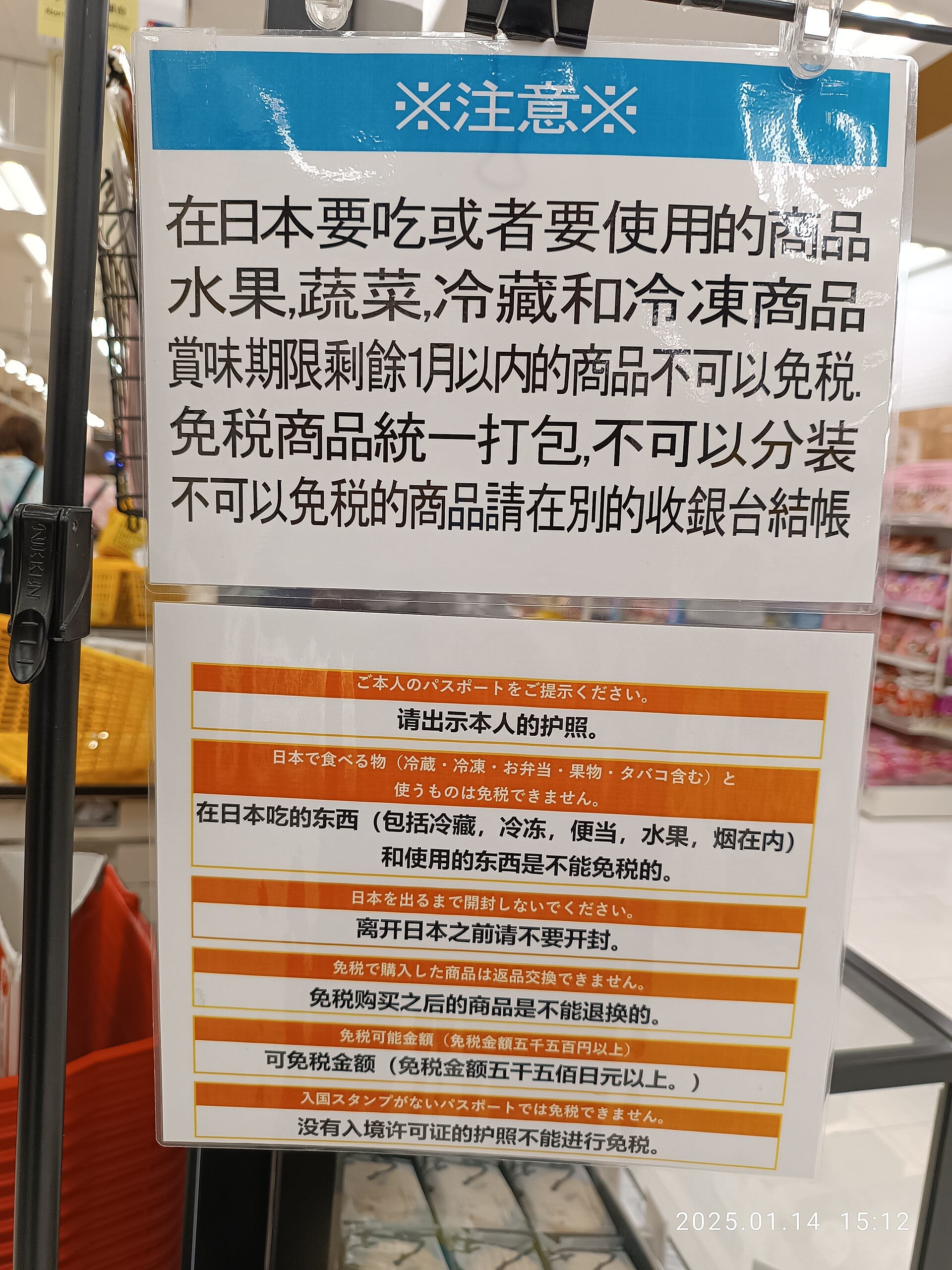
Photo: Naha Mama Pavilionz / Wikimedia Commons / CC0 (14 January 2025). The sign shows the rules before November 2026.
What gets easier. The Japan Tourism Agency's summary of the reform lists three changes for purchases from 1 November 2026. Food, cosmetics, medicines and other consumables no longer have to be sealed in special bags. The 500,000 yen upper limit on consumables is gone, so consumables and general goods are treated the same. And shops no longer have to judge whether an item counts as eligible for "ordinary daily use". The only quantity limit on the official page is that you must be able to carry the goods out of Japan yourself when you leave.
What gets stricter. You can open the goods now, but anything you eat, drink or use up in Japan does not qualify. If you have used part of something, do not scan it; tell a customs officer at the counter. Goods declared as exported but not taken out are charged the tax plus penalties. Bullion and goods already exempt from consumption tax are excluded, and since 1 April 2025 posting your own tax-free goods abroad no longer counts as exporting them (some shops still ship for you).
Who can use it. In general, foreign visitors on a short stay, and Japanese nationals who have lived abroad for two years or more and can prove it. The official FAQ links to the full list.
What about purchases before 1 November? Anything bought tax-free up to 31 October 2026 was sold under the old system, with the tax already taken off in the shop. Take it out of Japan as before. The new kiosk procedure applies to purchases from 1 November.
Common mistakes with the new system
- Checking in your suitcase first. The kiosks are before baggage check-in, and customs states that checked bags cannot be taken back out. Do the kiosk step first.
- Splitting a receipt between suitcases you no longer have. If you left one item from a receipt with a friend in Japan, the whole receipt fails.
- Leaving it to the last 30 minutes. The scan takes seconds, but a red result means queuing at an inspection desk. Allow extra time on top of the usual check-in advice.
- Connecting flights. Do the procedure at the airport where you actually leave Japan.
- Not asking how the refund arrives. Each shop chooses its own refund method and timing.
- Buying anything worth 1 million yen or more (before tax) without its papers. Customs may ask to see a certificate of authenticity or a warranty.
What is JESTA, and do I need it for my trip?
JESTA (Japan Electronic System for Travel Authorization) is a planned pre-travel online authorization for visitors who do not need a visa. Japan passed the law on 29 May 2026, but the system is not running yet. You do not need it for a trip in 2026 or 2027.
The Immigration Services Agency's summary of the amended Immigration Control Act explains the design. Visa-exempt foreign nationals coming for a short stay, cruise passengers and some transit passengers will have to obtain authorization online before each new entry. Airlines and shipping companies will have to report passenger details when tickets are issued and must not board anyone the agency says should not enter. Travellers with authorization who meet the entry conditions will no longer get a landing stamp in their passport, and the agency expects to use walk-through gates.
The official start date is "a date set by cabinet order before 31 March 2029". A Japan Tourism Agency document from the 2026 tax reform requests says the plan is to introduce JESTA during fiscal 2028, which runs from April 2028 to March 2029. The fee, how long an approval lasts and the application website have not been announced. Some media have printed fee estimates. No government document we found confirms them, so we do not repeat them here.
Why Japan is doing it. The agency's background note says about 38.46 million people entered Japan for tourism and other short stays in 2025, about 80% of them from visa-exempt countries, with no screening before travel and growing immigration queues. The US (ESTA) and the UK (ETA) run similar schemes.
A warning. JESTA has no official application site yet, so any site taking money for a "JESTA application" now is not official. When it opens, the Immigration Services Agency (moj.go.jp/isa) will publish the address.
Did visa fees go up?
Yes, for people who need a visa. From applications made on 1 July 2026, the Ministry of Foreign Affairs charges about 15,000 yen for a single-entry visa and about 30,000 yen for a multiple-entry visa, paid in local currency at the embassy or consulate. Visa-exempt travellers are not affected.
This is the first change to the fees since 1978. The cabinet approved the amended order on consular fees on 19 June 2026. The exact amount differs by nationality and by embassy. Some nationalities pay reduced fees or none under bilateral arrangements, and no fee is charged if a visa is refused. Check the page of the embassy or consulate that will handle your application. Applications made before 1 July 2026 were charged the old fees.
Is the consumption tax on food going down?
Possibly, but it is not law. On 9 October 2026 the cabinet approved a bill to cut the consumption tax on food and drink from 8% to 1% for two years from April 2027. As of 26 October it is still before the Diet.
The cabinet first adopted an outline of the plan on 15 September 2026, and the National Tax Agency has opened a special information page. Local governments' notices stress that the details apply only if the bill passes. For a trip before April 2027, nothing changes: food and non-alcoholic drinks to take away are taxed at 8%, and most other goods at 10%. If the cut does go ahead, the tax refunded on food bought tax-free would shrink accordingly.
Are there new local charges at popular places?
Yes. Several are already in force: Kyoto's higher accommodation tax, Himeji Castle's non-resident price, and Mount Fuji's climbing fees. They are local rules, so the amounts depend on where you go.
Kyoto accommodation tax (from 1 March 2026). Kyoto City charges per person per night, based on the room price excluding meals and consumption tax:
| Room price per person per night | Tax from 1 Mar 2026 |
|---|---|
| Under 6,000 yen | 200 yen |
| 6,000 to under 20,000 yen | 400 yen |
| 20,000 to under 50,000 yen | 1,000 yen |
| 50,000 to under 100,000 yen | 4,000 yen |
| 100,000 yen or more | 10,000 yen |
School trips are exempt. If you prepaid through a booking site, check whether the tax was included. Other cities and prefectures also charge accommodation taxes, so read the booking terms.
Himeji Castle (from 1 March 2026). Admission is 2,500 yen for adults (18 and over) who do not live in Himeji City and 1,000 yen for Himeji residents. Under-18s are free. The castle's own site lists these prices. Local press reported that the aim is to pay for the upkeep of a World Heritage castle that is more than 400 years old.
Mount Fuji (summer season). For the 2026 season, Yamanashi Prefecture charged 4,000 yen per climber on the Yoshida Trail, closed the 5th Station gate from 2 pm to 3 am (except for climbers with mountain-hut bookings) and capped numbers at 4,000 a day. Shizuoka Prefecture's three trails also charged 4,000 yen and required an online pre-learning module. The 2026 season ended on 10 September. Check both prefectures' pages again before summer 2027. For the mountain's cultural side, see How Mount Fuji became a national religion.
Is there a new luggage rule on the Shinkansen?
No. The rule is not new. Since 20 May 2020, on the Tokaido, Sanyo, Kyushu and Nishi-Kyushu Shinkansen, any bag whose length, width and height add up to more than 160 cm (and no more than 250 cm) needs a reserved "seat with oversized baggage area".
According to JR West, booking that seat costs the same as an ordinary reserved seat. If you board with an oversized bag and no booking, you pay a 1,000 yen fee (including tax) and staff will tell you where to put it. Bags over 250 cm cannot be taken on board. Bags of 160 cm or less go on the overhead rack without a booking. Strollers, sports equipment and musical instruments are outside the oversized-baggage rule, but the space behind the last row is kept for people who booked it. These rules do not apply to non-reserved cars or to conventional (non-Shinkansen) lines.
What to do: add up your suitcase's three sides at home. Over 160 cm, choose the oversized-baggage option when you book, or send the bag ahead by luggage delivery (takkyubin). Our guide to getting around Japan in 2026 covers passes and IC cards, and our train manners guide explains why big bags in the aisle annoy commuters.
What has not changed?
Visa-free short stays for eligible nationalities, Visit Japan Web for arrival, and card and IC-card payments all work much as they did in 2025.
- Entry. If your nationality is on MOFA's visa-exemption list, you can still enter for a short stay without a visa. Your passport must be valid for your whole stay. Check the list before you book, because visa-exemption arrangements can change.
- Visit Japan Web. The Digital Agency's Visit Japan Web lets you register immigration and customs information before you arrive. From November 2026 it can also handle the tax-free export step at seven major airports.
- Paying. Cards work widely in cities, but small restaurants, rural inns, shrine offices and some buses may be cash only. IC cards such as Suica and PASMO work on most urban trains and in convenience stores, and JR East's English-language Welcome Suica Mobile app (March 2025) lets iPhone users issue a Suica without visiting a station. Convenience-store ATMs accept many overseas cards; see our konbini guide.
- Tipping. Still not expected. Here is why.
New places worth knowing about. PokePark KANTO, a permanent Pokémon park inside Yomiuriland in Inagi, western Tokyo, opened in February 2026. Tickets are sold in advance (by lottery or first come, first served), and the official site says ID checks at the entrance start with November 2026 visits. Bring the passport that matches your booking.

Photo: 名無し野電車区 / Wikimedia Commons / CC BY-SA 3.0 (23 April 2014)
Why is Japan changing these rules now?
The common thread is that a record number of visitors now share space with people who live here, and the cost of that is being moved onto the people who create it, rather than onto residents.
The Immigration Services Agency counted about 39.18 million new foreign entries in 2025. The departure tax is earmarked for tourism and anti-overtourism measures. The tax-free reform targets goods bought tax-free and resold inside Japan. The Kyoto and Himeji charges help pay for places that residents look after and live beside.
The Japanese idea behind this is o-tagai-sama, "we are in this together". A temple courtyard or a lane in Gion is not a stage set; it is someone's neighbourhood, and the people who sweep it each morning are its real hosts. A small charge or a rule about bags is part of how a crowded country keeps those places liveable for both sides. For the everyday version of this, see 50 unspoken rules for visitors.
Checklist before you fly
- Passport valid for the whole stay. Check MOFA's visa-exemption list for your nationality, or apply for a visa (new fees from 1 July 2026).
- No JESTA application needed yet. Ignore any website that offers one.
- Departure tax: nothing to do. It is in your fare (1,000 yen if the ticket was contracted before 1 July 2026).
- Register on Visit Japan Web before you arrive.
- Suitcase over 160 cm in total? Book an oversized-baggage seat on the Tokaido, Sanyo or Kyushu Shinkansen, or use luggage delivery.
- Shopping tax-free from 1 November? Keep goods and receipts together, do not use them up in Japan, and ask each shop how it refunds.
- On departure day: kiosk before check-in, and arrive early.
- Staying in Kyoto? Check whether your booking includes the accommodation tax.
- Save the emergency numbers: 110 police, 119 fire and ambulance. See what to do in an emergency in Japan.
Frequently asked questions
Is the departure tax charged on domestic flights? No. It applies only when you leave Japan.
I bought my ticket in May 2026 for a flight in August. Which rate do I pay? Under the transitional rule, departures on or after 1 July 2026 under a contract made before that date are taxed at 1,000 yen. Your airline sets out how it applies this.
Can I open and use what I bought tax-free? The sealed-bag rule ends for purchases from 1 November, so you can open goods. But anything eaten, drunk or used up in Japan does not qualify for the refund, and if any item from a receipt is missing, the whole receipt fails.
I live in Japan on a work visa. Can I shop tax-free? In general, no. The system is for non-residents such as short-stay visitors. Japanese nationals who have lived abroad for two years or more can qualify with proof.
Is Japan cutting the consumption tax on food? A bill to cut it from 8% to 1% for two years from April 2027 was approved by the cabinet on 9 October 2026 and is before the Diet. It has not passed.
When will JESTA start and how much will it cost? The law says by a date set by cabinet order before 31 March 2029, and the government's target is fiscal 2028. The fee and application process have not been announced.
Sources and dates checked (all checked on 2026-10-26)
- National Tax Agency, "国際観光旅客税について" (rate 3,000 yen, transitional 1,000 yen rule, exemptions, collection) — nta.go.jp/publication/pamph/kansetsu/… (primary)
- Japan Tourism Agency, "国際観光旅客税" (rate change leaflet, uses of revenue, anti-overtourism measures; page updated 21 May 2026) — mlit.go.jp/kankocho/seisaku_seido/kiho… (primary)
- Japan Customs, International Tourist Tax — customs.go.jp/kaigairyoko/ryokakuzei.htm (primary)
- Japan Tourism Agency, "1. What is the Refund Method?" (5,000 yen threshold, 90 days, kiosks, Visit Japan Web, refunds by shop) — mlit.go.jp/kankocho/tax-free/page01_00… (primary)
- Japan Tourism Agency, FAQ for travellers (Refund Method) (connecting flights, cruises, consumed goods, 1 million yen items, refund methods, Japanese living abroad, separate shipment ended 31 Mar 2025) — mlit.go.jp/kankocho/tax-free/page01_00… (primary)
- Japan Customs, "Tax Exemption (Refund) Program for Foreign Visitors" — customs.go.jp/kaigairyoko/taxrefund_e.htm… (primary)
- Japan Tourism Agency, FY2026 tax reform result sheet on the tax-free system (sealed packaging and 500,000 yen cap abolished, purchases from 1 Nov 2026) — mlit.go.jp/kankocho/content/002002303.… (primary)
- Immigration Services Agency, outline of the amended Immigration Control Act (JESTA design, carrier duties, start "before 31 March 2029"; 2025 entry figures) — moj.go.jp/isa/content/001464339.pdf (primary)
- Japan Tourism Agency, tax reform request on JESTA and the tax-free system (law enacted 29 May 2026; introduction during FY2028) — mlit.go.jp/kankocho/content/002019837.… (primary)
- Ministry of Foreign Affairs, visa fees (from 1 July 2026) — mofa.go.jp/j_info/visit/visa/procedure… (primary; blocks automated access, content confirmed via search results and embassy notices)
- Travel Watch, "査証手数料を約5倍に引き上げ" (cabinet decision 19 June 2026, about 15,000 / 30,000 yen) — travel.watch.impress.co.jp/docs/news/2120419.html
- Kumamoto Nichinichi Shimbun (Kyodo), "食品消費税1%法案を閣議決定" (9 October 2026: cabinet approves bill, 8% to 1% from April 2027 for two years) — kumanichi.com/articles/2044798 ; Ibaraki Prefecture, "飲食料品に係る2年間の消費税引下げについて" (outline adopted 15 September 2026; applies only if the bill passes; updated 2 October 2026) — pref.ibaraki.jp/somu/zeimu/fuka/zeiritsuhik… (primary)
- Kyoto City, accommodation tax (rates from 1 March 2026, exemptions) — city.kyoto.lg.jp/gyozai/page/0000236942.html (primary)
- Himeji Castle official site (admission 2,500 yen / Himeji residents 1,000 yen / under 18 free) — himejicastle.jp (primary); Kobe Shimbun on the 1 March 2026 change — kobe-np.co.jp/news/society/202603/0020075…
- Yamanashi Prefecture, Yoshida Trail fee and limits (updated 7 July 2026) — pref.yamanashi.jp/fujisan/siyouryou.html (primary); official Mt Fuji climbing site 2026 leaflet (Shizuoka trails, 4,000 yen) — fujisan-climb.jp
- JR West, oversized baggage (lines, 160/250 cm, 1,000 yen fee, exempt items) — jr-odekake.net/railroad/service/baggage (primary); JR Central/JR West Smart EX, booking an oversized-baggage seat — smart-ex.jp/reservation/reserve_smart/o… (primary)
- Digital Agency, Visit Japan Web — services.digital.go.jp/en/visit-japan-web (primary)
- JR East press release, Welcome Suica Mobile (released 6 March 2025) — jreast.co.jp/e/press/pdf/0218wsm_en.pdf (primary); Business Wire copy — businesswire.com/news/home/20250310510899/en
- PokePark KANTO official site (open; ID checks from November 2026 visits) — pokepark-kanto.co.jp (primary)
- Images: Wikimedia Commons file pages (licences checked) — commons.wikimedia.org/wiki/File:JP_日本_Japan_沖繩_OK… , commons.wikimedia.org/wiki/File:Departure_lobby_o…
What we changed from the April 2026 version: the earlier text said customs pays the tax-free refund (the shop or its refund operator does), called the Shinkansen 160 cm rule a 2026 tightening (it dates from 2020), and mentioned a "Gundam Museum" opening and eSIM prices we could not verify. Those have been corrected or removed.
By J-Times Editorial (information as of 2026-10-26)
About this article
- By
- J-Times Editorial
- Published
- Updated
Sources are cited in the text and at the end. If you spot an error, please tell us. Editorial policy & corrections
J-Times is published by Jon&Coo Inc.
Written by
J-Times Editorial
J-Times 編集部 / J-Times Editorial Team