J-Times Editorial
J-Times 編集部 / J-Times Editorial Team
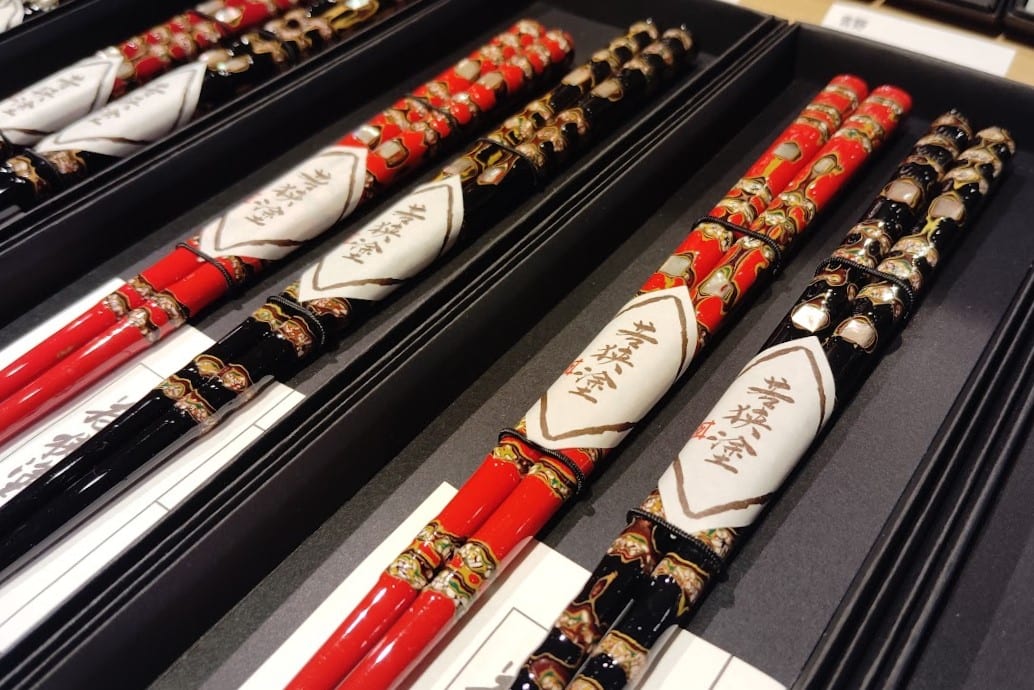
Wakasa-nuri is polished lacquerware from Obama, Fukui, designated a national Traditional Craft on 6 February 1978. How the pattern is made, how to pick the right length, and how to wash lacquer chopsticks so they last.
Read this article to earn +5 MTC
What is Wakasa-nuri? How to choose and care for Japanese lacquer chopsticks
Short answer (as of 2026-10-02): Wakasa-nuri is lacquerware from Obama, Fukui Prefecture, whose pattern is polished out of many coats of coloured lacquer. It was designated a national Traditional Craft on 6 February 1978. Wash lacquer chopsticks by hand, do not soak them, and keep them out of the dishwasher unless the label says otherwise.
Disclosure: J-Times and Matsuri are both operated by Jon&Coo Inc. This guide ends with a chopstick listing on Matsuri's shop; facts about that listing are as of 2 October 2026.
If you have ever been handed a pair of glossy red or black chopsticks flecked with gold and mother-of-pearl, there is a good chance they came from one small city on the Sea of Japan coast. This guide explains what makes Wakasa-nuri different from other lacquer, what the "80 per cent of Japan's lacquered chopsticks" figure really refers to, and how to choose, wash and give a pair.
What is Wakasa-nuri?
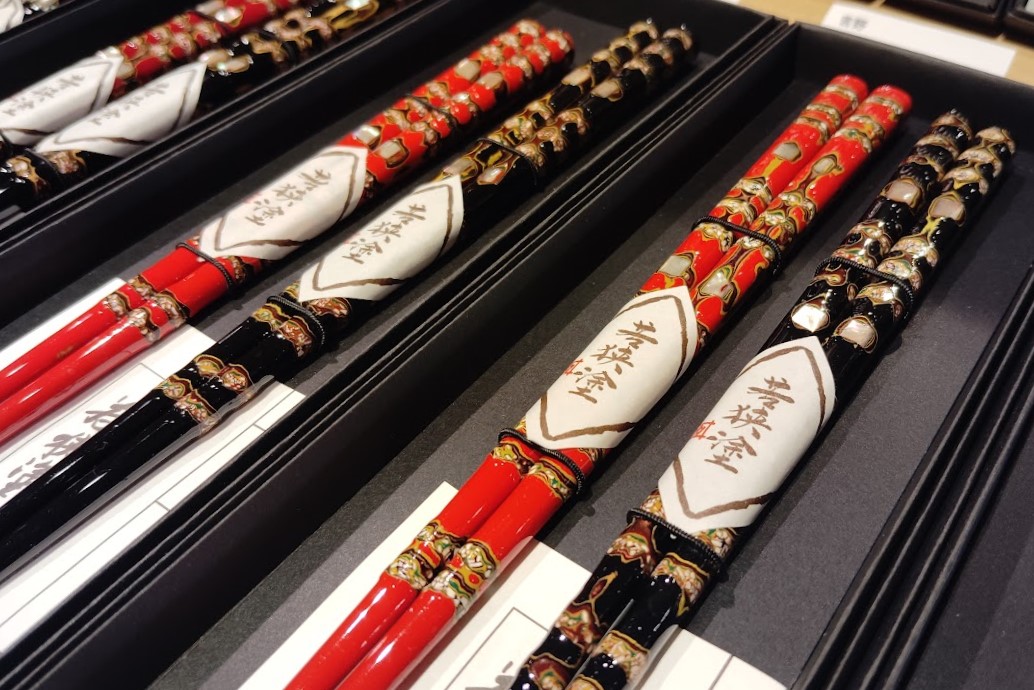
Wakasa-nuri (若狭塗, "Wakasa lacquer") is a type of Japanese lacquerware made mainly in Obama City, Fukui Prefecture, best known for patterns that look like the seabed.
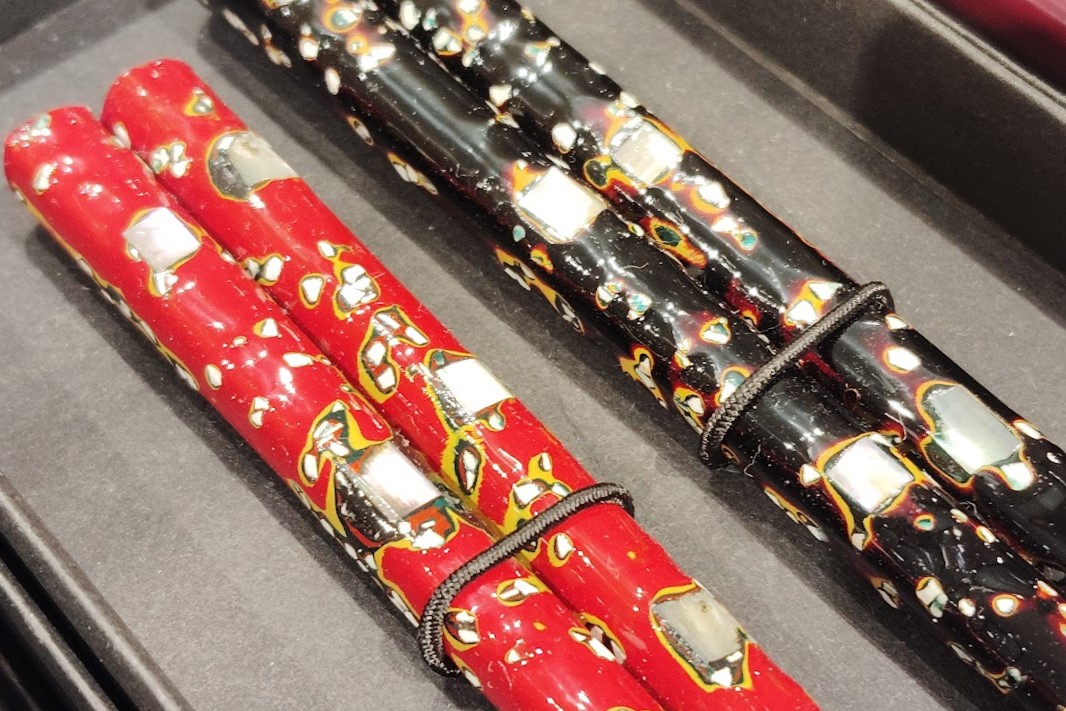
Wakasa is the old name of the province on Wakasa Bay, and nuri means "coating" or "lacquering". The Association for the Promotion of Traditional Craft Industries, which runs the Aoyama Square traditional-crafts shop in Tokyo, lists Obama as the main production area and flower vases, tea utensils, sake ware and chopstick boxes as the main products. Its description is specific: patterns are made with eggshell, blue-green shell, pine needles, cypress leaves and rapeseed, and gold leaf glints through them "like stars or jewels". Because the work is done by hand, no two pieces are identical.
Where does Wakasa-nuri come from, and how old is it?
It began in the early Edo period, in the 17th century, when lacquerers of the Obama domain adapted ideas from Chinese lacquerware to depict the seabed.
According to the Association, a lacquerer of the Obama domain took a hint from Chinese lacquer techniques and turned the look of the sea floor into a design. By the mid-17th century the method still used today, decorating with eggshell and gold or silver leaf, was complete, and the domain's lord named it Wakasa-nuri and encouraged it as side work for foot soldiers. The Fukui-based chopstick maker Hyozaemon tells the same origin story and names the craftsman as Matsuura Sanjūrō, the domain's official lacquerer. Hyozaemon adds that the mid-to-late Edo period was the craft's golden age, when more than 200 finishing techniques were developed.
How is the pattern made?
The pattern is built up first and then revealed by polishing. Craftsmen lay down shell, eggshell or pine needles, cover them with layers of coloured lacquer and gold leaf, and grind back through the layers with whetstones and charcoal.
This grinding-back is called togidashi (研ぎ出し, "polishing out"). The Association's outline of the work runs to about 60 steps, including:
- Base work. Cloth is pasted over joints to stop warping, then a ground of raw lacquer mixed with fired clay powder is applied.
- Patterning. Eggshell, shell, pine needles or rapeseed are set into the lacquer in each maker's own design.
- Layering. Two or more colours of lacquer are applied, and gold leaf is laid on top.
- Coating. More lacquer is built up over the pattern.
- Polishing out. Coarse, medium and fine whetstones, then charcoal, grind the surface until the pattern appears, and a final polish brings up the shine.
The Association says a piece takes about a year to finish. The official technical standard for Wakasa-nuri requires natural lacquer, and for chopsticks it specifies cherry, rosewood (shitan), moso bamboo or wood of equivalent quality.
When was Wakasa-nuri designated a Traditional Craft?
Wakasa-nuri was designated a Traditional Craft (伝統的工芸品) by Japan's Minister of Economy, Trade and Industry on 6 February 1978.
The date appears both on the Association's Wakasa-nuri page and in the list of designated crafts published by the Ministry of Economy, Trade and Industry (METI). METI says 244 crafts held the designation as of 27 October 2025. To qualify, a craft must meet five conditions: it is mainly for everyday use; the main stages are done by hand; it uses traditional techniques; it uses traditional materials; and a sizeable number of people make it in a defined area.
The designation covers the craft, not every product with "Wakasa" in its name. Pieces that pass the producers' inspection can carry the dentō shōshi, a small paper seal with the national "traditional mark". The seals are issued by the Association under a METI scheme.
Do most of Japan's lacquered chopsticks really come from Obama?
Yes, by the producers' own account. The Association says Wakasa makes more than 80 per cent of Japan's lacquered chopsticks, and Fukui's official tourism site says the same of Obama City.
The figure is useful but rough. Neither source gives the year it was measured, and it counts lacquered chopsticks (nuribashi) made in the area as a whole. That is broader than certified Wakasa-nuri. Hyozaemon's timeline says Obama's chopstick industry became the largest in Japan by output in 1978, the same year as the designation. Treat "about 80 per cent" as an industry claim, not a dated statistic.
How do you choose a good pair?
Choose a length that fits your hand, look for natural lacquer at the tips, and look for the traditional-craft seal if you want certified Wakasa-nuri.
- Length. A common rule of thumb is hitoata-han, "one and a half spans". Open your thumb and index finger at a right angle, measure tip to tip, and multiply by 1.5. Both Hyozaemon and the Shogakukan parenting site HugKum give this rule. For a 12 cm span, that is an 18 cm pair.
- Finish at the tips. Hyozaemon points out that a coating can legally be called "lacquer" in Japan if a single drop of lacquer is mixed into a synthetic paint. If it matters to you, ask what is used on the part that goes into your mouth.
- Certification. The dentō shōshi seal is the clearest sign that a piece passed the production-area inspection. Many good chopsticks are sold without it, so its absence is a reason to ask, not proof of anything.
- Dishwasher labels. Some Wakasa-style chopsticks are sold as dishwasher-safe. Follow the label on the pair you actually buy.
How do you care for lacquer chopsticks?
Wash them gently by hand straight after the meal, dry them, and store them out of direct sun. Do not soak them, and do not put them in a dishwasher unless they are labelled dishwasher-safe.
Hyozaemon's care guide gives the reasons:
- Hand-wash. Real lacquer releases grease easily, so a quick wash is usually enough. If you use a sponge, use the soft side. Do not rattle several pairs together while washing or drying, because the friction wears the coating.
- No soaking. Leaving chopsticks in water for a long time after a meal damages the wood underneath.
- No dishwasher. Hyozaemon says many dishwashers wash at 40 to 50°C and rinse at close to 80°C. Lacquer is weak against hot water, and the jets also rub the surface.
- Store away from sunlight. Lacquer and beeswax finishes can discolour in UV light, so a drawer is better than a sunny utensil pot.
- Repair rather than replace. The tips wear first. Natural-lacquer chopsticks can be re-lacquered, and some makers repair them or sell a single replacement stick.
The same rules apply to other lacquer tableware. For what not to do with chopsticks at the table, see our guide to chopsticks etiquette in Japan.
What are meoto-bashi, and are they a good gift?
Meoto-bashi (夫婦箸, "husband-and-wife chopsticks") are two matching pairs of chopsticks, one slightly longer than the other. In Japan they are a standard wedding and anniversary gift.
You can see this in how they are sold. Takashimaya's online gift store lists meoto-bashi sets among its wedding gifts, and the Wa-Sen listing below suggests its set for weddings and anniversaries. A paulownia (kiri) box is the usual gift packaging. If you give a pair to a couple, choose two lengths that suit both hands rather than assuming who gets the longer one. The hitoata-han rule above works for a gift too.
Where can you see or buy Wakasa chopsticks?
In Obama itself, or from shops that sell them online. In Obama you can watch artisans work and try polishing out a pattern yourself.
West Japan Railway's travel site says the Miketsukuni Wakasa Obama Food Culture Museum offers a hands-on session where visitors polish their own lacquered chopsticks. Fukui's official tourism site describes another programme, Wakasa Takumi Musubi, that pairs Wakasa lacquered chopsticks with Wakasa washi paper.
Online, Matsuri's shop has one listing from the shop Wa-Sen: "Wakasa-nuri meoto-bashi, Raku-usagi (rabbit) design, in a paulownia box".
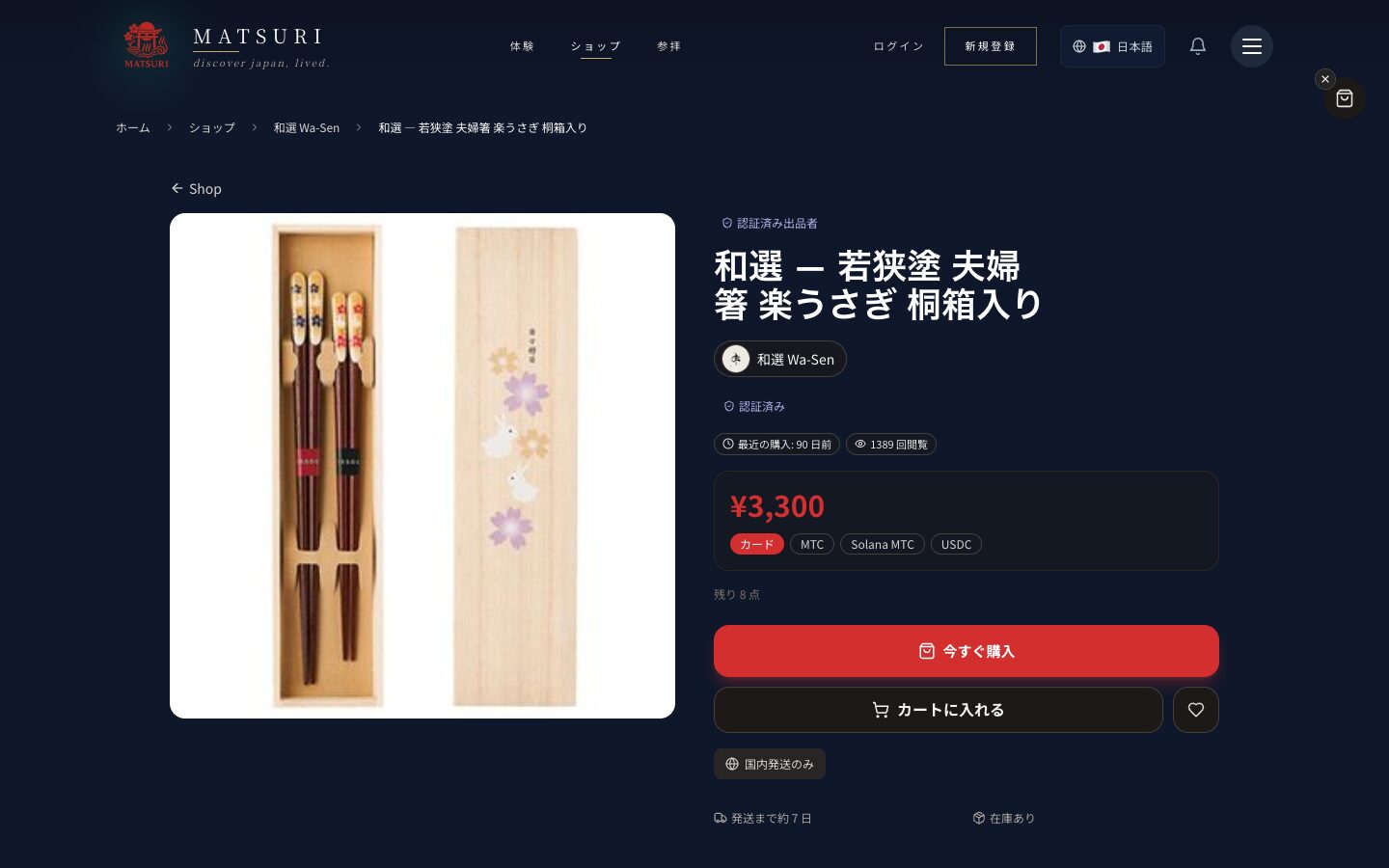
What the listing showed on 2 October 2026:
- Seller: Wa-Sen, shown as a verified seller. The shop was able to take orders on that date.
- Price: ¥3,300 in the Japanese view. Prices shown in other languages and currencies can differ, so check the total at checkout.
- Stock and dispatch: 8 left; ships in about 7 days.
- Shipping: Japan addresses only. The item cannot be sent abroad, so a visitor needs a Japanese delivery address, such as a hotel that accepts guest parcels, and enough time in the country.
- What it does not say: The seller describes the pair as Wakasa lacquer with hand-polished tips. The listing does not name the workshop, the type of lacquer or whether the pair carries the traditional-craft seal. If those points matter, ask the seller through Matsuri's Messages before you buy.
Our step-by-step guide to buying on Matsuri Shop explains the rest of the product page.
The Matsuri feature
- What is Matsuri? — the hub of this feature
- How to buy Japanese crafts on Matsuri Shop — reading a product page, payment and shipping
- What is Wakasa-nuri? (this page)
Sources and dates checked
All pages were accessed on 2 October 2026.
- Association for the Promotion of Traditional Craft Industries, "Wakasa-nuri" (origin, technique, technical standard, designation date, chopstick share): https://kougeihin.jp/craft/0518/
- Ministry of Economy, Trade and Industry, traditional crafts portal (244 designated crafts as of 2025-10-27) and designated-crafts list (Wakasa-nuri, 1978-02-06): https://www.meti.go.jp/policy/mono_info_service/mono/nichiyo-densan/index.html / https://www.meti.go.jp/policy/mono_info_service/mono/nichiyo-densan/xlsx/list_20251027.xlsx
- METI, designation criteria (five conditions): https://www.meti.go.jp/policy/mono_info_service/mono/nichiyo-densan/densan/designation.html
- METI, rules for the traditional-craft seal issued by the Association: https://www.meti.go.jp/policy/mono_info_service/mono/nichiyo-densan/pdf/20240731hyoji.pdf
- Fukui Prefectural Tourism Federation, "Wakasa Takumi Musubi" (more than 80% of Japan's lacquered chopsticks made in Obama): https://www.fuku-e.com/en/attractions/detail_8291.html
- West Japan Railway, Miketsukuni Wakasa Obama Food Culture Museum (chopstick-polishing experience): https://www.westjr.co.jp/global/en/ticket/hokuriku-arch-pass/Explore_Japan/spot/fukui/miketsukuni-wakasa-obama-food-culture-museum/index.html
- Hyozaemon, care guide: https://www.hyozaemon.co.jp/about/care/ ; Q&A (lacquer labelling, re-lacquering): https://www.hyozaemon.co.jp/about/qa/ ; techniques (Matsuura Sanjūrō, golden age): https://www.hyozaemon.co.jp/about/technique/ ; chopstick length: https://www.hyozaemon.co.jp/culture/saho/ ; timeline: https://www.hyozaemon.co.jp/culture/history/
- HugKum (Shogakukan), chopstick length by hitoata-han: https://hugkum.sho.jp/446689
- Takashimaya online store, wedding gifts: chopsticks and rests (meoto-bashi sets): https://www.takashimaya.co.jp/shopping/gift/kekkoniwai/A18366/0500004882/200129/0500004903
- Matsuri, Wa-Sen listing and public shop API (price, stock, shipping, can-take-orders status): https://matsuri.group/en/shop/p/wasen-meotobashi/
Featured image: Asturio Cantabrio / Wikimedia Commons / CC BY-SA 4.0 (https://commons.wikimedia.org/wiki/File:Wakasa_Lacquerware_chopsticks_ac_(3).jpg) — license checked on the Commons file page 2026-10-02
Written by
J-Times Editorial
J-Times 編集部 / J-Times Editorial Team