J-Times Editorial
J-Times 編集部 / J-Times Editorial Team
Kutani is colourfully painted porcelain from Ishikawa, Bizen is unglazed wood-fired stoneware from Okayama, and Mashiko is thick, glazed folk pottery from Tochigi. Origins, how to tell them apart, and how to use and care for each.
Read this article to earn +5 MTC
Kutani vs Bizen vs Mashiko ware: how to tell three Japanese potteries apart
Short answer (as of 2026-10-02): Kutani ware is porcelain from Ishikawa painted over the glaze in bold colours. Bizen ware is stoneware from Okayama, fired in wood kilns with no glaze and no painting. Mashiko ware is thick, glazed everyday pottery from Tochigi, tied to the folk-craft (mingei) movement. You can tell them apart by surface: painted, bare clay or glaze.
Disclosure: J-Times and Matsuri are both operated by Jon&Coo Inc. This guide ends with pieces listed on Matsuri's shop; facts about those listings are as of 2 October 2026.
Kutani, Bizen and Mashiko are three of the best-known names in Japanese ceramics, and all three are national Traditional Crafts. They have almost nothing else in common. One is about colour, one is about fire and clay, and one is about plain pots for daily use. This guide compares them side by side and then covers how to use and care for each.
How are Kutani, Bizen and Mashiko different?
They differ in body, decoration and firing. Kutani is painted porcelain. Bizen is bare, wood-fired stoneware. Mashiko is glazed pottery with a thick body.
| Kutani ware (九谷焼) | Bizen ware (備前焼) | Mashiko ware (益子焼) | |
|---|---|---|---|
| Where | Kanazawa, Komatsu, Kaga and Nomi, Ishikawa | Bizen, Okayama and Setouchi, Okayama | Mashiko, Mōka, Ichikai and Motegi, Tochigi |
| Body | Porcelain | Stoneware (sekki) | Pottery (tōki), thick-walled |
| Decoration | Hand-painted overglaze enamels in up to five colours | No glaze and no painting; marks come from the fire | Glazes such as persimmon, black, amber and rice-husk white; white slip and brushed patterns |
| Firing | Main firing about 1,300°C, then a second firing for the enamels | Wood-fired with red pine at about 1,230°C for about two weeks in a traditional kiln | 1,200–1,300°C for two to three days and nights |
| Traditional Craft since | 10 May 1975 | 1 November 1982 | 3 August 1979 |
The places, techniques and designation dates come from each craft's page at the Association for the Promotion of Traditional Craft Industries. The dates match the list of designated crafts published by the Ministry of Economy, Trade and Industry (METI).
What is Kutani ware?
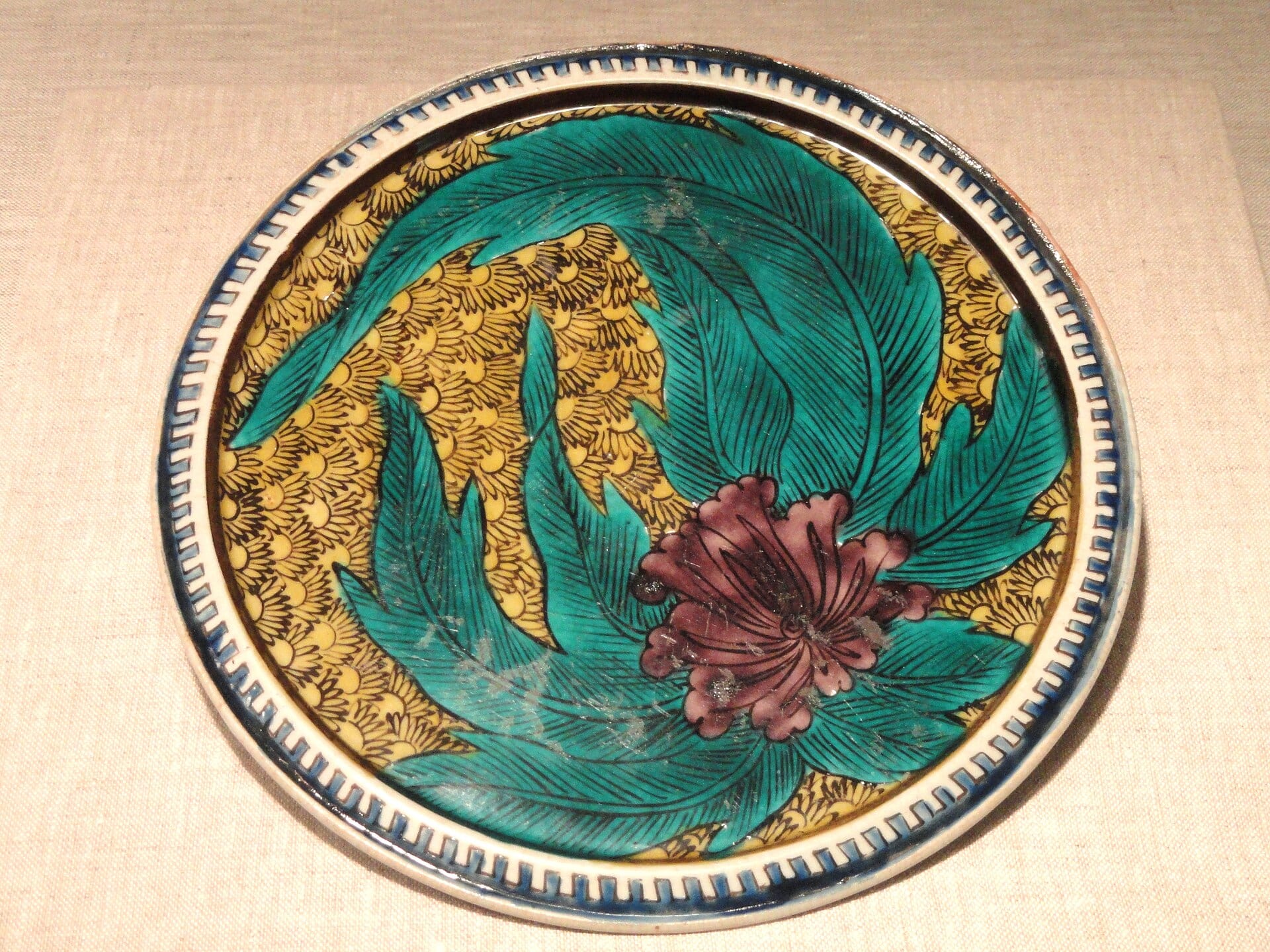
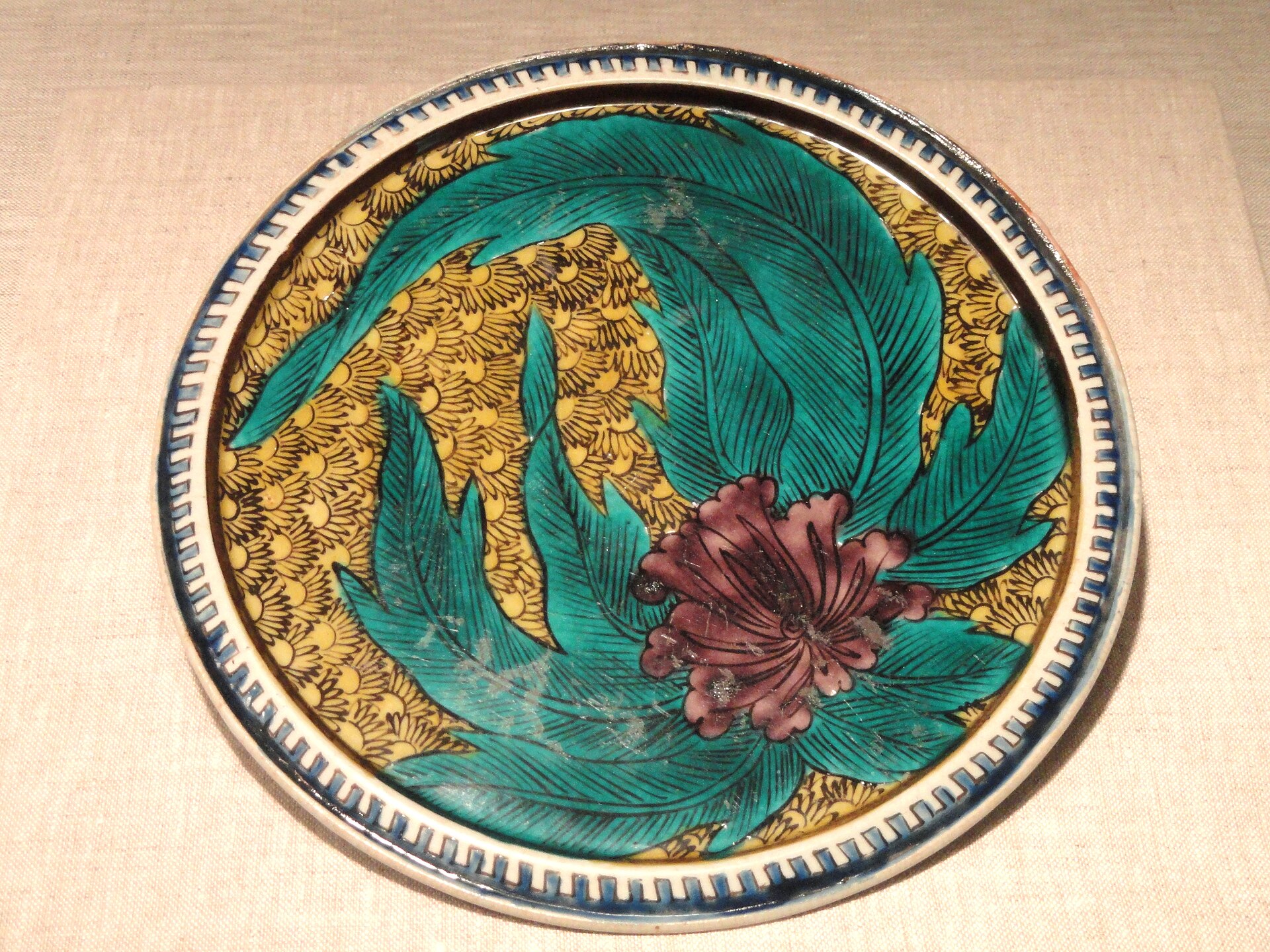
Kutani ware is porcelain from Ishikawa Prefecture whose character is in its overglaze painting: thick, glassy enamels in green, yellow, red, purple and dark blue over bold black outlines.
The Association describes these five colours, the Kutani gosai, as the heart of the style, set off by a slightly bluish porcelain body. Painters first draw strong black lines, then lay on enamel colours that only develop in the kiln, where they turn glassy and bright.
Kutani began in the mid-17th century. The Ishikawa Kutani ceramics federation dates the first kiln to around 1655. That year the Daishōji domain, a branch of the Kaga domain, opened it in the mountain village of Kutani using local porcelain stone. This early ware, now called Ko-Kutani ("old Kutani"), stopped within about half a century. Roughly a hundred years later, in the 19th century, kilns revived it with the Kaga domain's encouragement. These revival kilns developed distinct styles, including the kinrande style of the Eiraku kiln, gold over a red ground, and the minutely detailed red painting called aka-e.
One point is still argued. Some researchers say Ko-Kutani was actually made in Arita, in Saga Prefecture. The Ishikawa Prefectural Museum of Kutani Ware, in Kaga, calls this one hypothesis among several. Its position, shared by most museums in Ishikawa, is that Ko-Kutani was made in Kutani.
What is Bizen ware?
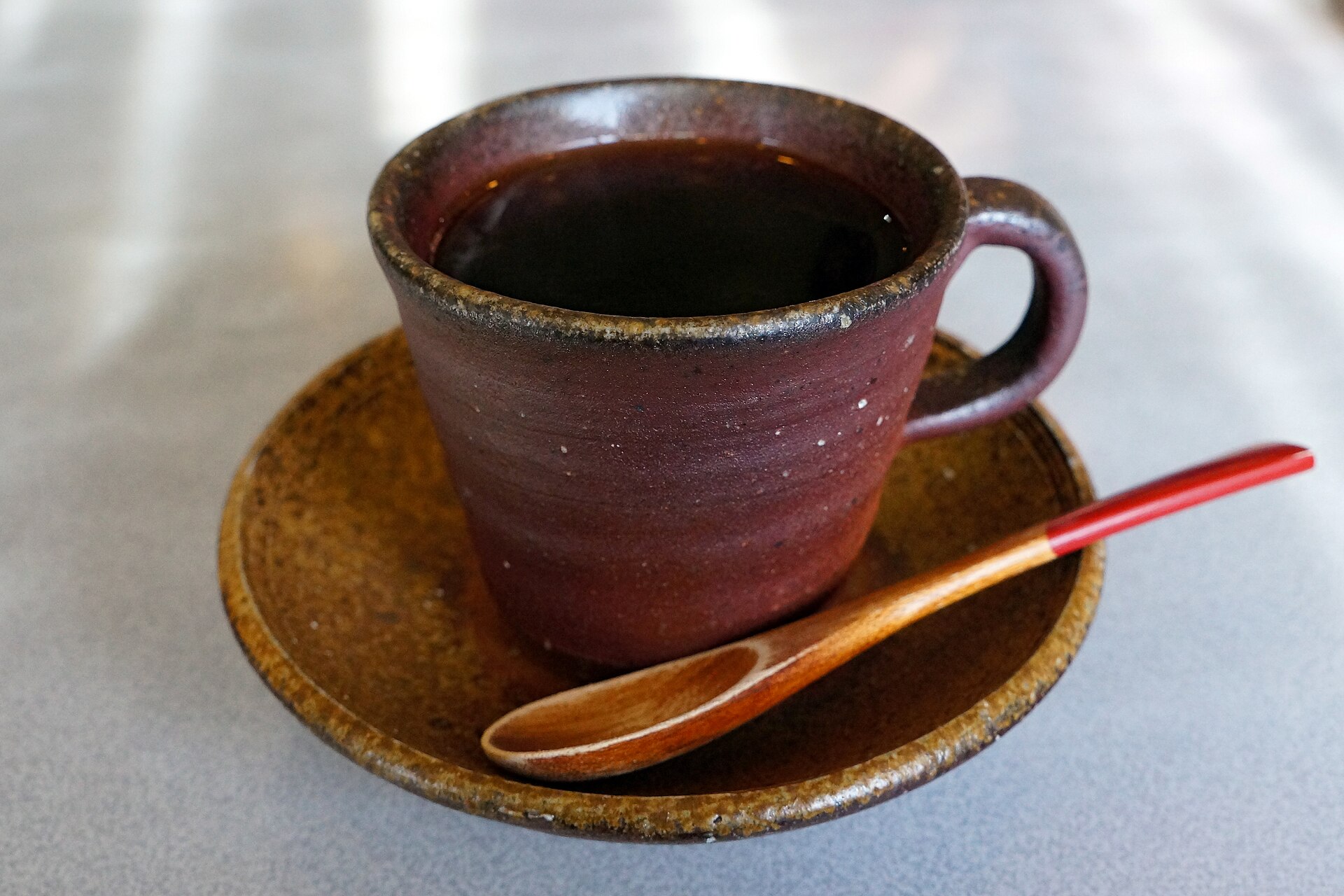
Bizen ware is unglazed stoneware from the Imbe area of Bizen City, Okayama Prefecture. Its colours and marks come only from clay, ash and flame.
Bizen potters use neither glaze nor painting. According to the Association, pieces are fired in a climbing kiln (noborigama) fuelled with red pine at about 1,230°C. In a traditional kiln the fire is kept going for around two weeks. The Okayama Bizen-ware producers' cooperative describes a firing of seven to ten days and nights, so treat the length as "one to two weeks", depending on the kiln. The clay is hiyose, an iron-rich clay dug from beneath the rice fields around Imbe. The cooperative says only small amounts can be extracted.
The fire leaves "kiln changes" (yōhen) that collectors learn to name:
- Goma ("sesame"): pine ash that lands on the pot and melts into speckles of natural glaze.
- Sangiri: grey or bluish patches where a pot lay buried in embers, away from the flame.
- Hidasuki ("fire cords"): red-brown streaks where rice straw wrapped around the piece reacted with iron in the clay.
- Botamochi: round, unmarked patches left where a smaller piece was stacked on a larger one.
Bizen is old. The Association says it was already being made in the Heian period (794–1185), and that tea masters valued it from the late Muromachi period. It is one of the Six Ancient Kilns of Japan. The official Six Ancient Kilns site describes these as kilns that have produced continuously from the medieval period to today: Echizen, Seto, Tokoname, Shigaraki, Tanba and Bizen. The group was named around 1948 by the ceramics scholar Koyama Fujio and recognised as a Japan Heritage in 2017. Bizen struggled in the Meiji era. The cooperative credits its revival to the potter Kaneshige Tōyō, who was named a Living National Treasure in 1956.
What is Mashiko ware?
Mashiko ware is thick, glazed pottery from Mashiko in Tochigi Prefecture, a town that grew from making everyday kitchenware and became a centre of the folk-craft movement through the potter Hamada Shōji.
Both the Japan Patent Office's regional trademark page and the Mashiko pottery cooperative date today's Mashiko ware to 1853. That year Ōtsuka Keizaburō, who had trained at nearby Kasama, built a kiln in Mashiko. For decades the town made storage jars, mortars and earthenware teapots, many of them for kitchens in Edo (later Tokyo).
Hamada Shōji (1894–1978) changed its course. The National Art Center, Tokyo, records that Hamada worked with the British potter Bernard Leach at St Ives from 1920. After returning to Japan in 1924, he chose Mashiko as his base. The Association adds that he influenced local potters, who began to make tableware and flower vessels in place of plain kitchen goods. In 1955 Hamada was among the first potters named a Living National Treasure, for folk-craft pottery (mingei tōki).
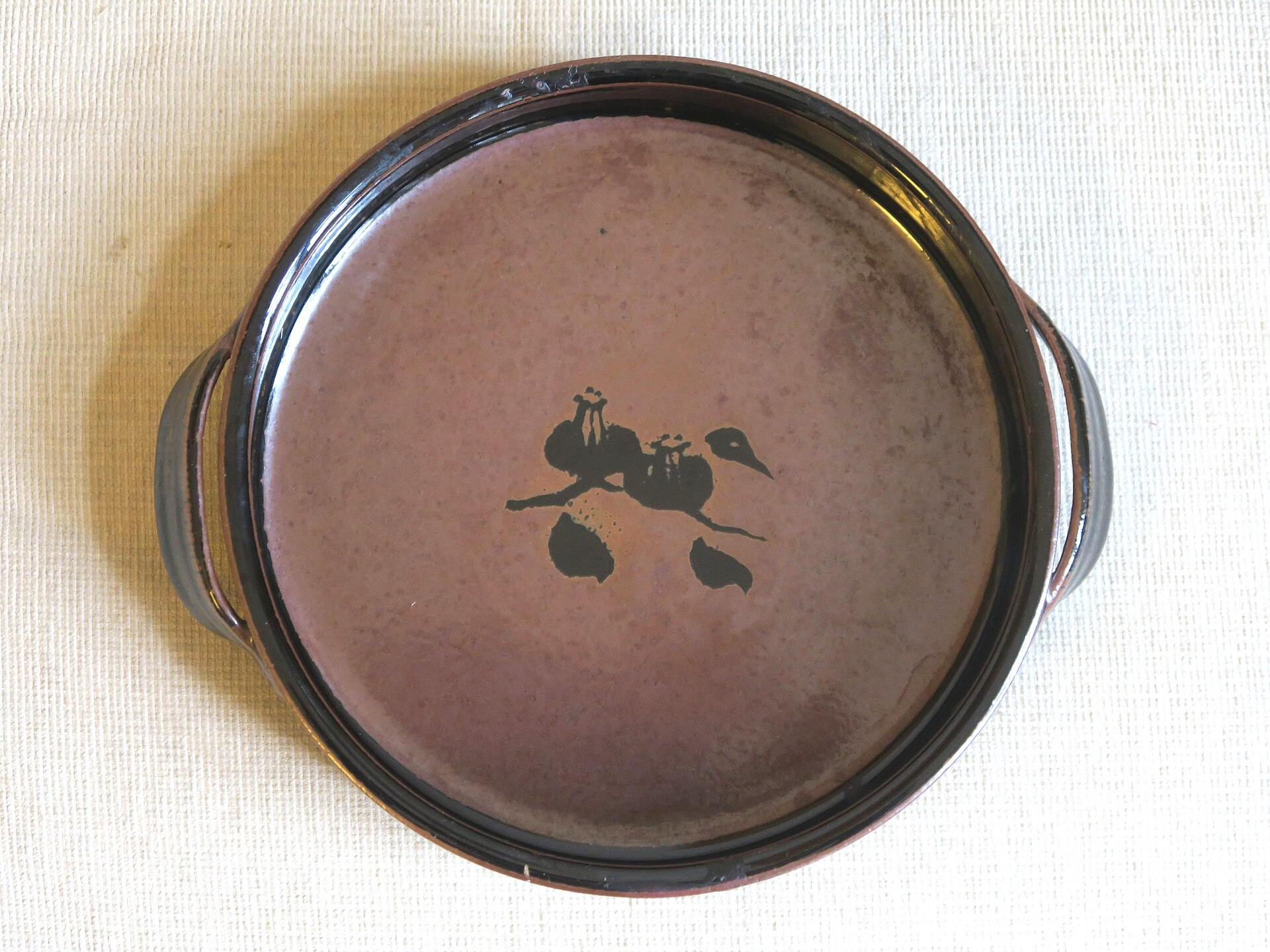
The national standard for Mashiko ware lists the decoration it uses. Surfaces are worked with white slip, brushed hakeme, carving and chattering. Glazes include a plain white, a persimmon red (kaki), black, amber (ame), a white made from rice-husk ash (nuka-jiro) and wood-ash glaze. The Japan Patent Office page describes the result as thick, plain and strong. It gave about 260 kilns and 50 pottery shops in the town when the page was last updated, on 16 March 2020.
How can you tell them apart at a glance?
Look at the surface first, then the weight and the sound.
- Bright painted pictures in green, yellow, red, purple or gold on a white or bluish body: almost certainly Kutani, since overglaze painting is the point of the style.
- No glaze at all, with reddish-brown to dark clay, ash speckles, straw-like red lines or grey patches: Bizen. Every piece is marked differently by the kiln.
- A thick body with a deep, often runny glaze in persimmon, black, amber or white, sometimes with brushed white slip: Mashiko.
Pottery towns make many styles, though, and modern potters borrow freely. For any single piece, ask the seller which kiln made it.
How do you know a piece is the real thing?
For certified traditional-craft pieces, look for the dentō shōshi, a paper seal with Japan's "traditional mark", and ask for the kiln or potter's name.
Under a METI scheme, the Association issues seals for products that pass inspection in the production area. The Mashiko pottery cooperative explains that pieces carrying the seal were made with the designated techniques and materials. Many fine pieces, especially by individual potters, are sold without a seal, so its absence is a reason to ask questions, not proof that a piece is fake.
How should you use and care for each?
Bizen is fired hard, and its cooperative says it can generally go in the microwave and dishwasher. Kutani's painted and gilded surfaces should stay out of the microwave. For Mashiko, follow the potter's own instructions.
- Bizen. The Okayama Bizen-ware cooperative says to wash new pieces with a neutral detergent before first use. Dipping a piece in water just before use brings out the colour. After use, wash it and dry it completely, because a damp piece can develop mould or smells. The cooperative says Bizen can generally go in the microwave and the dishwasher, though some potters' work cannot. It should never go in an oven or over a direct flame, because sudden temperature changes can crack it. The bare base is rough and can scratch furniture, especially lacquered tables, so put a cloth under it.
- Kutani. Panasonic's microwave manual warns against dishes with overglaze painting (iro-e), cracks, or gold and silver patterns, because they can be damaged or spark. Saitama Prefecture's consumer leaflet says the same of dishes with gold or silver decoration, and Hitachi's microwave FAQ explains that gold or silver leaf can cause sparks. Most Kutani is painted over the glaze, and kinrande pieces are covered in gold, so keep them out of the microwave. For the dishwasher, ask the maker.
- Mashiko. We found no single official care rule for Mashiko ware. Ask the potter or shop for the piece's instructions. The microwave warning above applies to any Mashiko piece with gold or overglaze decoration.
Where can you see or buy them?
In the production towns, especially during their pottery fairs, or from shops that sell them online.
- Mashiko Pottery Fair. Held each spring during Golden Week and each autumn around 3 November, according to the Association, which says it began in 1966. The Mashiko cooperative also lists the spring and autumn fairs.
- Bizen-yaki Matsuri. The Bizen cooperative describes it as Bizen City's main autumn event. In 2026 it also held its first spring edition, on 3–4 May, around JR Imbe Station.
- Kutani Chawan Matsuri. According to the Ishikawa Kutani ceramics federation, this pottery market is held every May at the Kutani pottery village in Nomi.
Online, buy from a seller who can tell you which kiln or potter made the piece. A listing that names only the ware ("Kutani", "Bizen") is not enough. Ask three things before you pay: the kiln or potter's name, whether the piece carries the traditional-craft seal (dentō shōshi), and whether the photos show the exact piece you will receive. That last question matters most for Bizen, where no two firings look alike. For how product pages, payment and shipping work on Matsuri, see how to buy Japanese crafts on Matsuri Shop.
The Matsuri feature
- What is Matsuri? — the hub of this feature
- How to buy Japanese crafts on Matsuri Shop — reading a product page, payment and shipping
- Kutani vs Bizen vs Mashiko (this page)
Sources and dates checked
All pages were accessed on 2 October 2026.
- Association for the Promotion of Traditional Craft Industries: Kutani ware https://kougeihin.jp/craft/0405/ ; Bizen ware https://kougeihin.jp/craft/0418/ ; Mashiko ware https://kougeihin.jp/craft/0404/ (areas, techniques, standards, history, firing, designation dates, Mashiko Pottery Fair)
- Ministry of Economy, Trade and Industry, designated traditional crafts list (dates for all three): https://www.meti.go.jp/policy/mono_info_service/mono/nichiyo-densan/xlsx/list_20251027.xlsx ; seal rules: https://www.meti.go.jp/policy/mono_info_service/mono/nichiyo-densan/pdf/20240731hyoji.pdf
- Ishikawa Kutani Ceramics Commerce and Industry Cooperative Federation (founding c.1655, revival, Kutani Chawan Matsuri): https://kutani.or.jp/
- Ishikawa Prefectural Museum of Kutani Ware, Q&A (origin in Kaga, Ko-Kutani/Arita debate): https://www.city.kaga.ishikawa.jp/material/files/group/21/QA.pdf
- Okayama Bizen-ware cooperative (Touyuukai): history and kiln changes https://touyuukai.jp/history.html ; how to use https://touyuukai.jp/howto.html ; events https://touyuukai.jp/look.html
- Six Ancient Kilns of Japan, official site (the six kilns, naming c.1948, Japan Heritage 2017): https://sixancientkilns.jp/
- Japan Patent Office, regional collective trademark No. 5595844 "Mashiko-yaki" (1853 origin, about 260 kilns as of the 2020-03-16 update): https://www.jpo.go.jp/system/trademark/gaiyo/chidan/shoukai/ichiran/5595844.html
- Mashiko pottery cooperative, history of Mashiko ware and the traditional-craft seal: https://mashikoyakikumiai.shop/pages/%E7%9B%8A%E5%AD%90%E7%84%BC%E3%81%AE%E6%AD%B4%E5%8F%B2
- The National Art Center, Tokyo, Art Commons, "Hamada Shōji" exhibition record (1920 St Ives, 1924 return, 1955 Living National Treasure): https://www.nact.jp/artcommons/user/detail/58313
- Panasonic microwave instruction manual (overglaze, gold and silver patterns): https://panasonic.jp/manualdl/p-db/p_/p_neeh225th225s390f_t_201301310916_0.pdf
- Saitama Prefecture consumer leaflet (gold or silver decoration in microwaves): https://www.pref.saitama.lg.jp/documents/231649/yakusoku.pdf
- Hitachi microwave FAQ (sparks from gold or silver leaf): https://kadenfan.hitachi.co.jp/support/range/q_a/a01.html
Featured image: Daderot / Wikimedia Commons / CC0 (https://commons.wikimedia.org/wiki/File:Kutani-Ware_Plate,_late_17th_century,_Japan,_porcelain_with_enamel_-_Art_Institute_of_Chicago_-_DSC00224.JPG) — license checked on the Commons file page 2026-10-02
Written by
J-Times Editorial
J-Times 編集部 / J-Times Editorial Team